U.S. DEPT. OF AGRICULTURE. OFC. OF INTERNATIONAL COOPERATION AND DEVELOPMENT. DEVELOPMENT PROJECT MANAGEMENT CENTER
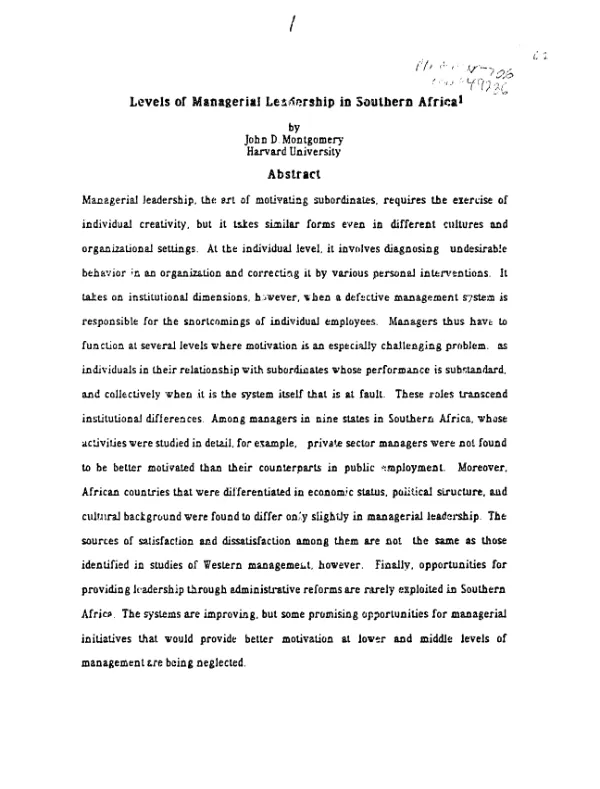
Levels of managerial leadership in southern Africa
Managerial leadership, the art of motivating subordinates, requires the exercise of individual creativity, but it takes similar forms even in different cultures and organizational settings.
Montgomery, John D. · 1986
Sign in to readA free account is required to download.
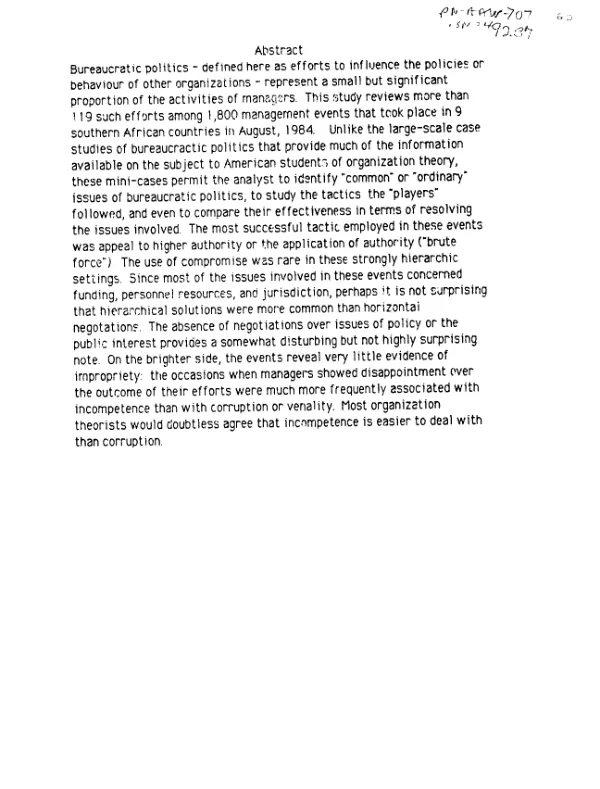
Abstract
At the individual level, it involves diagnosing undesirable behavior in an organization and correcting it by various personal interventions. It takes on institutional dimensions, however, when a defective management system is responsible for the shortcomings of individual employees. Managers thus have to function at several levels where motivation is an especially challenging problem: as individuals in their relationship with subordinates whose performance is substandard and collectively when it is the system itself that is at fault. These roles transcend institutional differences. Among managers in nine states in Southern Africa, whose activities were studied in detail, for example, private sector managers were not found to be better motivated than their counterparts in public employment. Moreover, African countries that were differentiated in economic status, political structure, and cultural background were found to differ only slightly in managerial leadership. The sources of satisfaction and dissatisfaction among them are not the same as those identified in Western management, however. Finally, opportunities for providing leadership through administrative reforms are rarely exploited in Southern Africa. The systems are improving, but some promising opportunities for managerial initiatives that would provide better motivation at lower and middle levels of management are being neglected. (Author abstract)
Related documents