ACADEMY FOR EDUCATIONAL DEVELOPMENT, INC. (AED)
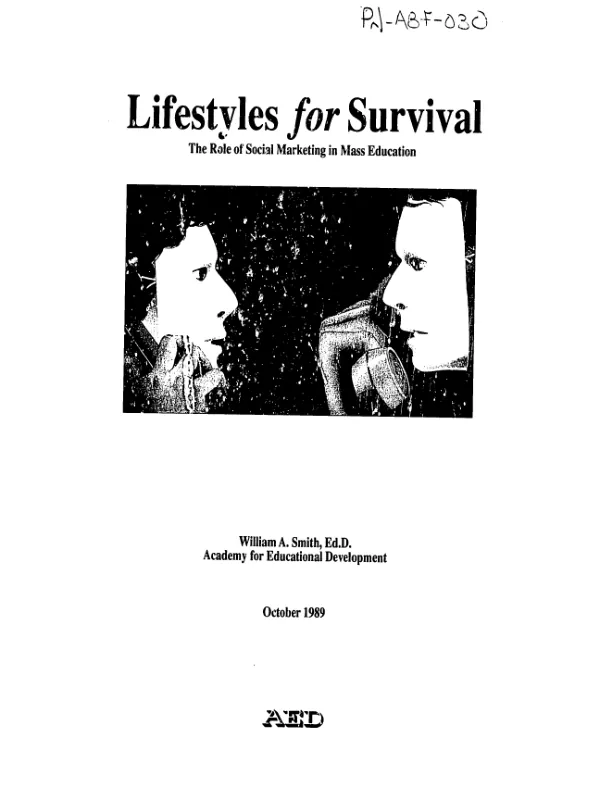
Lifestyles for survival : the role of social marketing in mass education
Lifestyle behavior -- in such areas as eating, smoking, sexual activity, and personal health care -- is the major cause of disease in the world today.
Smith, William A. · 1989
Sign in to readA free account is required to download.
Abstract
This booklet describes the role that social marketing can play in the large-scale educational and motivational effort needed to help people modify unhealthy behavior. Moving beyond the ad hoc health education strategies of the past, social marketing involves a process of comprehensive research and planning, incorporating the theories and methods of several disciplines. Marketing provides a framework for selecting and segmenting audiences and for promoting products and services. Behavior analysis supplies tools for investigating existing health-related practices, defining and teaching new practices, and identifying opportunities to motivate changes. Anthropology assesses the perceptions and values that underlie existing practices and suggests mechanisms for linking new ideas to traditional values. A successful social marketing program can produce changes in behavior because it: (1) is fundamentally centered on the audience and systematically consults the consumer throughout the design and implementation processes; (2) targets its activities by setting narrow objectives and by segmenting the audience into groups which can be reached and influenced; (3) considers all the factors that influence change, such as the behaviors themselves, obstacles to new practices, and means of communication and education; (4) integrates delivery systems (e.g., mass media, interpersonal, print) so that they bolster each other with the same clear message; and (5) uses empirical data -- not just experience, intuition, or anecdotes -- to support and guide health decisions. Contains brief descriptions of social marketing success stories from around the world.
Related documents