USAID
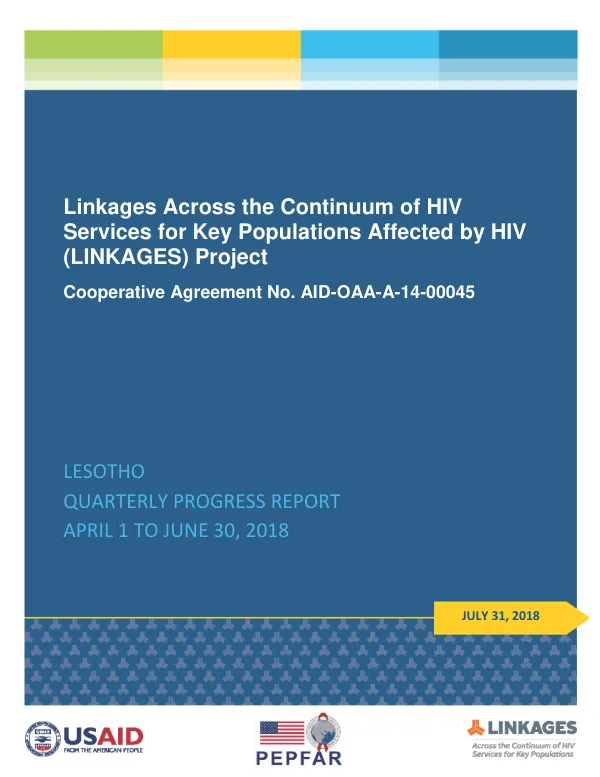
LINKAGES Quarterly Report (April 1 – June 30, 2018) - Lesotho
The LINKAGES project in Lesotho aimed to increase the availability of comprehensive prevention, care, and treatment services for key populations affected by HIV.
2018 · 22 pages
Sign in to readA free account is required to download.
Abstract
The project focused on scaling up interventions and introducing new strategies in the second quarter of 2018. Using the microplanning approach, 4,314 key populations, including 1,545 female sex workers and 2,769 men who have sex with men, were reached in Maseru and Leribe. Implementation of HIV prevention programs using the microplanning approach involved providing support to sub-partners in developing peer outreach work plans and linking key populations to HIV testing and support. A total of 4,314 key populations were reached with comprehensive HIV prevention interventions, with 88.3% of those eligible for HIV testing successfully linked and/or directly tested for HIV. Of those tested, 7.7% tested positive for HIV, and all 2,490 received their test results. The project also implemented the enhanced peer outreach approach (EPOA) campaigns in 12 areas in Maseru and Leribe, with the goal of increasing the reach and effectiveness of HIV prevention services. Additionally, density mapping activities were concluded with support from LINKAGES headquarters, as part of introducing virtual outreaches. Institutional capacity assessments were completed for Phelisanang Bophelong, a subpartner, and an institutional strengthening plan (ISP) for the organization was developed. The project's results showed that a total of 1,545 female sex workers were reached with comprehensive HIV prevention services, with 1,000 living with HIV, 115 having recently tested for HIV, and 245 declining testing. Of those eligible for HIV testing, 185 were linked and/or directly tested for HIV, with 69 testing positive for HIV. A total of 76 of those who tested negative were linked to clinical partners and initiated on Pre-Exposure Prophylaxis (PrEP). Similarly, a total of 2,769 men who have sex with men were reached with HIV prevention interventions, with 122 having a known HIV-positive status and all 122 already on ART, 257 recently tested negative for HIV, and 2,390 eligible for HIV testing. Of those eligible, 2,305 were linked to HIV testing, with 123 testing positive for HIV. A total of 60 of those who tested negative were linked to clinical partners and initiated on PrEP. The project's results also showed that the overall HIV case identification rate for all key populations was 7.7%, with 192 testing positive for HIV out of 2,490 tested. The remaining 330 key populations eligible for HIV testing were either provided with HIV self-tests or were being provided with further education and one-on-one counseling to get them motivated to test for HIV.
Related documents