PACT
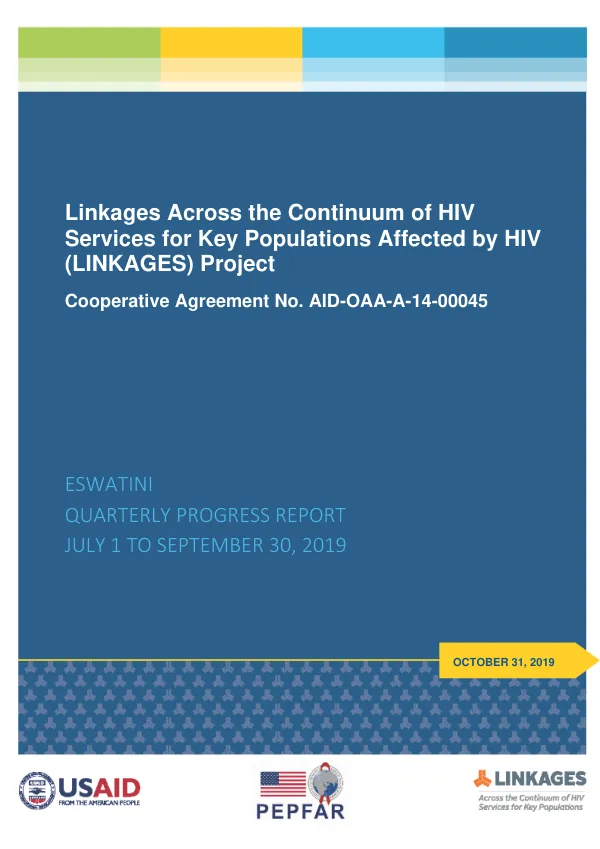
LINKAGES Quarterly Report (July 1 to September 30, 2019) - Eswatini
The LINKAGES project in Eswatini continued implementing strategies and interventions to address stagnant HIV case finding in Q4 FY19.
2019 · 24 pages
Sign in to readA free account is required to download.
Abstract
The project met the majority of its program targets, but underperformed in identifying positives, specifically for men who have sex with men (MSM). Despite this, MSM programming showed growth, with a 15 percent case finding rate in Q4, more than double the rate in Q3. The project achieved a case finding rate of 15 percent for Female Sex Workers (FSW) in Q4. Implementation focused on increasing availability of comprehensive prevention, care, and treatment services, including reliable coverage across the continuum of care for MSM and transgender women. The project reached 1,901 FSW with HIV prevention interventions, tested, and gave results to 380 FSW, of which 56 tested positive (15 percent case finding). A total of 47 FSWs were confirmed linked to treatment, providing a linkage rate of 84 percent for Q4 and a cumulative linkage rate of 80 percent for FY19. The project also reached 948 MSM with HIV prevention interventions, tested, and provided results to 231 MSM, of which 34 tested positive (15 percent case finding). A total of 22 MSM were confirmed linked to treatment, providing a linkage rate of 65 percent for Q4 and a cumulative linkage rate of 70 percent for FY19. The project distributed 111,824 male condoms, 7,843 female condoms, and 73,382 lubricants. In terms of result areas, the project aimed to increase availability of comprehensive prevention, care, and treatment services, including reliable coverage across the continuum of care for MSM and transgender women. The project reached 99 percent of its annual target for FSW, with 626 FSW eligible for HIV testing, of which 61 percent (379/626) were tested, providing a 15 percent (56/379) case finding for the quarter and a cumulative case finding rate of 11 percent. The project also implemented a risk segmentation approach at the community and clinical services to support improved identification of medium to high-risk individuals and to work to identify appropriate testing frequency amongst FSWs to reduce too frequent re-testing. Of those that were eligible for testing and received a risk screening, 36 percent (65/181) were identified as low risk, 51 percent (92/181) were identified as medium risk, and 13 percent (24/181) were identified as high risk. The project saw a low rate of testing for those identified as eligible based on the introduction of the risk segmentation approach. The project also provided navigation support for clients on treatment and helped them to initiate treatment if not on treatment or re-initiate treatment if they are defaulters. Q4 saw a linkage to treatment rate of 84 percent. The main reasons for non-linkage to treatment included one client receiving support from psychosocial support and clinical staff, two clients having pending appointments, three clients having incorrect contact information, one client having mobility issues, and two clients pending confirmation from clinics. The project uses multiple data sources to identify where FSWs are in regards to treatment, including access to information in the Client Management Information System (CMIS), through support from clinical TA partners, outreach workers, and clients. The project also looked at viral load (VL) status amongst the KPs, which will be discussed in a later section of the report.
Related documents