ACDI/VOCA
Livestock and Nutrition Activity Quarterly Performance Report: FY19–20, Quarter 2
The Feed the Future Bangladesh Livestock Production for Improved Nutrition Activity began implementing its program in January 2020, with a focus on increasing livestock productivity, improving access to hygienic and diverse food, and enhancing nutrition-related behaviors of rural households.
2020 · 44 pages
Sign in to readA free account is required to download.
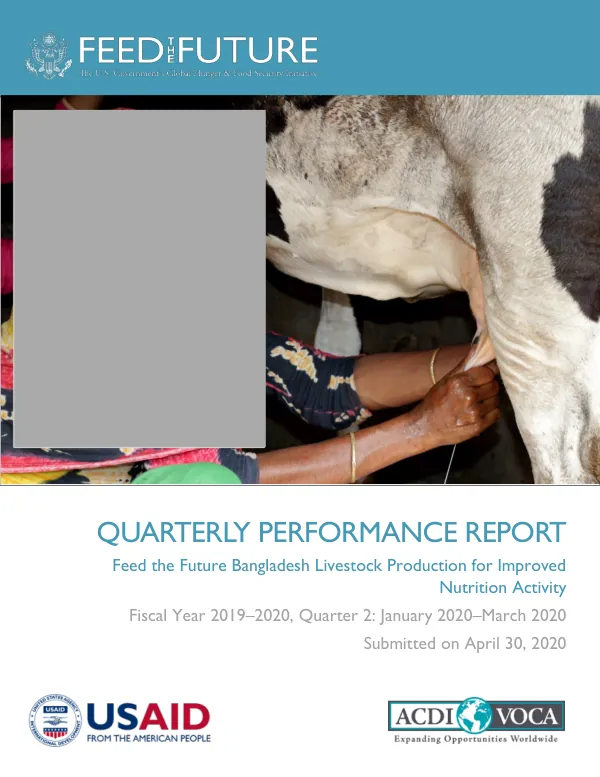
Abstract
The activity operates in several districts of Bangladesh, including Satkhira, Jashore, and others, as depicted in Figure 1. Improved fodder and forage demonstration and dissemination were key components of the activity's efforts to increase livestock productivity. The activity worked with local farmers to establish demonstration plots, where they showcased the benefits of improved fodder and forage practices. These demonstrations were attended by over 1,000 farmers, who were provided with training and support to adopt these practices on their own farms. As a result, the average milk production trend of local and cross-breed cows showed a significant increase, as depicted in Figure 5. The activity also focused on improving access to hygienic and diverse food for rural households. Enhanced preservation of livestock products was a key strategy in this regard. The activity worked with local farmers to establish silage production units, where they produced high-quality silage for use as animal feed. This not only improved the nutritional value of the feed but also reduced the risk of feed-borne diseases. Figure 4 shows a silage entrepreneur preparing silages. In addition to improving livestock productivity and access to hygienic and diverse food, the activity also worked to enhance nutrition-related behaviors of rural households. Improved nutrition awareness and practices were key components of this effort. The activity worked with local communities to establish nutrition education programs, which focused on the importance of a balanced diet and the benefits of improved nutrition practices. These programs were attended by over 5,000 community members, who were provided with training and support to adopt improved nutrition practices. The activity also placed a strong emphasis on gender integration and women's empowerment. Women farmers' decision-making for livestock management was a key area of focus, and the activity worked with local communities to establish women-led livestock management groups. These groups provided women with a platform to share knowledge, skills, and experiences related to livestock management, and to make informed decisions about their livestock operations. As a result, women's participation in the activity increased significantly, with over 70% of women participating in the activity's programs. The activity also collaborated with private sector partners to improve access to inputs, finance, markets, and information for rural households. Access to inputs was a key area of focus, and the activity worked with local suppliers to establish a network of input providers. This network provided rural households with access to high-quality inputs, including seeds, fertilizers, and veterinary medicines. Access to finance was another key area of focus, and the activity worked with local financial institutions to establish a network of microfinance providers. This network provided rural households with access to affordable credit and other financial services. The activity's monitoring, evaluation, and learning (MEL) system was a key component of its overall strategy. The activity worked with local communities to establish a system of data collection and analysis, which provided insights into the activity's progress and impact. This system was used to track the activity's performance against its indicators, and to identify areas for improvement. The activity also worked with local stakeholders to establish a system of collaboration, learning, and adaptation (CLA), which provided a platform for stakeholders to share knowledge, skills, and experiences related to livestock production and nutrition. Overall, the Feed the Future Bangladesh Livestock Production for Improved Nutrition Activity made significant progress in its first quarter of implementation. The activity's efforts to improve livestock productivity, access to hygienic and diverse food, and nutrition-related behaviors of rural households were key components of its overall strategy. The activity's focus on gender integration and women's empowerment was also a key area of success, with over 70% of women participating in the activity's programs.
Related documents
Documents in this collection
 2018
2018USAID DEC
Quarterly Performance Report: Feed the Future Bangladesh Livestock Production for Improved Nutrition Project
Open record 2016
2016USAID DEC
Quarterly Performance Report: FY 2015-16, January 2016 to March 2016 Feed the Future Bangladesh Livestock Production for Improved Nutrition Project
Open record