USAID. MISSION TO PHILIPPINES
Local development
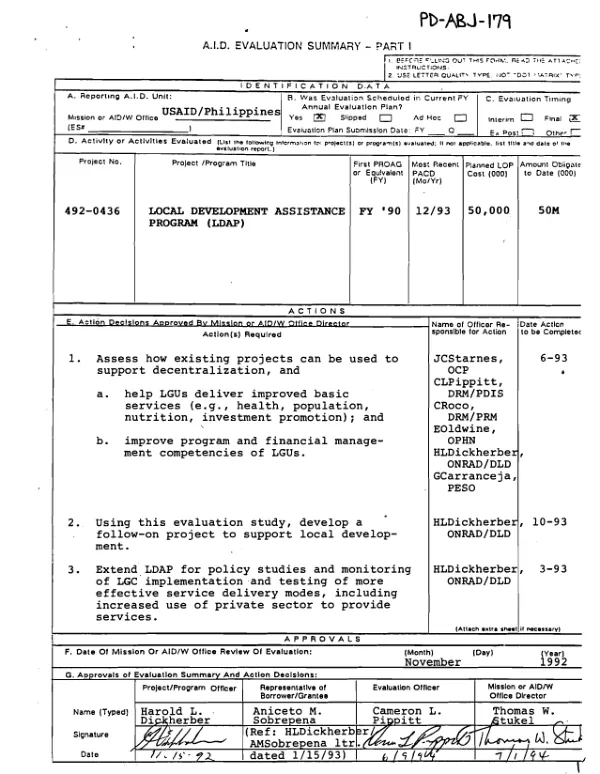
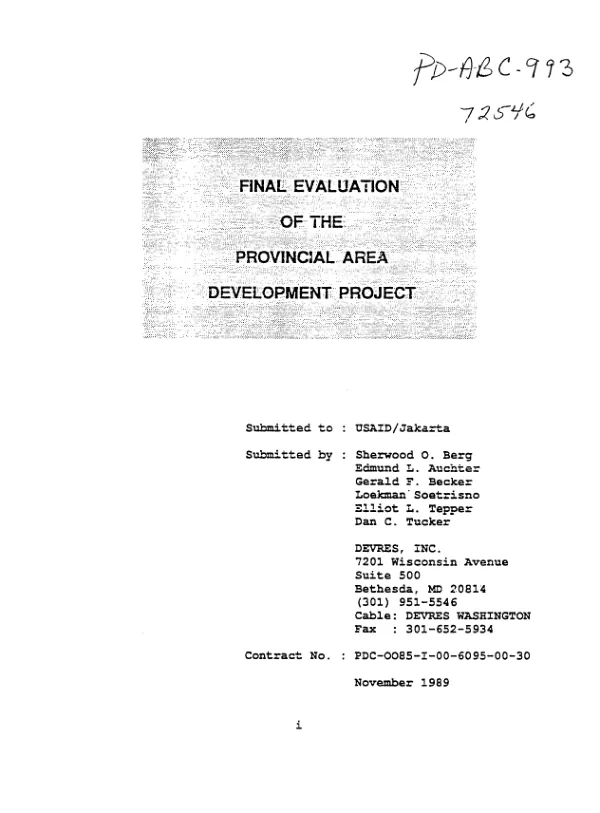
Evaluates project to support the Government of the Philippines" Provincial Development Assistance Project (PDAP) to strengthen the management capacities of local governments (LG"s).
Flores, George M.; Socrates, Salvador P. · 1980
Sign in to readA free account is required to download.
Abstract
PES covers the period 6/73-8/80 and is based on an external end-of-project evaluation. Despite shortcomings, the project set in motion a development process exceeding original expectations. Although PDAP-Central (as opposed to special subprojects) did not perform effectively and its organization is in serious disarray, this actually helped the project by weakening controls and allowing provinces to operate flexibly and confidently and to initiate their own projects and systems. PDAP introduced a modern management facility strengthening the provincial governor and aided development of a strong provincial executive and decisionmaking staff. Planning and analysis training provided by PDAP encouraged a system of interaction among provincial staff, while the de facto decentralization it brought at the provincial level has led to the emergence of LG systems with the resources needed to govern their jurisdictions. Lessons learned are that: (1) projects must provide for a phased withdrawal of the project control agency; (2) external assistance should be offered in the form of tangible resources which can be directly deployed under the locality"s authority; (3) fixed amount reimbursement systems provide rigorous but non-threatening forms of fiscal and quality control which assist local development programs; (4) programs to build LG staff capacities must impose duties that mark the staff as a leading actor in the local system; (5) care must be taken to make local staffs accountable to local leaders rather than the central agency; (6) premature assumption of responsibility for a pilot program (as in this case by PDAP-Central) can check the program"s experimental and innovative thrust; (7) high priority should be given at the design stage to analyzing the managerial and planning techniques to be used in a project in order to eliminate biases hindering project goals; (8) care must be taken to avoid overloading the local administrative structure with marginal requirements and to include both closed (detailed) and open planning strategies.
Related documents