USAID. MISSION TO PHILIPPINES
Local development assistance program (LDAP)
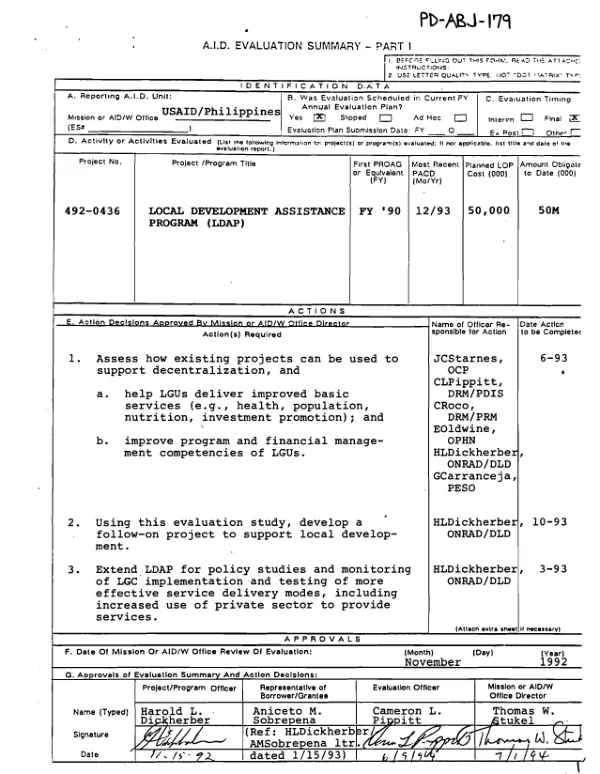
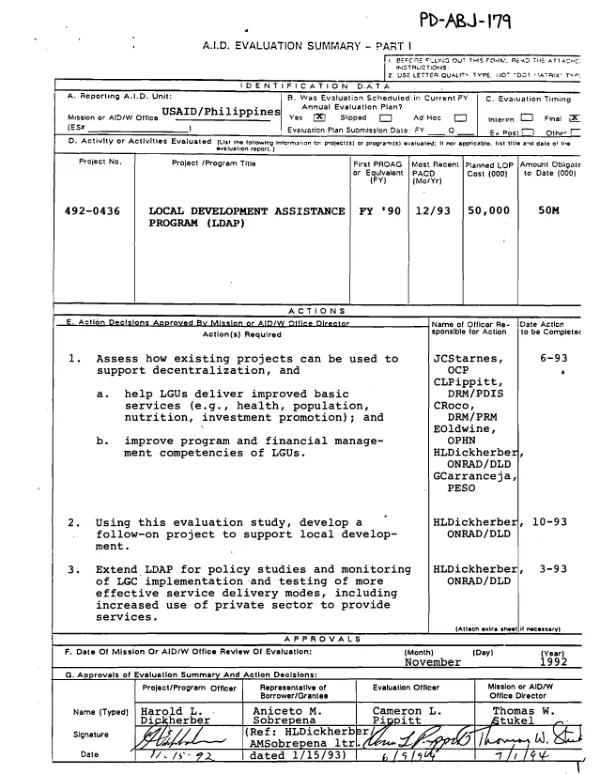
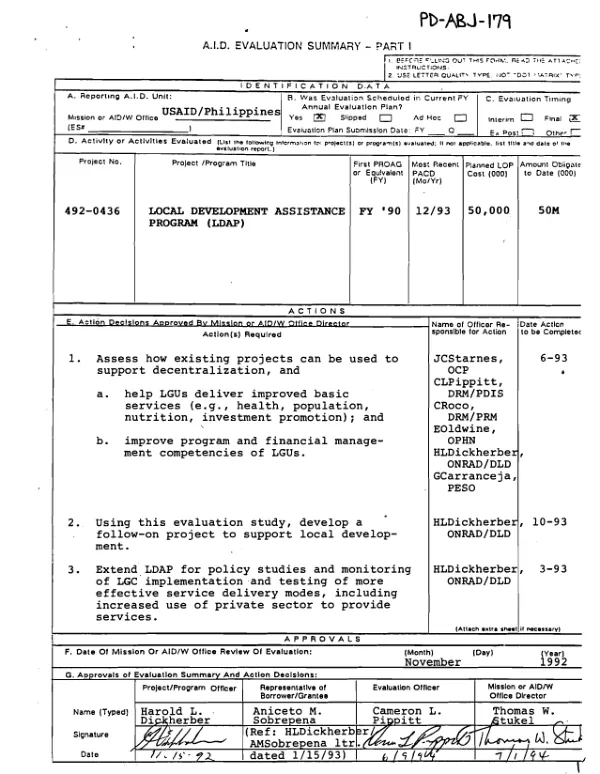
Summarizes attached final evaluation (XD-ABJ-179-A) of a program in the Philippines to support decentralization of authority, functions, and resources from the central government to local government units (LGUs) in provinces, cities, and municipalities.
1994
Sign in to readA free account is required to download.
Abstract
The evaluation covered the period 9/90-10/92 against a PACD of 12/93. The program provided strong support to national policy and planning officials at an important time, just when they were beginning to recognize the need for decentralization. Policy conditionalities helped to focus counterparts" attention and funds on key areas such as local revenue enhancement, environmental protection, and strengthening LGU and NGO capacities to accelerate local development and investment; for example, the Department of Environment and Natural Resources started a pilot program to provide environmental protection training for local government staff. Through its support for policy studies and related workshops, the program sensitized key public and private sector leadership and technical groups to the essentials of a successful decentralization strategy, and thus contributed significantly to the formulation and early implementation of the 1991 Local Government Code, which represents a milestone in efforts to promote decentralization, local development, and democratization in the Philippines. Currently, the program is helping to prepare LGUs and NGOs to perform their new roles under the Code, via information dissemination, training, policy studies, and operational research. This support has helped to mold new partnerships between local government and the private sector to jointly identify new ways to provide services and stimulate private investment. The Code mandates:: (1) stronger and more responsible local governments; (2) firming up LGUs" share of national revenues by making it a matter of law; (3) more open local governments (e.g., by requiring at least 25% private sector representation in some local bodies and development councils; (4) giving citizens the potential to control LGUs (through such tools as the referendum, recall, and initiative); (5) increased cooperation by LGUs and the private sector in development and provision of basic services; and (6) giving LGUs more flexibility in seeking funding and investment (e.g., being able to deal directly with foreign donors and investors). Progress in implementing the various mandates is reviewed in the report. There is strong Philippine support for continued USAID participation in local development and private sector involvement. A follow-on project is planned. Suggestions for the follow-on are to target activities on a geographic and/or functional basis; provide funds as far as possible on a matching basis directly to LGUs/NGOs; provide TA through a single major contract; and establish a permanent secretariat to support the League of LGUs.