USAID DEC
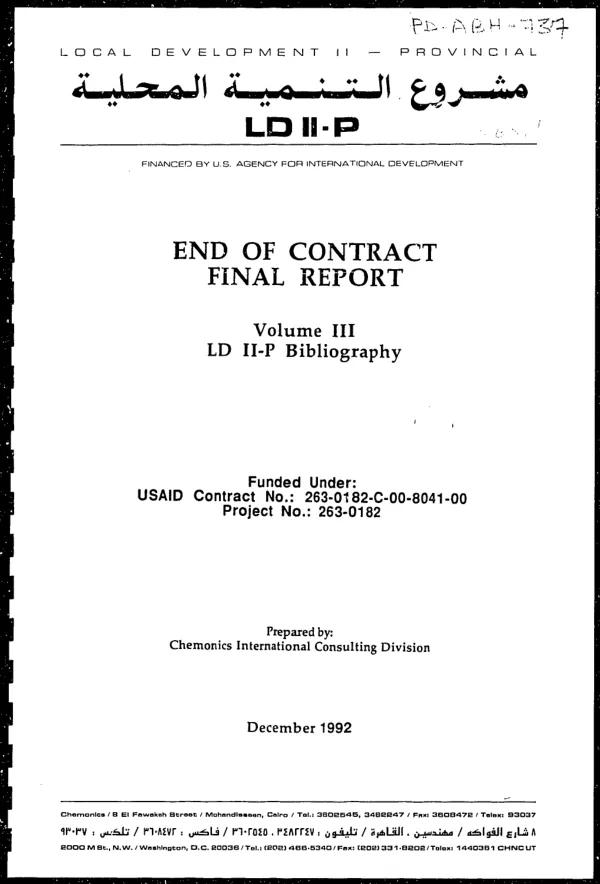
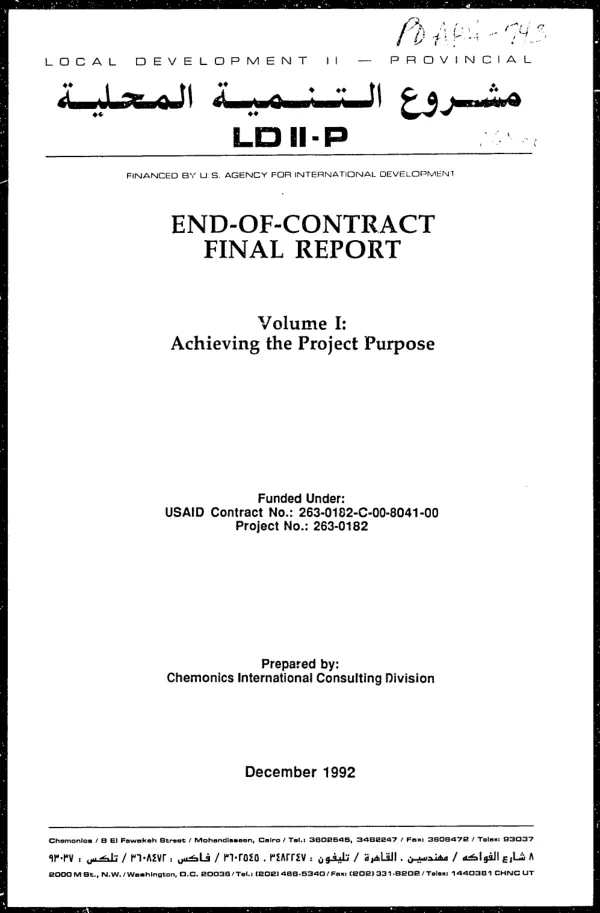
Local development II - provincial (LD II - P) : end-of-contract final report. Volume I : achieving the project purpose
Sign inCHEMONICS INTERNATIONAL, INC.
Local development II - provincial (LD II - P) : end-of-contract final report. Volume I : achieving the project purpose
Final report by the contractor, Chemonics International, on a project (2/88-12/92) to improve the capacity of local government units (LGUs) in rural Egypt to implement municipal service delivery projects.
1992
Sign in to readA free account is required to download.
Abstract
Overall, this project which, with its predecessor (Basic Village Services), constitutes the largest, broadest-based rural infrastructure initiative ever undertaken by A.I.D., was successful. It produced 13,000 municipal projects serving 95% of Egypt"s rural population (over 30 million people); most of these projects are rendering actual services. They are also yielding indirect benefits by way of employment generation and multiplier effects in local economies. The project enhanced LGU capacity in the targeted areas: (1) codification and documentation of tools for sector and subproject planning, model terms of reference and contracts, construction supervision, operations and maintenance (O&M), and management information systems has been achieved; (2) these tools have been diffused through extensive training, TA, and publications; (3) LGUs" actual use of the tools has been documented. Much progress has also been achieved in developing the overall management capacity of LGUs. However, there are important exceptions to this record of success. One is the slow rate of achievement in local financial capability, compared to other functional areas. On another level, devolution of authority to local governments did not result from their improved capacity to plan, implement, and maintain infrastructure projects, as was assumed in the project design. Nor has significant resource mobilization to recover O&M costs and eventually some capital costs occurred as expected. Central authorities never relinquished their control over the collection of user fees that financed local municipal projects, while O&M finance is also primarily under central authority. A major impediment has been Egypt"s lack of consistent national names and codes for population settlements, administrative boundaries, and jurisdictions, and of basic population data at a suitable level of aggregation. As a result, LGUs lack the data their need to identify user profiles, plan services, and delineate boundaries for their services. Given this state of affairs, Chemonics agrees with USAID/E"s decision to terminate the project. Among the lessons learned is that the planning, budgeting, monitoring, and management of actual physical service delivery systems are fragmented. For example, governorates must plan local water and wastewater projects in virtual ignorance of the efforts of the National Organization for Potable Water and Sanitary Drainage (NOPWASD) in these sectors; water readings are generally monitored by local councils in separation from local utilities; and existing accounting systems would be unable, even if data were available, to compare the efficiency of separate water supply systems. Other conclusions by Chemonics are as follows. (1) At present, decentralization driven from the top would find LGUs without adequate management structures in place to cope with municipal service delivery. The lack of performing, locally accountable municipal services organizations over which users have a sense of ownership and control is a fairly pervasive feature of Egypt"s organizational landscape. (2) The profound realities of meeting service provision costs have not been confronted at the local level, nor are they likely to be. (3) Fostering greater institutional pluralism through professional local government management associations remains a viable agenda for improving local governance in Egypt. The report concludes with recommendations for a deep restructuring of local municipal services organizations, based on an enterprise model.
Related documents