USAID. MISSION TO EGYPT
Local government II
Project, follow-on to Decentralization Sector Support I (projects -0021, -0103, -0143, -0153), to expand the capacity of Egyptian local governments (LGs) to provide basic services and mobilize local resources for these services.
1985
Sign in to readA free account is required to download.
Abstract
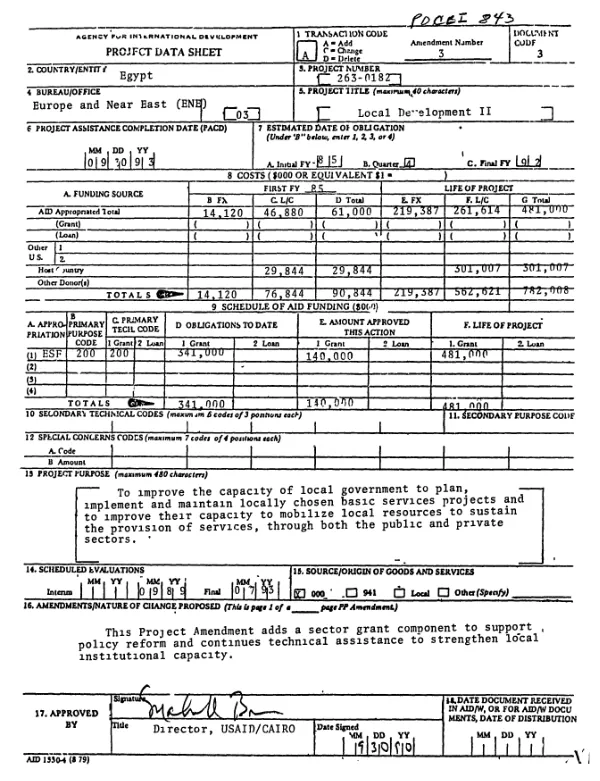
A Technical Secretariat (Amana) and governorate-level Local Development Committees (LDCs) will implement the project under an Interministerial LDC (ILDC). A Basic Service Delivery System will engage every Egyptian LG unit in two major annual planning and budget exercises; these exercises will be synchronized with the Government of Egypt"s (GOE) annual planning/budget exercises for investment and recurrent cost financing and will involve popularly elected local councils selecting basic service subprojects (SPs) addressing community needs. LGs that complete the exercises and contribute at least 5% of SP costs will be eligible for annual USAID/E and matching GOE block grants. The project will also undertake a major effort to develop the capacity of LGs, in conjunction with the private sector, to maintain basic infrastructure and equipment and to include operations and maintenance (O&M) costs in the planning and budgeting exercises. In another innovation, the Ministry of Finance will budget recurrent costs for O&M on an "actual needs" basis and finance them annually from the recurrent cost budget. Finally, procedures will be developed to decentralize recurrent cost financing. Targets include 550 urban SPs (e.g., clinics, lighting, paving, waste disposal) and 1,900 provincial SPs (e.g., water/wastewater, secondary roads), and training for 55,000 persons, including 43,000 village and district council members. A Local Resource Mobilization System will be developed for both the public and private sectors. The public system will focus on user fees and benefit charges to defray O&M expenses. Activities will include ILDC/Amana policy discussions, senior seminars on resource mobilization, and development of a cadre of public finance specialists through U.S. M.A. training of 30 GOE staff, U.S. postdoctoral training of 10 university faculty (who on return will establish an Egyptian M.A. Program in Public Finance), training of some 20 others in the latter program, and short courses for 520 governorate and local staff. The private system includes grants (ca. 1,700), TA, and training for indigenous PVOs for basic service SPs and credit to small private enterprises for SPs. Amendment of 9/30/90 extends the PACD 1 year to 9/30/93 and adds a sector grant to support GOE policy reforms to improve LG resource mobilization. Grant funds will be used for a commodity import program and for debt servicing and will be disbursed in two tranches. Prior to the first tranche, the GOE will: (1) instruct all governorates to employ user fees to maximize the recovery of recurrent costs from local SPs; (2) fund a study on local resource mobilization; and (3) deposit the local currency equivalent of the tranche for disbursement to governorates in block grants (no block grants will now be provided directly by USAID). Benchmarks for tranche two will focus on developing a cost recovery schedule and a grants system or revenue sharing formula for the allocation of central government resources to LG units. (PD-CBI-843) Amendment of 5/9/92 deletes the sector grant component, effective FY 1992, and places increased emphasis on supporting the transition to a totally GOE-financed and managed local development block grant program. Activities will include TA for the Ministries of Local Administration and Social Affairs, as well as continued TA to governorates in developing annual investment and O&M plans, and in institution building. (PD-ABF-521)
Related documents