USAID DEC
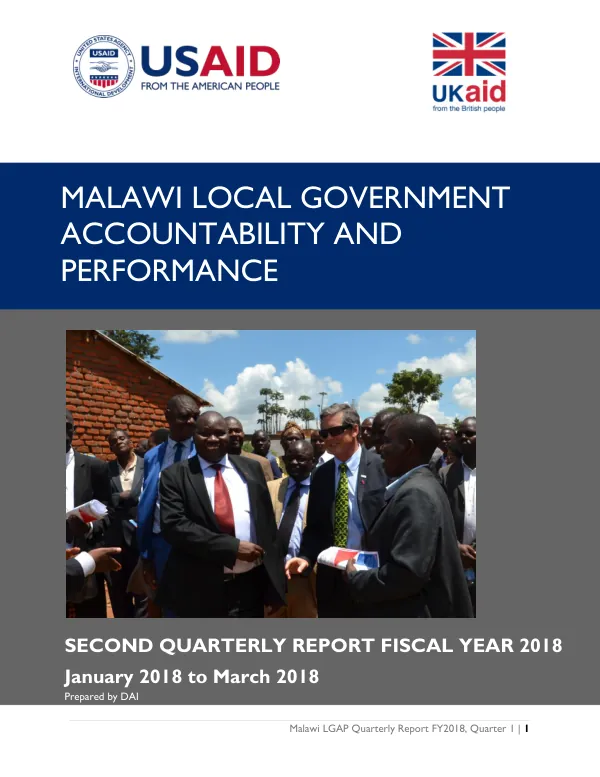
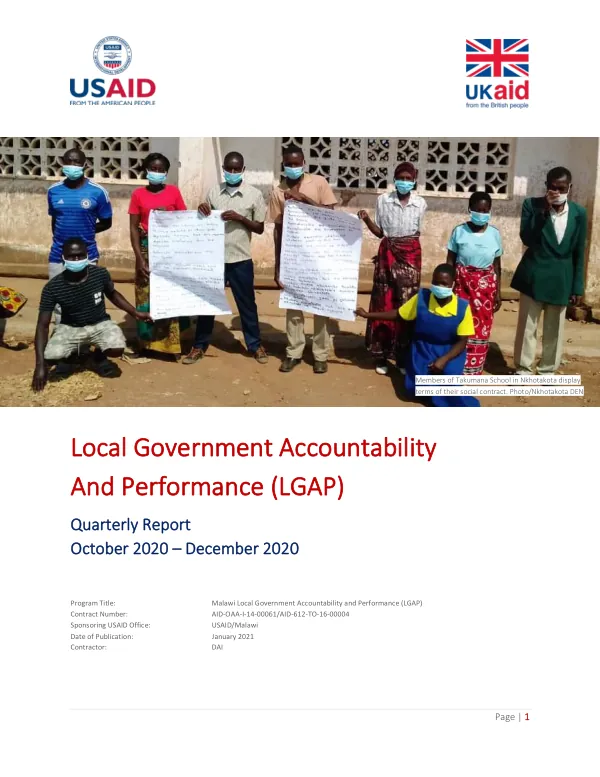
Local Government Accountability And Performance (LGAP) Quarterly Report October 2020 – December 2020
Sign inDAI
Local Government Accountability And Performance (LGAP) Quarterly Report October 2020 – December 2020
The Local Government Accountability and Performance (LGAP) activity in Malawi has been in its 5th year of programming as of October 2020.
2021 · 80 pages
Sign in to readA free account is required to download.
Abstract
The year began with a relative calm compared to the previous months of political instability and concerns about the pandemic. However, the projected rise of COVID-19 cases and deaths, as well as floods, increased the risk of food insecurity and real economic concerns, putting pressure on the new administration to make progress on their reforms. LGAP recognizes that project success cannot be measured solely in the best of times. Council functionality must be seen in the most trying times as well. As LGAP prepares to close its doors after a 5-year run, the focus is on responding to these challenges and leaving behind a local government system more equipped to respond to people's needs and demonstrate resilience in the face of external challenges. Public Service Reform has remained a priority on the executive's agenda, which is an advantage to the LGAP activity. The COVID-19 pandemic has continued to test the basic tenets of decentralization, but the efforts to uphold these principles continue to enjoy a receptive audience. The review of the Local Government Authority (LGA) fiscal decentralization reform is underway, and there is a promising future for Public Service Reform efforts. The response to the pandemic is highlighting the responsibility and authority of local governments. At the heart of everything LGAP seeks to accomplish is the need for both human and institutional performance improvement, with the aim of professionalizing Public Service in Malawi. This would consequently promote participatory and functional governance. LGAP has prioritized support to harmonize various pieces of legislation, as well as alignment with the Constitution, focusing on the Public Service Act, the Malawi Public Service Regulations (MPSR), and User Procedural Tools. During the quarter, the revised MPSR went through a stakeholder engagement process. LGAP has been working to advance strategic reform priorities, promote the use of the Integrated Financial Management Information System (IFMIS) in all councils to maximize accountability in Public Financial Management (PFM), increase Own-Source Revenue (OSR) and Local Economic Development, strengthen the Internal Audit Function at the council level, fill key local government vacancies, and maximize the impact of donor support to local government. The project has also been pivoting to respond to the COVID-19 pandemic, with a focus on supporting local governments in their response efforts. Monitoring and evaluation are critical components of the LGAP activity, with a focus on tracking progress towards the project's objectives and identifying areas for improvement. The project has also been conducting risk analysis to identify potential challenges and develop strategies to mitigate them. The LGAP activity has been engaging with various stakeholders, including local government officials, civil society organizations, and the media, to promote the project's goals and outcomes. The LGAP activity has been making progress in various areas, including the implementation of the IFMIS system, the development of OSR and Local Economic Development, and the strengthening of the Internal Audit Function. The project has also been supporting the development of the Public Service Act and the MPSR, and has been working to promote participatory and functional governance. Despite the challenges posed by the COVID-19 pandemic, the LGAP activity remains committed to its goals and is working to leave behind a local government system that is more equipped to respond to people's needs and demonstrate resilience in the face of external challenges.
Related documents