USAID DEC
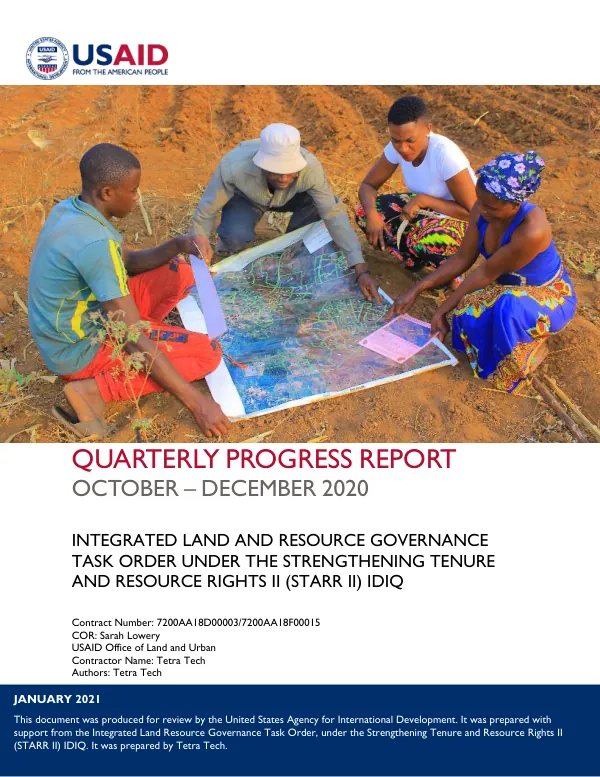
Integrated Land and Resource Governance Task Order Quarterly Progress Report for October-December 2020
Sign inTETRA TECH
Integrated Land and Resource Governance Task Order Quarterly Progress Report for October-December 2020
The Integrated Land and Resource Governance (ILRG) Task Order under the Strengthening Tenure and Resource Rights II (STARR II) IDIQ began in 2020 with the goal of improving land governance and tenure security in several countries.
2021 · 66 pages
Sign in to readA free account is required to download.
Abstract
The task order is funded by the United States Agency for International Development (USAID) and is implemented by Tetra Tech. During the October-December 2020 quarter, the project faced significant challenges due to the COVID-19 pandemic. The pandemic had a substantial impact on staff, with many team members working remotely and facing difficulties in implementing work plans. The pandemic also affected the project's budget and expenditures, with some activities being delayed or modified to accommodate the new circumstances. Despite these challenges, the project made significant progress in several areas. In Mozambique, the project implemented environmental mitigation measures and monitoring, which helped to reduce the impact of human activities on the environment. In Zambia, the project focused on community-based planning and governance, with a particular emphasis on advancing the rights of indigenous peoples. In Mexico, the project supported the development of capacity development indicators and tools, which will help to improve the effectiveness of land governance programs. The project also implemented a mobile approach to secure tenure (MAST), which aims to provide secure land tenure to vulnerable communities. In addition to these activities, the project also made progress in several other areas, including the completion of several activities in Ghana, India, Indonesia, and Liberia. These activities focused on a range of issues, including land tenure assessment, community land protection, and women's economic empowerment. The project's performance indicators show that significant progress was made during the quarter, with several activities being completed ahead of schedule. The project's staff also demonstrated their ability to adapt to the challenges posed by the COVID-19 pandemic, with many team members working remotely and finding innovative solutions to the challenges they faced. Overall, the ILRG Task Order under the STARR II IDIQ made significant progress during the October-December 2020 quarter, despite the challenges posed by the COVID-19 pandemic. The project's activities and achievements demonstrate its commitment to improving land governance and tenure security in several countries. The project's activities in Mozambique, Zambia, and Mexico demonstrate its focus on community-based planning and governance, environmental mitigation, and capacity development. The project's completion of several activities in Ghana, India, Indonesia, and Liberia shows its ability to deliver results in a range of contexts. The project's activities and achievements demonstrate its commitment to improving land governance and tenure security in several countries. The project's focus on community-based planning and governance, environmental mitigation, and capacity development will help to improve the effectiveness of land governance programs and promote sustainable development. The project's completion of several activities in Ghana, India, Indonesia, and Liberia shows its ability to deliver results in a range of contexts. The project's performance indicators show that significant progress was made during the quarter, with several activities being completed ahead of schedule. The project's staff demonstrated their ability to adapt to the challenges posed by the COVID-19 pandemic, with many team members working remotely and finding innovative solutions to the challenges they faced. The project's activities and achievements demonstrate its commitment to improving land governance and tenure security in several countries. The project's focus on community-based planning and governance, environmental mitigation, and capacity development will help to improve the effectiveness of land governance programs and promote sustainable development. The project's completion of several activities in Ghana, India, Indonesia, and Liberia shows its ability to deliver results in a range of contexts.
Related documents