RICE UNIVERSITY
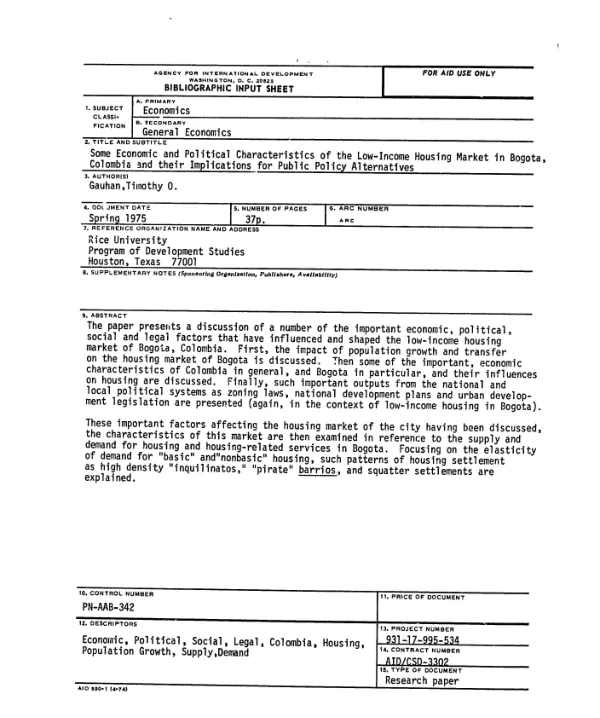
Low income housing development in Bogota
Traditional views of squatter settlement development, those built outside of accepted legal parameters, have been seen as blighted areas that must be removed and replaced by institutional means, and later, as homogenous settlements marginal to the rapid growth of urban areas, but significant in their internal organization, spontaneous creation and development, and potential impact on the city"s economic and political life.
Bender, S. O. · 1970
Sign in to readA free account is required to download.
Abstract
Only recently has the squatter settlement"s importance been identified -- that of viable, adaptive physical environments which allow their occupants to participate in and benefit from development. Moreover, the growth and change which takes place in these settlements, that of transforming aggregations of dwelling units (however rudimentary in nature) into a mature urban community with a full range of public and private services, is duplicated in government sponsored settlements for similar income groups. This evolution is brought about by investment and construction under the control of the dwellers themselves. Their housing costs are kept as low as possible and real economic gains are made from provision of housing and commercial services to the settlements" inhabitants, which improves income distribution. This phenomenon as it occurs in Bogota, Colombia, is influenced by the availability of land, construction materials, key public services, and the decision of the settlement dwellers to exercise control over the creation and/or maintenance of their physical environment. All of these are dynamic factors whose modification could bring about reduction or cessation of settlement development.
Connected topics
Related documents