USAID DEC
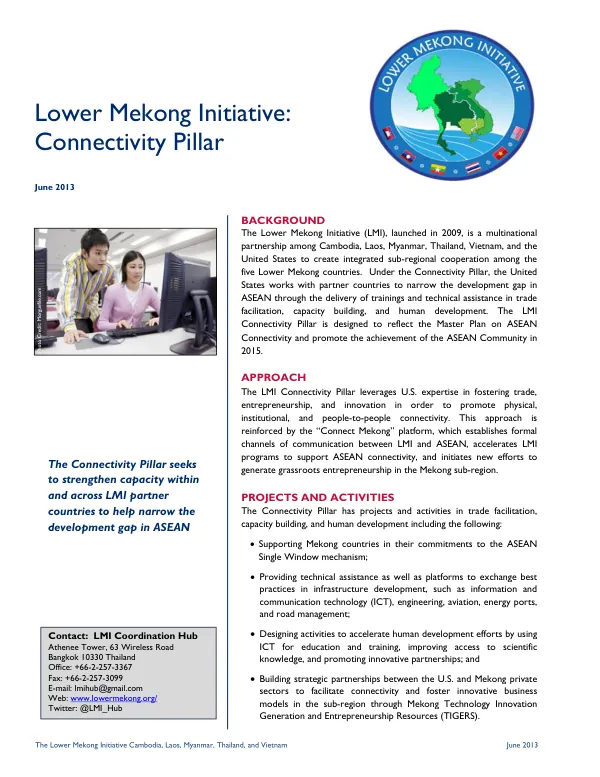
Lower Mekong Initiative: Connectivity Pillar
The Lower Mekong Initiative (LMI) is a multinational partnership among Cambodia, Laos, Myanmar, Thailand, Vietnam, and the United States.
2013 · 1 pages
Sign in to readA free account is required to download.
Abstract
Launched in 2009, the LMI aims to create integrated sub-regional cooperation among the five Lower Mekong countries. The initiative is designed to narrow the development gap in ASEAN through the delivery of trainings and technical assistance in trade facilitation, capacity building, and human development. The LMI Connectivity Pillar is a key component of the initiative, focusing on promoting physical, institutional, and people-to-people connectivity. This approach leverages U.S. expertise in fostering trade, entrepreneurship, and innovation. The "Connect Mekong" platform serves as a formal channel of communication between LMI and ASEAN, accelerating LMI programs to support ASEAN connectivity and generating grassroots entrepreneurship in the Mekong sub-region. The Connectivity Pillar has projects and activities in trade facilitation, capacity building, and human development. These include supporting Mekong countries in their commitments to the ASEAN Single Window mechanism, providing technical assistance and platforms for exchanging best practices in infrastructure development, and designing activities to accelerate human development efforts using information and communication technology (ICT) for education and training. Additionally, the pillar seeks to build strategic partnerships between the U.S. and Mekong private sectors to facilitate connectivity and foster innovative business models in the sub-region through the Mekong Technology Innovation Generation and Entrepreneurship Resources (TIGERS) program. The LMI Connectivity Pillar aims to strengthen capacity within and across LMI partner countries to help narrow the development gap in ASEAN. This is achieved through the delivery of trainings and technical assistance, as well as the promotion of physical, institutional, and people-to-people connectivity. The initiative's focus on trade facilitation, capacity building, and human development is designed to support the achievement of the ASEAN Community in 2015. The LMI Coordination Hub is responsible for coordinating the initiative's activities and providing technical assistance to LMI partner countries. The hub is based in Bangkok, Thailand, and can be contacted through various channels, including email, phone, and social media. The LMI's website and social media platforms provide additional information on the initiative's activities and progress.