ROBERT NATHAN ASSOCIATES
ASEAN Regional Agricultural Trade Environment (RATE) Assessment
The agricultural trade environment in the Association of Southeast Asian Nations (ASEAN) region is a critical factor in determining the growth of agricultural trade and food security.
2013 · 22 pages
Sign in to readA free account is required to download.
Abstract
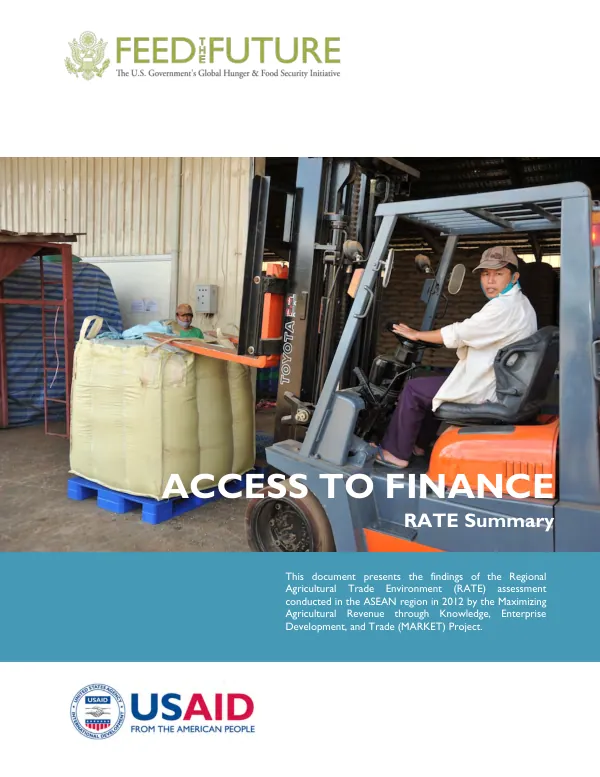
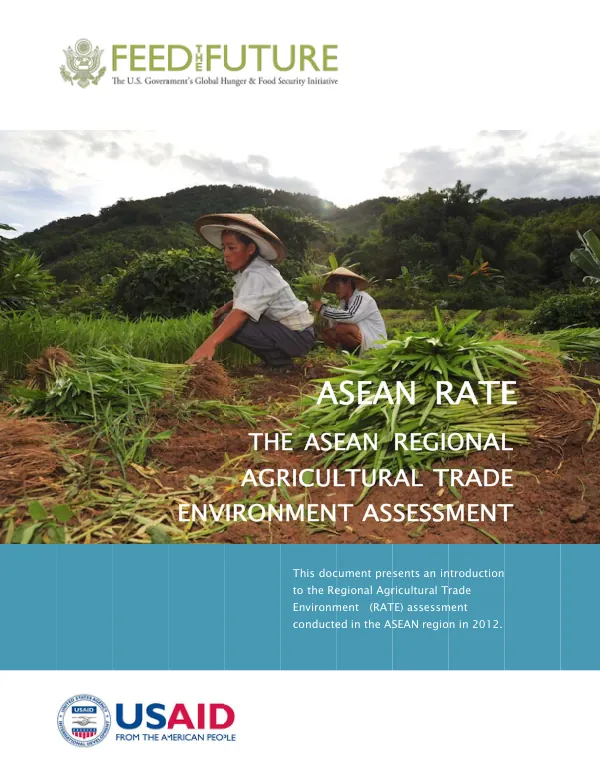
The USAID-sponsored Regional Agricultural Trade Environment (RATE) assessment, implemented by the Maximizing Agricultural Revenue through Knowledge, Enterprise Development and Trade (MARKET) Project, aims to examine the enabling environments for agricultural trade and food security in the region. The RATE assessment covers the ten member states of ASEAN, including Brunei, Cambodia, Indonesia, Laos, Malaysia, Myanmar, the Philippines, Singapore, Thailand, and Vietnam. The assessment examines a range of agriculture and trade-related policies, laws, institutions, and social dynamics that impact the environment for trade, both with respect to international markets and among ASEAN member states themselves. The RATE methodology is drawn from USAID's well-established Agribusiness Climate Legal and Institutional Reform (AgCLIR) diagnostic tool, which examines many country-specific aspects of starting and running an agribusiness, including farming, processing, exporting, and other agriculture-related enterprises. The RATE assessment has been adapted from AgCLIR as an efficient but still detailed method for examining regional legal and institutional environments for trading in agricultural goods. The assessment identifies specific policies and practices on a comparative basis, highlighting how certain efforts at legal and regulatory harmonization or strengthened institutional performance can improve conditions for food security and growth. Mindful of comprehensive efforts to bring together ASEAN's member states as one economic, political, and socio-economic community by 2015, the RATE assessment has devoted special attention to opportunities for legal harmonization and institutional collaboration across the region. The assessment focuses on ten topics, each of which is critical to the development of a well-functioning trade environment in the region. These topics include impact on agricultural trade, informal economy, access to finance, infrastructure, intellectual property rights, competition, non-tariff barriers, trade facilitation, and supporting institutions. The assessment examines the current state of laws and regulations related to these topics, as well as the institutional capacity of ASEAN member states to implement and enforce them. The RATE assessment also reviews the role of supporting institutions, including private sector and professional associations, research institutes, farmer associations, banks, women's groups, business support organizations, transporters, laboratories, universities, think tanks, and many others that have the potential to contribute to a well-functioning trade environment. The assessment aims to provide a comprehensive understanding of the enabling environments for agricultural trade and food security in the ASEAN region, and to identify opportunities for reform and improvement. The findings of the RATE assessment are presented in a four-part framework, which includes a diagnosis of the current state of the trade environment, a review of the underlying policies and regulations, an analysis of the impact of these policies and regulations on stakeholders across the agricultural value chain, and a set of recommendations for reform and improvement. The assessment aims to provide a comprehensive and detailed understanding of the trade environment in the ASEAN region, and to identify opportunities for reform and improvement that can contribute to the growth of agricultural trade and food security in the region.