CHEMONICS
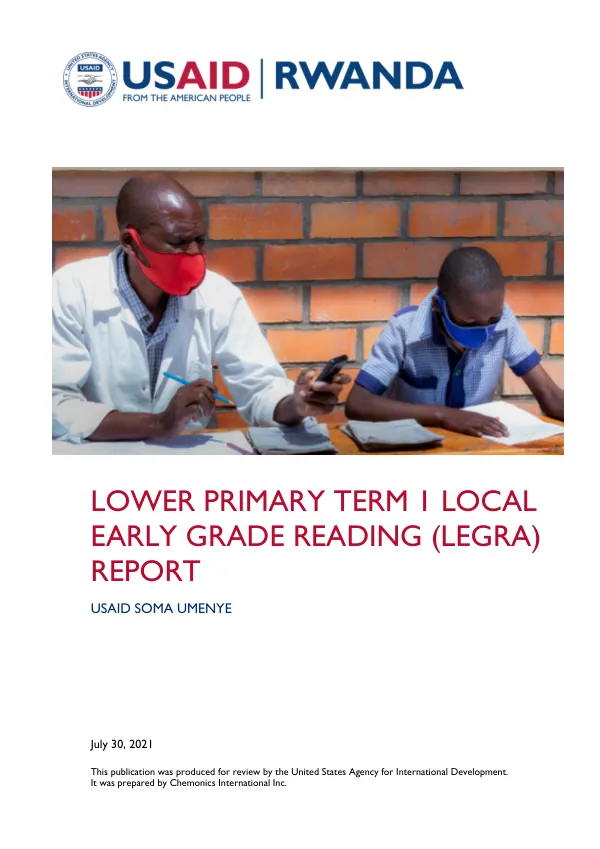
LOWER PRIMARY TERM 1 LOCAL EARLY GRADE READING (LEGRA) REPORT
The Local Early Grade Reading Assessment (LEGRA) is a comprehensive assessment framework implemented by the National Examination and School Inspection Authority (NESA) in Rwanda.
2021 · 48 pages
Sign in to readA free account is required to download.
Abstract
The assessment measures key reading skills using four sub-tests derived from the Early Grade Reading Assessment (EGRA) and is administered to every P1-P3 student across the country. At the end of Term 1, P1-P3 teachers assessed a total of 1,742,000 students, providing five literacy data points for each student. The LEGRA assessment is part of the national Kinyarwanda early grade reading benchmarks, which were approved in 2019. The benchmarks are used to measure student progress and inform targeted remediation programs. The assessment also aims to provide a harmonized, coordinated, and moderated assessment framework for schools, sectors, and districts to produce a picture of student learning achievement. The Term 1 LEGRA results indicate that 24% of P1 students, 27% of P2 students, and 24% of P3 students met the Term 1 benchmark for reading accuracy of letters, syllables, and simple words. The results also show that girls outperform boys in all three grades. However, the consistent difference in performance between P2 and P3 learners suggests that the combination of term and test difficulty may need slight recalibration. The assessment results also indicate that reading comprehension results are generally better than oral reading fluency results, particularly at the P2 level. This may be due to the fact that students were given an extra two minutes to read or re-read the passage before the teacher asked them the reading comprehension questions. The results also suggest that P1 students faced challenges this year, including the double P1 cohort and the introduction of a large number of new untrained teachers. The LEGRA assessment is supported by Soma Umenye, which has worked with the Rwanda Basic Education Board (REB) and NESA to implement comprehensive assessment in lower primary Kinyarwanda. The assessment aims to provide a harmonized, coordinated, and moderated assessment framework for schools, sectors, and districts to produce a picture of student learning achievement. The approved oral reading fluency benchmarks for P1-P3 students are as follows: P1: 0 CWPM, P2: 1-9 CWPM, P3: 10+ CWPM. The approved reading comprehension benchmarks for P1-P3 students are as follows: P1: 0 questions answered correctly, P2: 1 question answered correctly, P3: 2 questions answered correctly. The LEGRA assessment has several benefits, including enabling Rwanda to compare reading progress with other countries in the region and increasing Rwanda's potential to provide data to report on the Human Capital Index (HCI) and Sustainable Development Goal (SDG) 4. The assessment also provides Rwanda with a unique opportunity to assess progress towards national targets during the academic year, enabling potential targeted turnaround activities to improve results during the year. The LEGRA assessment is an essential tool for improving reading outcomes in Rwanda, particularly in the lower primary grades. The assessment provides a comprehensive picture of student learning achievement and informs targeted remediation programs to support students who are struggling. The assessment also aims to provide a harmonized, coordinated, and moderated assessment framework for schools, sectors, and districts to produce a picture of student learning achievement. The LEGRA assessment has several implications for education policy and practice in Rwanda. The assessment highlights the need for targeted support for P1 students, particularly those who joined as part of the new cohort. The assessment also suggests that the combination of term and test difficulty may need slight recalibration to ensure that students are adequately prepared for the greater rigors of the P4 curriculum. The LEGRA assessment has several recommendations for education stakeholders in Rwanda. The assessment recommends that education stakeholders prioritize targeted support for P1 students, particularly those who joined as part of the new cohort. The assessment also recommends that education stakeholders review and revise the term and test difficulty to ensure that students are adequately prepared for the greater rigors of the P4 curriculum. The LEGRA assessment has several benefits for education stakeholders in Rwanda. The assessment provides a comprehensive picture of student learning achievement and informs targeted remediation programs to support students who are struggling. The assessment also aims to provide a harmonized, coordinated, and moderated assessment framework for schools, sectors, and districts to produce a picture of student learning achievement.