DAI GLOBAL, LLC
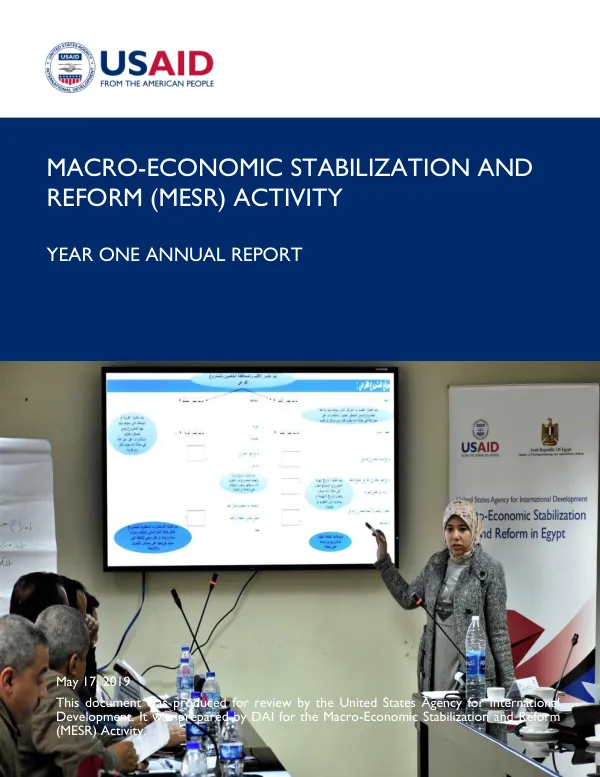
Macro-Economic Stabilization and Reform (MESR) Activity Year One Annual Report
The Macro-Economic Stabilization and Reform (MESR) activity commenced on April 2, 2018, with the primary objective of promoting economic reform best practices in Egypt.
2019 · 37 pages
Sign in to readA free account is required to download.
Abstract
The activity engaged key stakeholders, including the Ministry of Finance (MOF) and Ministry of Planning, Monitoring, and Administrative Reform (MPMAR), to inform baseline assessments and build relationships necessary for implementing reforms. Initial efforts focused on introducing planned activities for economic reform to the MOF and MPMAR, with the goal of embedding the MESR activity within both ministries. As Year One progressed, MESR adapted its programming to meet strategic needs, coordinating with other donor organizations such as the International Monetary Fund (IMF), GIZ, the British Embassy, and current reform projects operating within Egypt to synchronize technical assistance provided to the Government of Egypt (GOE). Strengthening relationships with the MOF and MPMAR required considerable time and effort, resulting in some activities scheduled for Year One being shifted to accommodate the necessary approvals. Despite these challenges, MESR made significant progress in building constructive working relationships with its counterparts, laying the groundwork for future reforms. The MESR activity focused on two primary objectives: Improved Public Investment Planning, Implementation, and Monitoring to Enhance the Productivity of Public Capital Assets and the Efficiency and Effectiveness of Public Services, and Upgraded Effectiveness of Public Financial Management to Improve Fiscal Management, Budgeting, and Expenditure Control, and Promote Greater Budget Efficiency, Transparency, and Accountability. Key results achieved during Year One include the strengthening of capital investment appraisal and decision support mechanisms at the MPMAR and across all government entities, the development of suitable alternative financing schemes, and the improvement of process flows related to public investment management and finance. Additionally, the existing monitoring and evaluation system at the MPMAR was upgraded to ensure that all capital investments are linked to the Sustainable Development Strategy 2030 goals and objectives. The activity also made progress in improving cash management to support fiscal consolidation, enhancing the effectiveness and efficiency of the budgeting process, and improving tax administration, tax revenue analysis, and forecasting systems. Furthermore, the capacity of the MOF to measure, manage, and monitor fiscal risks and engage in public-private dialogue was improved. Overall, the MESR activity demonstrated significant progress in promoting economic reform best practices in Egypt during Year One, laying the foundation for future reforms and improvements in public financial management and investment planning.