DAI GLOBAL, LLC
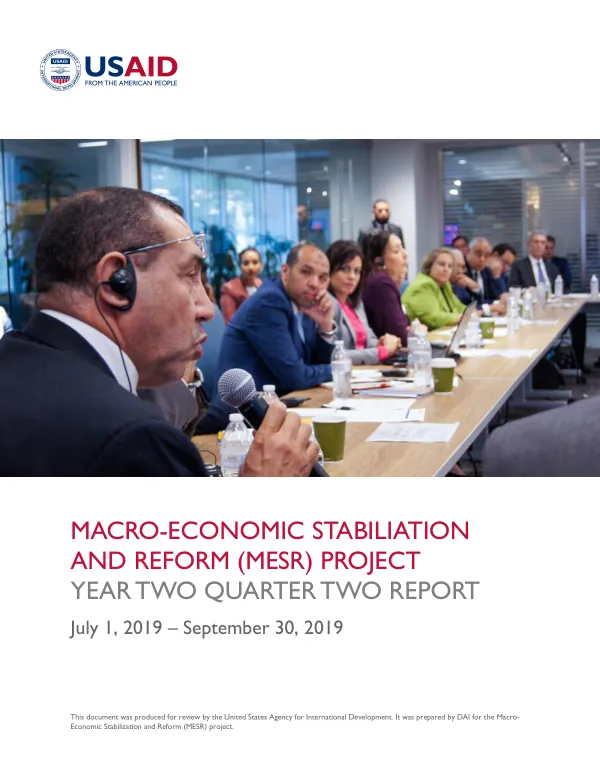
Macro-Economic Stabilization and Reform Project Year Two Quarter Three Report
The Macro-Economic Stabilization and Reform (MESR) project is a five-year initiative beginning in April 2018 and ending in April 2023.
2020 · 41 pages
Sign in to readA free account is required to download.
Abstract
The project is designed to support the Government of Egypt (GOE) reform efforts included in the GOE's agreement with the International Monetary Fund (IMF). The reforms aim to address macro-economic imbalances that negatively impact the ability of enterprises to grow and become more competitive. The MESR project has two primary objectives: Objective One, Improved Public Investment Planning, Implementation, and Monitoring to Enhance the Productivity of Public Capital Assets and the Efficiency and Effectiveness of Public Services; and Objective Two, Upgraded Effectiveness of Public Financial Management to Improve Fiscal Management, Budgeting, and Expenditure Control, and Promote Greater Budget Efficiency, Transparency, and Accountability. The primary counterparts to the MESR project are the Ministry of Planning and Economic Development (MPED) and the Ministry of Finance (MOF). In Year Two, Quarter Three, the MESR project continued to make significant strides to improve public investment planning, implementation, and monitoring and increased effectiveness of public financial management. The project worked with counterparts including MPED, MOF, related government officials, Parliamentarians, the private sector, and Egyptian citizens. MESR took substantial steps toward improving the GOE's budgeting practices, with technical assistance that increased GOE efficiency, transparency, and accountability. One notable achievement is the work done to link the Integrated System for Investment Plan Preparation and Monitoring (ISIPPM) and the Government Financial Management Information System (GFMIS). Once these systems are integrated, the GOE will be able to include investment projects from the ISIPPM within the government accounting system (GFMIS). This will allow the GOE to better allocate and track expenses, and account for ongoing costs during the yearly budget cycle. MESR also coordinated closely with both the MPED and MOF to establish a process mechanism for efficiently addressing requests for public investment reallocations and transfers for both the GFMIS and ISIPPM. This process is now subject to increased accountability, with internal audit units able to audit for checks and balances. MESR continued to provide technical assistance on fiscal risk, which will further support the GOE to better mitigate its reliance on transfers and reallocations. In addition to supporting linkage of the ISIPPM and the GFMIS, MESR continued to support both systems independently. MESR conducted an IT retreat to analyze ISIPPM's structure and recommend next steps for automation improvement, including with an eye toward GFMIS integration. To further improve the quality of data entry for the ISIPPM, MESR strengthened the planning capacity of governorate planning and monitoring departments across Egypt as well as supported revision of public investment projects' names. MESR also provided examples of international best practice to MOF officials managing the GOE's GFMIS. MESR continued to strengthen the GOE's shift toward program-based budgeting (PBB), which involves allocating resources to investments and programs rather than basing budgets on static line items. In Quarter Three, MESR provided extensive technical assistance to Parliament, the MOF, and MPED. This included providing training to over 2000 government budget unit officials across Egypt to support their shift to more responsive and accountable budgeting. To build counterpart capacity and ensure sustainability, MESR first provided training to MOF and MPED officials, who then used the knowledge and skills acquired to train over 2000 government officials over a four-day period in December 2019. To further support GOE's institutionalization of PBB, MESR worked with the MOF to draft a PBB manual, which is now being translated into Arabic. MESR also provided other technical assistance as needed, such as an organizational development workshop for MOF and MPED officials to support the development and capacity of the newly established PBB Units in both ministries. MESR facilitated the establishment of a joint taskforce with representatives from both units, which will further strengthen the units' development as well as promote collaboration and coordination between the two ministries.