USAID. MISSION TO MADAGASCAR
Madagascar -- IRRI rice research project
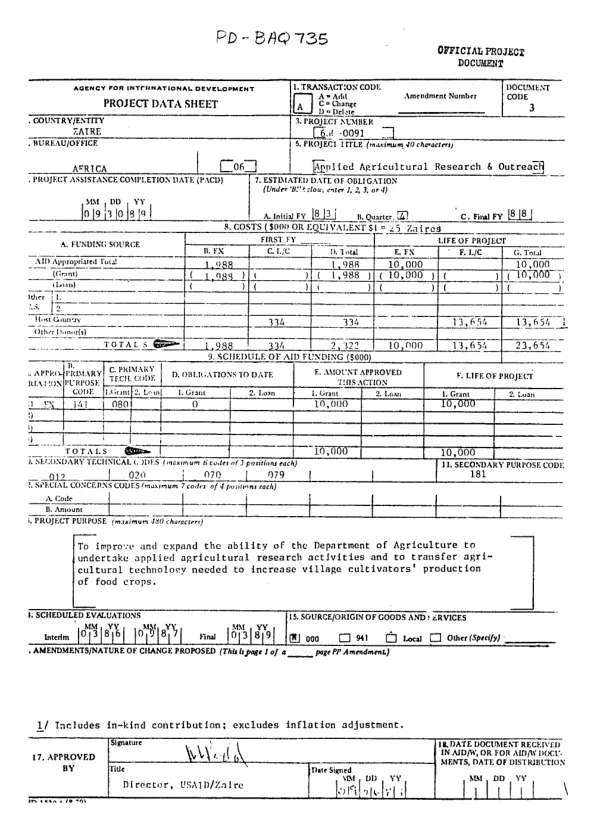
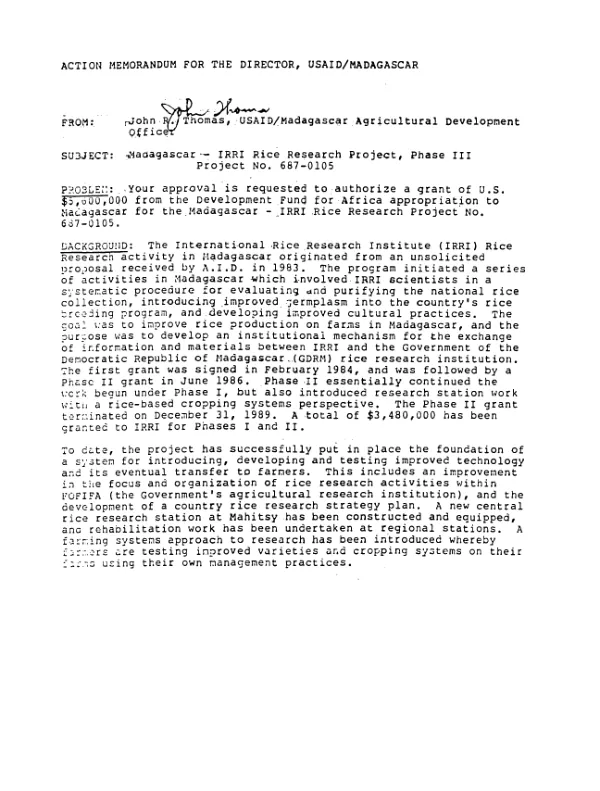
Project, follow-on to 936411122, to help the Malagasy National Center for Applied Research on Rural Development (FOFIFA) conduct research to improve rice varieties, cropping systems, technologies, and technology transfer.
1990
Sign in to readA free account is required to download.
Abstract
The International Rice Research Institute (IRRI) will help FOFIFA implement the project. Varietal research will focus on developing/identifying high- yielding varieties for irrigated and rainfed upland and lowland ecologies. About 200 varieties per year will be introduced from national and international centers and evaluated for milling and cooking characteristics, as well as yield level and stability. Local strains will be purified and characterized, and a hybridization will be conducted to cross improved local and introduced germplasm; hybrids will be targeted for irrigated and rainfed areas. Advanced varieties will be evaluated on-farm. The project will also develop a database management system for varietal research and ensure the refrigeration of the national rice germplasm collection. Cropping systems research will be multidisciplinary and will involve: (1) farming systems diagnostic surveys in priority ecologies; (2) design/testing of alternative rice-based cropping patterns and agronomic practices (e.g., fertilizer, weed control); and (3) farmer-managed verification trials. The project will introduce non-rice crops for inclusion in rice-based cropping systems, including green manure legumes for upland rice systems in the Middle-West. FIFAMANOR, a Malagasy wheat and white potato improvement entity, will assist in this component. Soils research will: (1) review existing literature on Malagasy soils; (2) examine the dynamics of soil nutrients, particularly phosphorous, with respect to rice cropping; (3) identify reliable tests and critical values for major nutrients; and (4) develop a more functional rice soils classification system. The primary focus will be on High Plateau wetland soils Technology transfer activities will include: testing and diffusion of project-developed technologies; in-depth research on socioeconomic, institutional, and policy constraints to increasing rice production and farm income; (4) evaluation of the impact of research/extension activities in the project"s target areas; and (5) development of an effective national technology transfer/extension system. Pest management research will: (1) inventory rice diseases and identifying pathogenic nematodes; (2) develop integrated control techniques for major rice pests; and (3) assess the economic damage caused by pests. Agricultural engineering research will focus on the development of simple machines for wetland soils, and will identify and strengthen private sector capacity to fabricate such machines locally. Finally, the project include short courses for 34 scientists/administrators and 12 extensionists and supervisors, M.S. and Ph.D. training of 10 scientists, and participation of 56 scientists in conferences and workshops. Supporting construction will be funded through P.L. 480 counterpart.
Related documents