USAID. MISSION TO INDIA
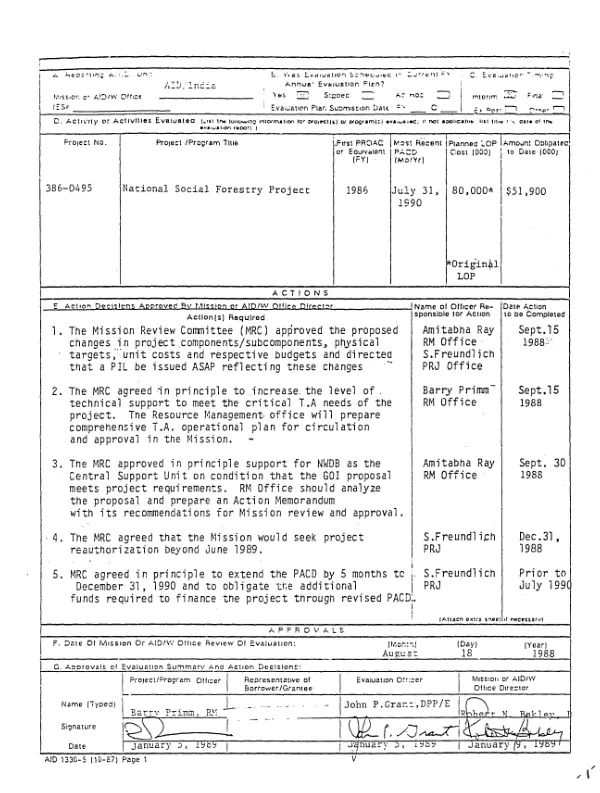
Madhya Pradesh social forestry project
Summarizes second midterm evaluation of a project to encourage the development of community tree plantations in Madhya Pradesh.
1986
Sign in to readA free account is required to download.
Abstract
The evaluation covered the period 11/83-12/85 and was based on site visits and interviews with beneficiaries and project personnel. Social forestry as it has been implemented in Madhya Pradesh is fundamentally flawed. The principal purpose of the project - to build institutional capacity to motivate villager participation in the establishment of community plantations - has fallen by the wayside, largely because the village authorities (panchayats) bow to pressure to use available land for grazing rather than trees. Project reconceptualization is strongly recommended and should focus on: (1) developing estimates of land availability (shortage of land has been a serious constraint); (2) reassessing the feasibility of establishing financially self-sustaining community plantations (none of the plantations visited will achieve self-sufficiency given current management practices); (3) improving methods for persuading panchayats to participate in plantation management from the outset (village involvement has been weak, except in nursery and seedling distribution programs); (4) reexamining relationships between the Social Forestry Directorate (SFD), which implements the project, and other governmental and nongovernmental institutions (present institutional arrangements - especially personnel transfer procedures within SFD"s parent organization, the Forestry Department, have been a serious problem); and (5) improving the continuity of SFD management personnel and their capabilities and interest in extension activities - extension should be SFD"s major program emphasis. USAID/I comments that a major overhaul of SFD may help to establish self-sustaining community plantations; without such an overhaul, costs would be very high and the chances of success slim. Alternative forestry approaches may prove to be better investments. USAID/I will not extend the project, but will support related institution-building projects. The project teaches that quantitative targets are incompatible with projects that have as their main purpose institution building. Also, projects that build on experimental activities and/or attempt to change established political economies should be allowed to develop gradually; there should be at least one successful trial run before a major commitment of resources is made. This project leapt from small activity to a major effort (operational in 21 Madhya Pradesh districts) in the space of 2 or 3 years and has been unable to cope with local political and financial pressures.
Related documents