USAID. MISSION TO INDIA
National social forestry project
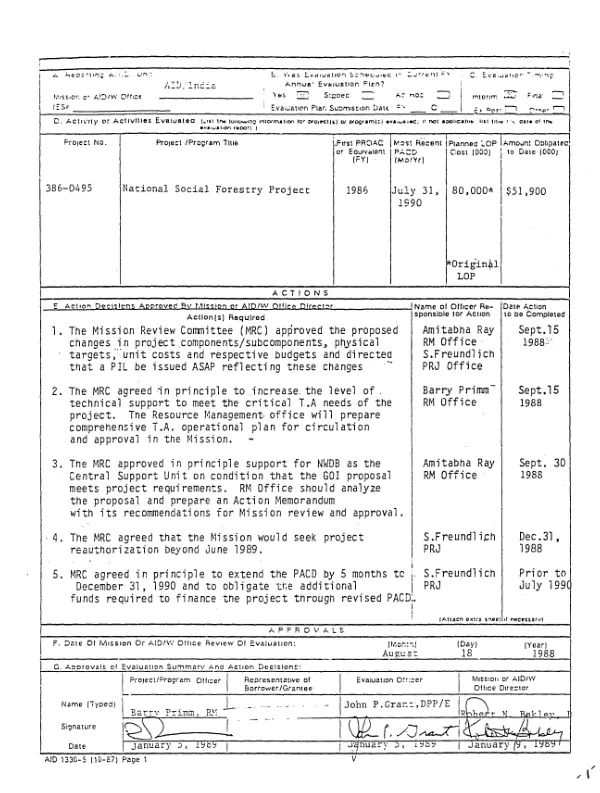
Summarizes mid-term evaluation (XD-AAZ-020-A) of a joint USAID/World Bank social forestry project in the States of Gujarat, Himachal Pradesh, Rajasthan, and Uttar Pradesh in India.
1989
Sign in to readA free account is required to download.
Abstract
Evaluation covered 1986-88 and was based on rapid appraisal field visits by specialist teams. Significant progress has been made in physical plantings, with some half a billion seedlings (118% of target) distributed. Most project components have only achieved in the 80% range, partly as the result of a 25% budgetary shortfall relating to the continuing drought; budgets for the remaining years are expected to increase, however. Project reports indicate reasonable survival rates (50-60% for farm forestry and 60-70% for public forestry), but few independent surveys have been conducted. More specific objectives are being met to different extents by the various planting programs. Increases in the production of wood products have been spectacular among farmers planting trees on their own land. Total production from farm forestry through the project could approach 10% of India"s current needs, a considerable achievement. Rural incomes are being augmented through private farm forestry and through the huge employment benefits of community and government wasteland planting. These benefits are obtained entirely by the poor. Equity objectives are being addressed through the collection of fuel and fodder from public land plantations and through targeted pilot activities such as tree tenure initiatives, although neither of these efforts is functioning wholly as expected. Environmental aspects of the plantings were neglected during project design, and achievements in this area are considerably less than they could be. In addition, overreliance on traditional timber production models and methods without regard to site variations and the need for continuous groundcover sometimes produces negative or neutral results. Important, if insufficient, incremental gains have been made in strengthening the capacity of the concerned Forest Departments and private farmers to carry out social forestry programs. Training, monitoring/evaluation, and micro-planning have shown noteworthy progress, but extension and research have lagged. The capacity of the Government of India"s Central Support Unit to support the States has been less than anticipated. Finally, little progress has been made in employing and involving women, except in one State, and there has been negligible involvement of NGO"s. The evalution shows the importance of linking project components to specific objectives. Controversy and some confusion in the field have been generated by failing to clearly distinguish those components primarily directed to production (i.e., farm forestry) and those directed toward poverty alleviation and environmental concerns (i.e., public forestry). A strategy for the remainder of the project is included in the evaluation.
Related documents