USAID. MISSION TO BURMA
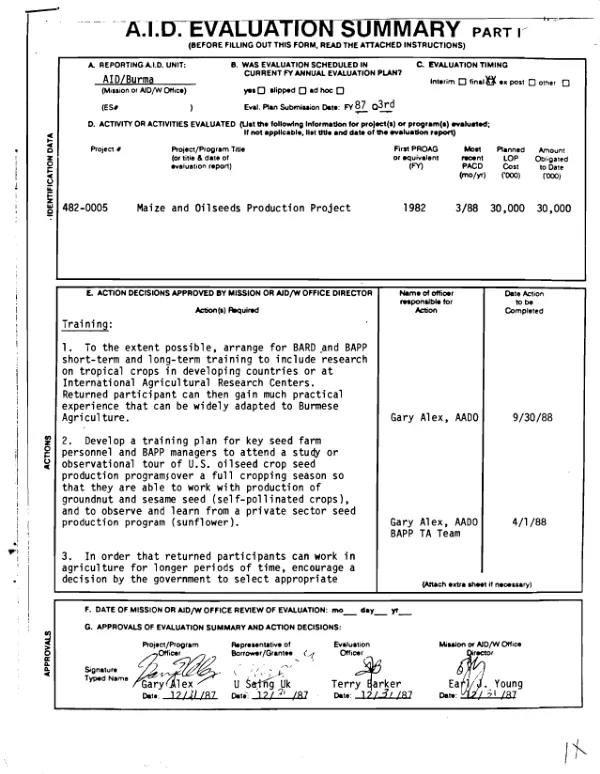
Maize and oilseeds production project
Project to increase the production of maize and oilseeds in rural Burma.
1981
Sign in to readA free account is required to download.
Abstract
The project, which will be implemented by the Agriculture Corporation (AC) of the Ministry of Agriculture and Forests, will improve national research capabilities, introduce improved technology and production practices, and establish seed farms and a rhizobium production facility. Of the 28 townships selected for the project, eight having a high potential for increased agricultural production will receive concentrated extension and material inputs (including 80% of the fertilizer to be supplied under the project). In these townships, ongoing field trials in maize and oilseed production will be conducted at 40 field-level, high-technology sites; research will also be conducted at a central research facility in Yezin. These trials, which will be conducted on seed varieties, soils, fertilizer application rates, water control, and other variables affecting crop production, will serve to develop locally adapted, prototype, farm packages for each crop. Further, two foundation seed farms will plant 70 acres of oilseeds and 110 acres of maize, while two certified seed farms will cultivate 800 acres of oilseeds and 3,000 acres of maize. The farms will be integrated with three seed processing facilities to be established under the project, resulting in the annual bagging and storing of 3,500 MT of maize, groundnut, sesamum, sunflower, and soybean seed. In addition, an information system to monitor farm-level production practices and provide feedback to research and extension centers will be established in the eight major project townships, and a rhizobium production facility capable of producing local nitrogen-fixing inoculum for groundnuts and soybeans will be established. Because project townships are located in both dry and wet climates, special emphasis will be placed on testing water management techniques. Overall, project farmers will receive 70,000 MT of fertilizer, 9,000 MT of seed, and 8 million pounds of inoculum, as well as agricultural equipment and pest management inputs. Participant training of AC personnel will include 11 Ph.D."s, 25 M.S."s, and 70 short-term non-degree programs.
Related documents