USAID. MISSION TO BURMA
Maize and oilseeds production project
Summarizes final evaluation (XD-CBA-787-A) of a 1982-1988 project to increase maize and oilseed production in Burma.
1987
Sign in to readA free account is required to download.
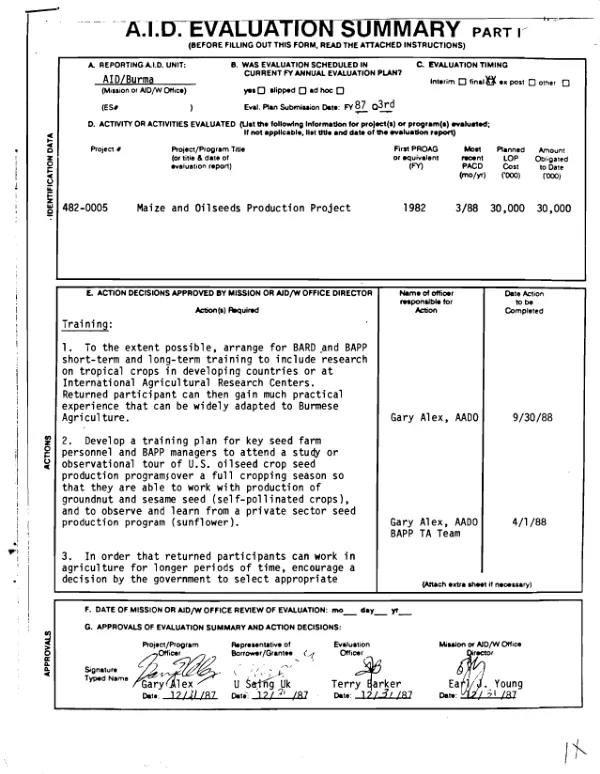
Abstract
The project was highly successful. The main shortfall - delays in completing the planned four seed farms - was made up for by the use of contract growers. Other shortfalls - in developing a farm management information system, redressing the shortage of Ph.D. candidates, assessing the project"s impact on participating farmers, and conducting research - will be addressed in other projects. A key reason for the project"s success was its sound design, which had been developed in principle prior to the project by the Burmese themselves and which used a proven, albeit unsophisticated technology disseminated through the existing network of extension, research, input supply, and seed multiplication systems to obtain production gains. Also contributing to the project"s success was the conscientiousness of Burmese staff; hard work by USAID/B; the project"s provision of fertilizer, new seed varieties, improved cultural practices, and economic opportunities to farmers; the fact that oilseeds are not a government controlled crop; and the TA contractor"s innovative (and well-received) use of U.S. farmers as consultants. Whether the project"s production increases can be sustained is doubtful, however. Additional oilseed increases can be obtained through further development and use of hybrid sunflowers and expanded use of honeybees for pollination, but increases beyond this will depend on the ability of research programs to develop or adapt other varieties/technology and particularly on the availability of fertilizer. This will not be easy given Burma"s current economic situation, especially its increasing difficulty in obtaining the foreign exchange needed to import investment goods for the economy and to replace the country"s deteriorating capital plant (equipment, mills, infrastructure, processing facilities). All this is exacerbated by declines in oil production, an increasing debt service burden, and an aging pool of professional scientists and the lack of candidates to replace them. Several recommendations and action decisions for the follow-on Burma Agriculture Production Project are included.