USAID DEC
Making good on a call to expand method choice for young people - Turning rhetoric into reality for addressing Sustainable Development Goal Three
Sign inPATH
Making good on a call to expand method choice for young people - Turning rhetoric into reality for addressing Sustainable Development Goal Three
Making good investments in the nearly two billion young people, aged 10–24 years, in the world today is paramount to the world's ability to meet its global development commitments, specifically the Sustainable Development Goals, especially Goal Three; the United Nations Global Strategy for Women's, Children's and Adolescents' Health; Family Planning 2020 (FP2020); and the United States Agency for International Development's Ending Preventable Child and Maternal Deaths priority.
2017 · 6 pages
Sign in to readA free account is required to download.
Abstract
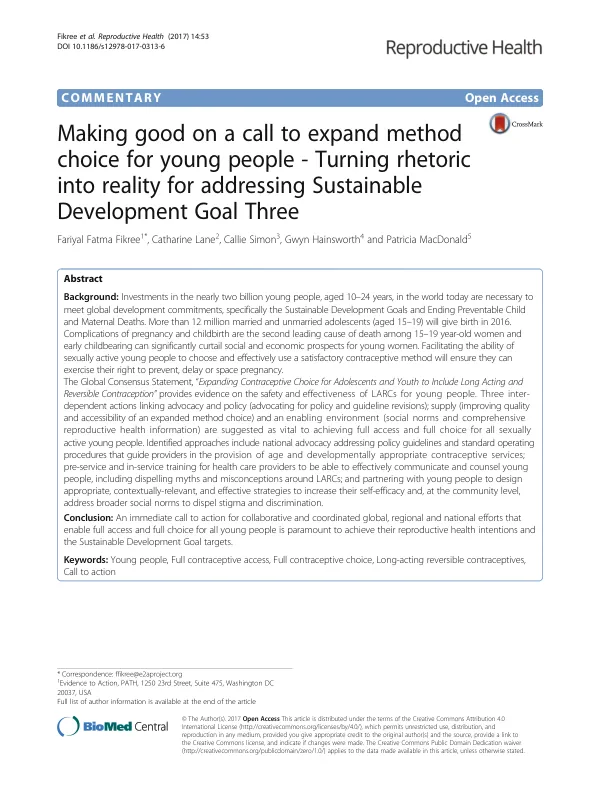
This large cohort of young people who are now – or soon will be – sexually active will have a profound impact on the ability of governments to ensure the health and wellbeing of their current and future populations. Greater attention to age and developmentally appropriate information and services across the health care spectrum can mitigate the potential cost of not taking action. Facilitating the ability of sexually active young people to choose and effectively use a satisfactory contraceptive method will ensure they can exercise their right to prevent, delay or space pregnancy. With increasing global awareness of and attention to adolescent and youth health, it is an opportune time to both establish and accelerate the implementation of policies and programs that enable young people's full access to the widest range of contraceptive choices, including highly effective, long-acting and reversible contraception. The Global Consensus Statement, "Expanding Contraceptive Choice for Adolescents and Youth to Include Long Acting and Reversible Contraception," provides evidence on the safety and effectiveness of LARCs for young people. Countless speeches, statements, and declarations have called for the increased attention to the health and rights of young people through better access to sexual and reproductive health information and services, yet comprehensive action has been inadequate and fragmented. Poor adolescent and youth reproductive health outcomes and the attendant social consequences persist. Twenty-eight percent of young women in developing regions are married before age 18, and 7% of girls marry before they are 15. More than 12 million married and unmarried adolescents (aged 15–19) will give birth in 2016. Rapid repeat pregnancy is increasingly associated with increased maternal and newborn morbidity, as well as abortions, including unsafe abortions. Research and practical experience reveal that one of the biggest barriers to expanding access to LARCs is providers, who are reluctant to counsel on and provide LARCs to sexually active young people. However, recent research in the United States and Kenya suggests that when young women are offered and accept the option of a LARC, they report greater method compliance and satisfaction and are less likely to experience an unintended pregnancy. Increasing young women's access to the full range of contraceptive methods, including LARCs, and improving their ability to prevent unintended pregnancies holds significant promise for accelerating efforts to improve sexual and reproductive health (SRH) for young people. The Global Consensus Statement formally endorsed by youth organizations, professional associations, donors, and individuals, provides evidence on the safety and effectiveness of LARCs for adolescents and youth and addresses commonly held myths and misconceptions regarding their effect on young women's health and fertility. The statement suggests three inter-dependent actions linking advocacy and policy, supply, and an enabling environment as vital to achieving full access and full choice for all sexually active young people. These actions include national advocacy addressing policy guidelines and standard operating procedures that guide providers in the provision of age and developmentally appropriate contraceptive services, pre-service and in-service training for healthcare providers to effectively communicate and counsel young people, and partnering with young people to design appropriate, contextually-relevant, and effective strategies to increase their self-efficacy and address broader social norms to dispel stigma and discrimination.