USAID DEC
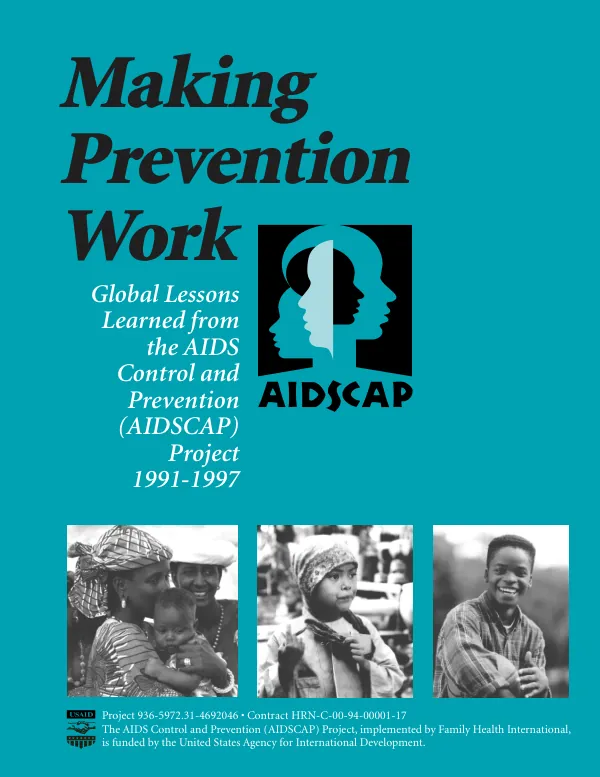
Making prevention work : global lessons learned from the AIDS control and prevention (AIDSCAP) project 1991-1997
Sign inFAMILY HEALTH INTERNATIONAL (FHI)
Making prevention work : global lessons learned from the AIDS control and prevention (AIDSCAP) project 1991-1997
Documents achievements of and lessons learned from the AIDS Control and Prevention (AIDSCAP) Project, implemented from 8/91 to 12/97.
1997
Sign in to readA free account is required to download.
Abstract
Through 584 projects and activities in 45 countries in Africa, Asia, and Latin America and the Caribbean, AIDSCAP trained more than 180,000 people in HIV/AIDS prevention skills and helped produce and disseminate 5.8 million videos, dramas, television and radio programs, advertisements, and printed materials reaching almost 19 million people. More than 254 million condoms were distributed or sold. Evaluations of programs in 19 countries suggest that these efforts had an impact on HIV knowledge and behavior. In Cameroon, for example, the proportion of male students who reported having sex with more than one partner dropped from 53% to 36% in 3 years. In Nepal, 62% of sex workers in the AIDSCAP intervention area reported using condoms with their most recent client in 1996 -- up from 35% in 1994 -- while reported condom use decreased among sex workers in non-target areas. In Jamaica, the majority of the population now reports some kind of behavior change to avoid HIV infection, and the percentage of 12- to 14-year old boys reporting sexual experience fell from 59% to 41%. Behavior change communication (BCC) was at the heart of all AIDSCAP interventions. Through TA, training, and a series of handbooks, the project promoted a shift from the old information, education, and communication (IEC) model to a more systematic approach that gives people the knowledge, skills, encouragement, and support they need for HIV risk reduction. BCC efforts used the results of epidemiological and social science research to design interventions that called on the talents of artists, writers, actors, producers, counselors, and community members. AIDSCAP was one of the first organizations to adopt STD prevention and treatment as a primary HIV/AIDS prevention strategy. The key accomplishment in this area was increasing the use of syndromic case management, an approach that has improved access to effective STD services for tens of thousands of people. The project also developed a methodology for conducting rapid ethnographic studies to improve communication between health care providers and their clients and tested several innovative approaches to expanding access to STD treatment. Although millions of free condoms were distributed, social marketing (SM) was the project's main strategy for increasing condom use. Using commercial distribution systems and marketing techniques, AIDSCAP and its partners sold more than 222 million condoms in 8 countries. AIDSCAP also revised the traditional SM model, developing innovative distribution strategies and opening thousands of nontraditional sales outlets to provide reliable, affordable condoms to those most at risk of HIV infection. At the policy level, AIDSCAP strengthened local capacity to inform and influence policy, and used analytic tools to influence the HIV/AIDS policies of governments, businesses, and religious organizations in Kenya, Tanzania, Senegal, Indonesia, the Dominican Republic, El Salvador, Honduras, and Nicaragua. Behavioral research laid the scientific foundation for effective HIV/AIDS prevention interventions and built the capacity of more than 150 social scientists and 100 institutions to conduct such research. The scale of the research ranged from small, program-related studies of behavior among specific populations to a large efficacy trial of voluntary HIV counseling and testing in 3 countries. Research studies and pilot efforts produced recommendations and models for addressing emerging issues such as the role of structural and environmental activities in HIV risk reduction, prevention options for women in stable relationships, and linkages between HIV prevention and care. AIDSCAP refined existing methods of HIV/AIDS evaluation and tested innovative methods. Detailed evaluation plans were designed for 19 country programs at the outset, and their implementation yielded important information and lessons for evaluators worldwide. Tools to overcome some of the limitations of assessing progress in HIV/AIDS prevention were also developed. In Bangkok, for example, AIDSCAP pioneered a survey methodology to monitor trends in risk behavior among different target groups; this technique has already been adapted in eight countries. An AIDSCAP Women's Initiative played an important role in raising awareness among policymakers and program managers about women's vulnerability to HIV infection and the need for more gender-sensitive prevention efforts. AIDSCAP used gender analysis and training to help project staff and implementing partners meet the needs of both men and women. It also worked with international and local women's organizations to empower women to protect themselves from HIV infection. AIDSCAP-sponsored research offered valuable insights into barriers to sexual communication, the role of peer support in sustaining use of the female condom, and ways to encourage dialogue between men and women. Management systems linking AIDSCAP headquarters, regional and country offices, and host country partners created the infrastructure needed for successful implementation of technical strategies. Besides creating systems for planning, monitoring, financial management, and reporting for the world's largest international HIV/AIDS program, AIDSCAP built the capacity of more than 500 organizations to design, implement, and evaluate their own prevention projects. Special initiatives were created to involve more local community-based organizations and U.S. PVOs in HIV/AIDS prevention, create indigenous NGOs to help sustain interventions, and develop models for integrating prevention into AIDS care and management programs. Since AIDSCAP's mandate was to build capacity in prevention, its experience in HIV/AIDS care and management was limited to a few pilot projects. In Tanzania, AIDSCAP integrated prevention and care into community-based programs in nine regions. Results suggest that programs are more effective when they address both prevention and care, but few studies have examined this linkage. An AIDSCAP study conducted in Tanzania -- one of the first to assess whether providing support for people with HIV/AIDS can encourage them to adopt prevention measures -- offers important guidance for policymakers and program managers. AIDSCAP was also one of the first organizations to address the heightened risk of HIV infection among mobile populations. Early interventions with truck drivers and their partners along major highways in Africa were expanded to reach sailors, migrant workers, military troops, and refugees. AIDSCAP's success in carrying out some of the world's earliest cross-border prevention projects in Asian border towns and port cities has inspired other donors to support and expand such efforts. And the first large-scale, early HIV/AIDS intervention in a refugee camp -- an AIDSCAP-sponsored demonstration project in Rwandan refugee camps in Tanzania -- has served as a model for reaching vulnerable refugee populations in other parts of the world. The bulk of the report details key lessons and specific recommendations for strengthening HIV/AIDS efforts in these areas, as well as challenges to be met by the next generation of HIV/AIDS programs. (Author abstract, modified)