DEVELOPMENT ASSOCIATES, INC.
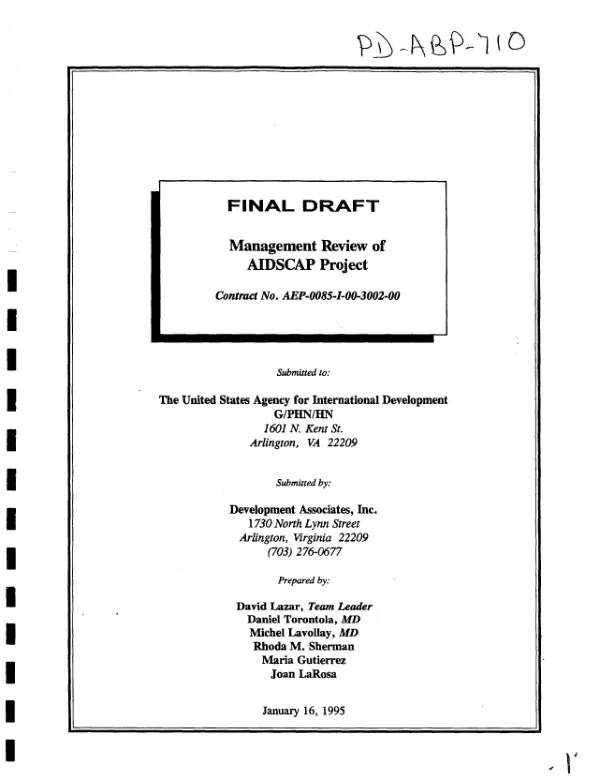
Management review of AIDSCAP project
Evaluates umbrella project to provide assistance in a broad range of areas related to AIDS prevention and control (AIDSCAP project).
Lazar, David|Torontola, Daniel · 1995
Sign in to readA free account is required to download.
Abstract
Evaluation covers the period 1987-1/95 against a PACD of 9/97. Although AIDSCAP is about a year behind schedule, a group of well-designed and promising subprojects (SPs) is now getting off the ground. Currently, AIDSCAP has projects in 17 priority countries and 27 associate countries in Asia, Africa, and Latin America and the Caribbean, some of them begun under predecessor programs AIDSTECH and AIDSCOM. AIDSCAP is designed around three primary strategies -- Behavior Change Communication (BCC), condom programming, and the reduction of sexually transmitted diseases (STDs) -- and three supporting strategies -- behavioral research, policy development, and evaluation. Programs in priority countries conduct activities under all six rubrics. In associate countries, a mix of some of these elements is tailored to country needs. These strategies focus on individuals rather than society at large, although AIDSCAP has recognized the need to shift somewhat in the latter direction. BCC activities, which aim to delay the onset of sexual activity among young people, decrease the number of their sexual partners, and increase appropriate STD treatment-seeking behavior and condom use/demand, appear carefully designed and methodically implemented. However, due to the frequent unavailability of either condoms, STD treatment drugs, or both (neither are provided under the project), some BCC activities have in effect motivated people to seek goods or services not available to them. By the end of 1994, AIDSCAP had assessed the status and trends of STDs and developed prevention and control strategies in 22 countries. AIDSCAP favors the "syndrome-based" approach at the "point of first encounter". In some countries, the medical profession resists this approach, preferring laboratory support, which, however, is not always available. (Several recommendations are made for reducing this resistance over time). AIDSCAP's efforts to create or strengthen STD diagnosis and treatment centers are commendable. AIDSCAP has completed condom programming in 17 countries and embarked on social marketing schemes for condoms in seven countries. As of 9/94, AIDSCAP was supporting more than 15,000 outlets for condom distribution. Overall, however, sustainable access to affordable/free condoms remains a serious challenge to AIDSCAP's work. Some USAID family planning programs are reluctant to expand condom distribution to serve AIDSCAP clientele, partly out of fear that associating condoms with AIDS and STDs might create resistance to their use for family planning purposes. Four thematic research grants and two commissioned research grants have been awarded. AIDSCAP also completed two research projects begun under the AIDSTECH program and initiated a series of narrower studies. Future research should focus on projects with narrow objectives, rapid turn-around time, and direct applicability to improving program delivery. The practice of allowing reviewers of research proposals to conduct AIDSCAP-funded research should be discontinued. Though most projects have increased outreach and coverage, they need to better define their target populations, both in qualitative and quantitative terms, and to refine their evaluation indicators and processes, as well as specify their primary purpose. AIDSCAP has produced a number of studies demonstrating the need for a strong national AIDS policy in several countries. In other countries, however, more work is needed to convince governments to accord a hierarchical position to AIDS organizations commensurate with the high priority placed on the problem itself. USAID pre-project appraisal documents should assess the likely interactions between forthcoming projects and HIV/AIDS. The widespread provision of TA to associate countries and to USAID Missions carrying out their own AIDS programs is exerting heavy pressure on AIDSCAP's Regional Offices, particularly in Africa and Asia. AIDSCAP should now consolidate its work and refrain from engaging in new country programs or projects. (Author abstract, modified)