 1986
1986USAID DEC
USAID. BUR. FOR SCIENCE AND TECHNOLOGY. OFC. OF HEALTH
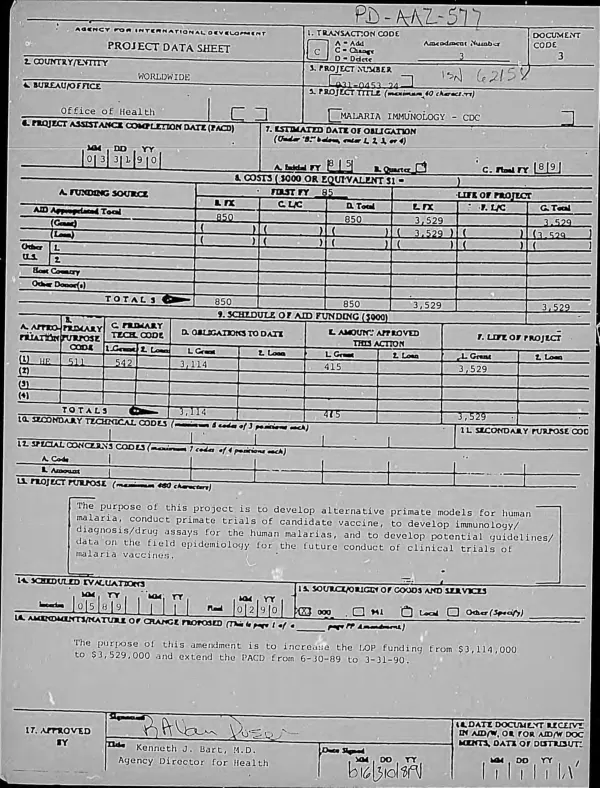
Project to develop an immunodiagnostic test to detect plasmodial malarial infection at clinical and subclinical (latent) levels.
1984
Abstract
KT and R Laboratories will conduct trials with Bolivian squirrel monkeys in order to develop an enzyme-linked immunosorbent assay (ELISA) which will enable rapid, simple, low-cost detection of specific blood plasma circulating antigens of malaria species. Strains of Plasmodium falciparum from Southeast Asia, Africa, and Central America adapted to and propagated in the squirrel monkeys will be used; these isolants represent a spectrum of chloroquine sensitive and resistant P. falciparum organisms. Blood samples for assay of parasitemia, antigen, antibody, and immune complexes will be collected regularly from clean (control) monkeys and from monkeys inoculated with P. falciparum - the latter before onset of infection, during early and overt phases, and following either natural recovery or chemotherapeutic cure, as the case may be. The P. falciparum strains will be propagated in cultures using homologous squirrel monkey erythrocytes and serum. Soluble antigens will be emulsified and then repeatedly injected into monkeys to produce a hyperimmune serum. This method will reliably produce monospecific anti-P. falciparum antibodies. P. falciparum soluble antigens will be prepared from cell culture supernatants and be used for initial standardization of the test on monkeys. Sera (or plasma) from primary P. falciparum human infection, positive for circulating antigen will be used as a standard antigen. The proposed version of ELISA is the DOT-ELISA system. Monospecific anti-P. falciparum IgG will be absorbed onto nitrocellulose membranes. After interaction with the test sample, an enzyme-labeled, monospecific antibody is added. Subsequent addition of a precipitate enzyme substrate leads to hydrolysis directly proportional to the amount of antigen in the test sample. A blue dot develops on the membrane, the intensity of which indicates degree of antigen concentration. The DOT-ELISA test will be evaluated under field conditions in human populations in malaria endemic areas of Colombia and Venezuela. Participants will include malaria-free individuals; suspected early cases; fulminating cases; clinically confirmed, naturally recovered cases; carriers; and chemotherapeutically cured cases.
Classification