ACADEMY FOR EDUCATIONAL DEVELOPMENT, INC. (AED)
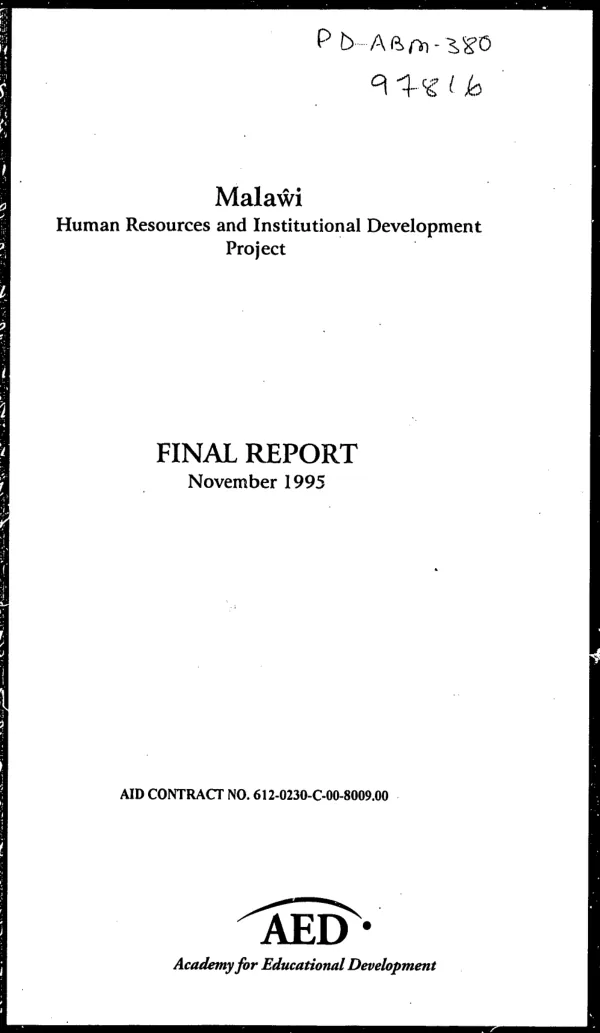
Malawi : human resources and institutional development project -- final report
Final contractor report on a project (3/88-9/95) to strengthen the capacity of postsecondary and nondegree training institutions in Malawi to provide technical, managerial, and professional training to public and private sector individuals.
1995
Sign in to readA free account is required to download.
Abstract
Considerable progress was made in strengthening human resources and in institutional development. Of particular note is the increased capacity of the University of Malawi, although significant progress has occurred in other institutions as well (e.g., Ministry of Local Government and Rural Development, Ministry of Works, Malawi Broadcasting Corporation, Malawi Bureau of Standards, Electricity Supply Commission of Malawi). Not everything went according to plan, but on the whole the pattern of results was encouraging. As the project comes to a close, a number of issues merit attention. (A) Design and implementation issues. This project was unique in adopting a process rather than a blueprint approach. Key elements of such an approach are to: develop and maintain consensus around the project vision and overall goals, phase in funding in a deliberate manner, help organizations carry out organizational needs assessments, maintain transparency in funding decisions and implementation management, provide for staff continuity on the project implementation team, establish a long-term timeframe, and apply blueprint approaches to the extent possible once funding allocations have been decided. (B) Participant trainee selection and management. Organizational performance and concern for multiplier effects should be primary criteria for training. Keep in touch with long-term participants during training. Emphasize in-country training to the extent possible. Develop a critical mass of trained individuals within organizations. (C) Role and use of TA. Give priority to assignments that train others and create sustainable systems and programs. Local counterparts are especially important for institutionalization and sustainability. For teaching positions, include responsibilities that will contribute to improved curricula and the introduction of new course materials. Make sure that essential support conditions and facilities are available to advisors. (D) Commodity support. Make sure that equipment specifications are thoroughly developed. Include installation, training, and maintenance agreements in procurements. Anticipate a minimum of 9 months for commodity procurements, as well as the need for ongoing technical support beyond the life of the project. Require the grantee institution to prepare a budget line for recurrent maintenance of equipment. (E) Sustainability. Concern for sustainability was addressed at every stage of this project. This included mutual goal-setting at the design stage, attention to counterpart training and skills transfer by TA personnel, and provision of at least minimal financial support by recipient institutions as well as counterpart staff for specific project activities. Other features to promote sustainability included: adopting a participative strategy for making funding decisions, encouraging potential recipient institutions to develop their own needs assessments and proposals for funding, maintaining close collaboration in implementing and monitoring specific activities, responding flexibly to differing and evolving needs of recipient institutions, and making organizational performance improvement the overriding criterion for funding.