USAID DEC
Malawi Teacher Professional Development Support (MTPDS) Program Monthly Newsletter October 2012 Issue
Sign inCREATIVE ASSOCIATES INTERNATIONAL INC.
Malawi Teacher Professional Development Support (MTPDS) Program Monthly Newsletter October 2012 Issue
The Malawi Teacher Professional Development Support (MTPDS) program is a 3-year USAID project supporting the professional development of teachers in Malawi and implementation of the National Primary Curriculum (NPC).
2012 · 4 pages
Sign in to readA free account is required to download.
Abstract
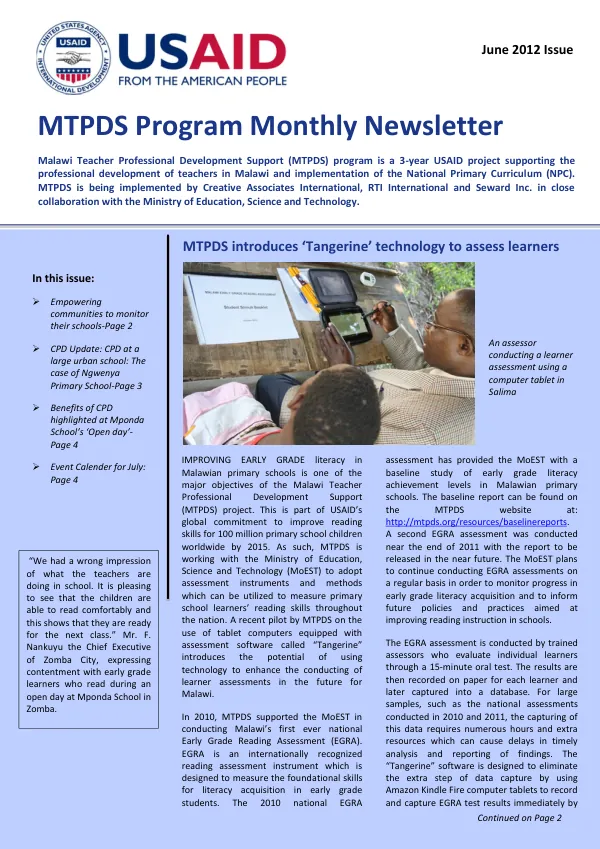
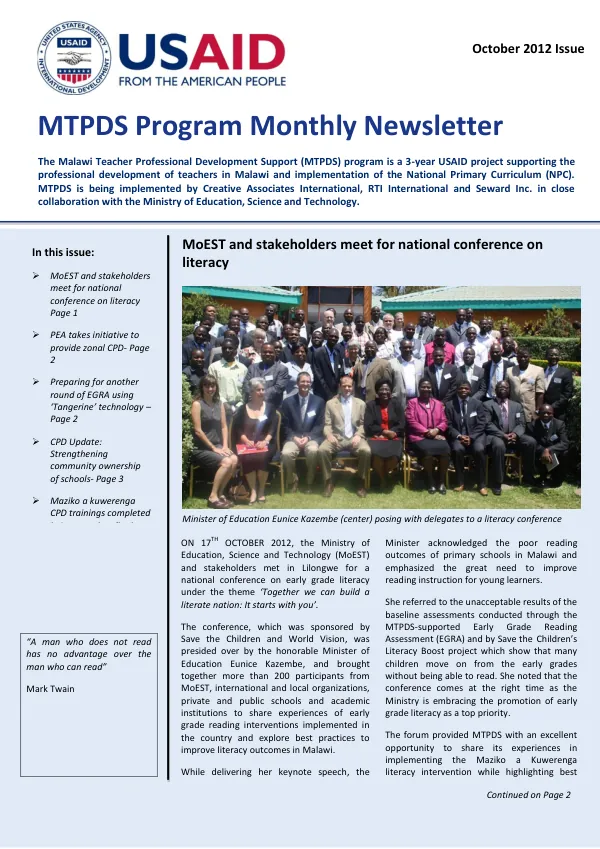
The program is being implemented by Creative Associates International, RTI International, and Seward Inc. in close collaboration with the Ministry of Education, Science, and Technology. The Minister of Education, Eunice Kazembe, acknowledged the poor reading outcomes of primary schools in Malawi and emphasized the great need to improve reading instruction for young learners. She referred to the unacceptable results of the baseline assessments conducted through the MTPDS-supported Early Grade Reading Assessment (EGRA) and by Save the Children's Literacy Boost project, which show that many children move on from the early grades without being able to read. The Minister noted that the conference comes at the right time as the Ministry is embracing the promotion of early grade literacy as a top priority. The national conference on early grade literacy, held on October 17, 2012, brought together more than 200 participants from the Ministry of Education, Science, and Technology, international and local organizations, private and public schools, and academic institutions. The conference provided a platform for sharing experiences of early grade reading interventions implemented in the country and exploring best practices to improve literacy outcomes in Malawi. MTPDS presented on the key components of the literacy intervention and reviewed assessment results showing significant improvements in reading scores in the intervention districts. The conference included presentations by Save the Children and World Vision International sharing their experiences implementing the Literacy Boost program along with plans to expand the activity into more zones and districts. A panel discussion featured the directors of Basic Education and Malawi Institute of Education, the USAID education team leader, and other development partners and academics, who discussed issues arising from the conference and explored ways to build upon international best practices while working to improve the current situation in Malawi. Breakout group discussions looked at the challenges and proposed possible solutions across the areas of teacher continuous professional development, continuous assessment in primary schools, and community involvement in school management. The Director of the Department of Inspection and Advisory Services closed the workshop by acknowledging the great support the Ministry is receiving from its partners and promised that the Ministry will take heed of concerns, recommendations, and comments from the workshop. The conference highlighted the importance of community ownership and involvement in school management, with the Director of the Department of Inspection and Advisory Services emphasizing the need for the community to take a more active role in supporting schools. In the Chimwalira Zone, the Primary Education Advisor (PEA) took the initiative to provide zonal CPD, recognizing the need for teachers to be charged and ready to deliver in class. The PEA organized a two-day Zonal CPD INSET for Standards 1 and 2 teachers in the zone, covering topics such as types of lessons, the five reading components, and the MaK lesson cycle. The training was facilitated by the PEA and key teachers, demonstrating the sustainability of the project intervention. MTPDS supported the Ministry in preparing for another round of EGRA using 'Tangerine' technology, training enumerators who will assess learners in schools for a period of three weeks. A total of 45 enumerators were drawn from various Ministry of Education, Science, and Technology departments and partners. The training workshop in Mponela saw enumerators practicing using the tablets to assess learners in nearby schools, with over 90% of participants reaching or surpassing the mark required to become a competent enumerator. The MTPDS Program also rolled out Leadership CPD Module 4, which aims to strengthen the role of communities in monitoring, evaluating, and supporting their schools. The module focuses on School Management Committees (SMCs) and Parent Teacher Associations (PTAs), providing them with a simple and effective way to collect data about teaching, learning, and assessment from teachers, head teachers, and directly from the classroom and school records. The School Assessment Tool is designed to be implemented collaboratively by SMCs and school staff to provide both with evidence of how the school is performing academically.