USAID DEC
Malawi Teacher Professional Development Support (MTPDS) Program Monthly Newsletter June 2012 Issue
Sign inCREATIVE ASSOCIATES INTERNATIONAL INC.
Malawi Teacher Professional Development Support (MTPDS) Program Monthly Newsletter June 2012 Issue
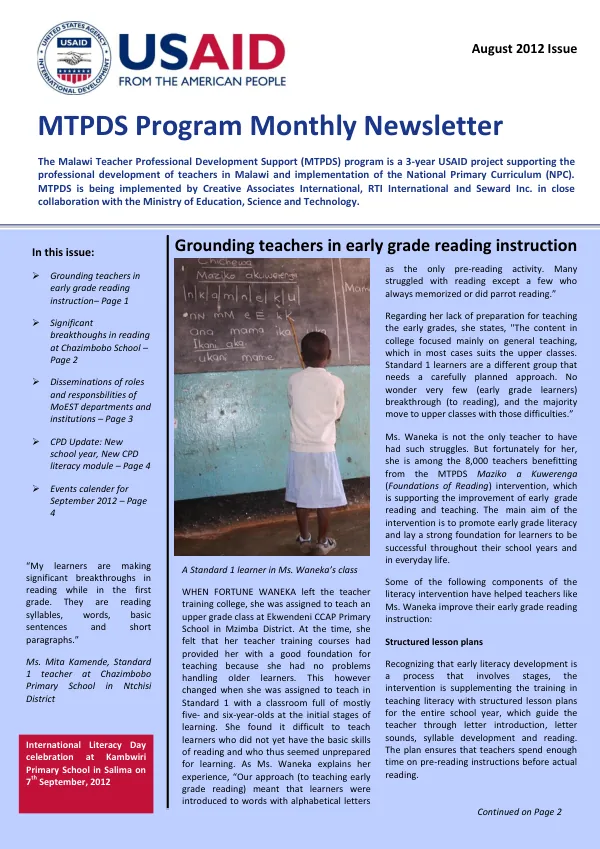
The Malawi Teacher Professional Development Support (MTPDS) program is a 3-year USAID project aimed at supporting the professional development of teachers in Malawi and implementing the National Primary Curriculum (NPC).
2012 · 4 pages
Sign in to readA free account is required to download.
Abstract
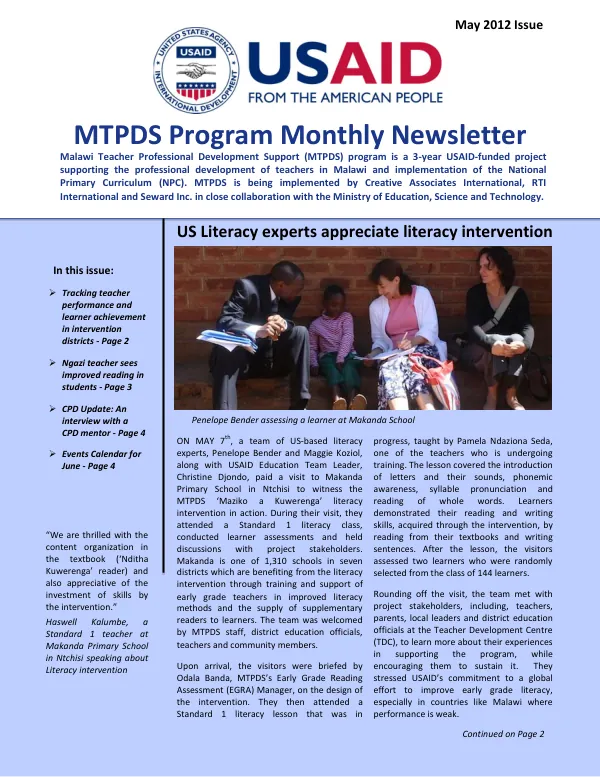
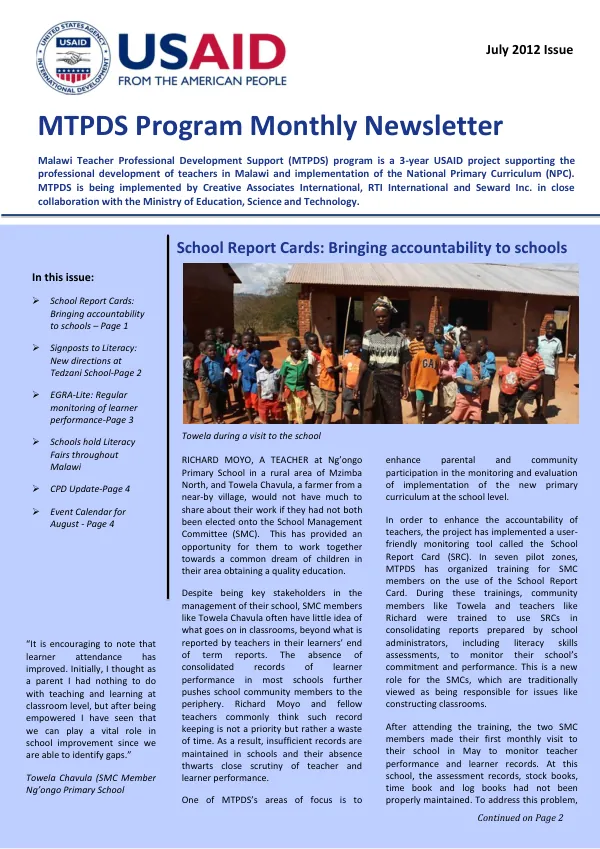
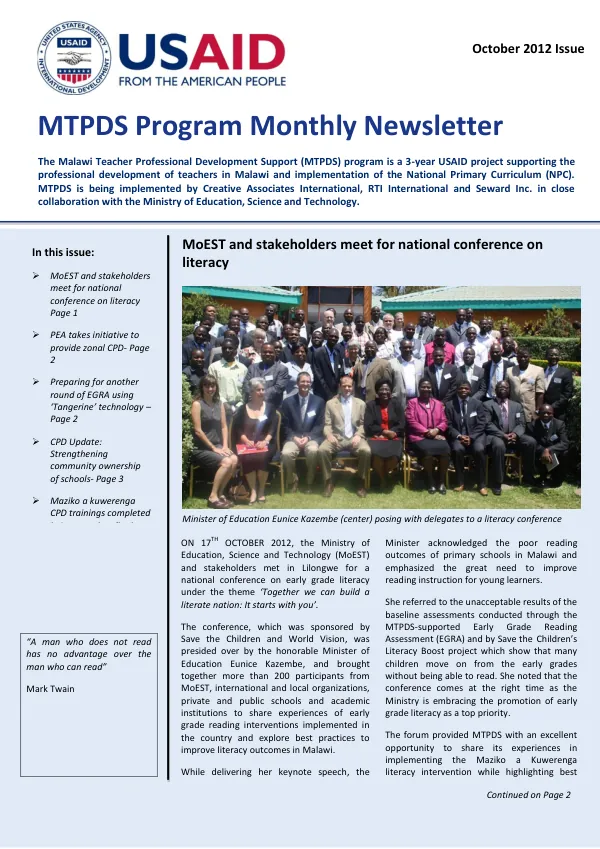
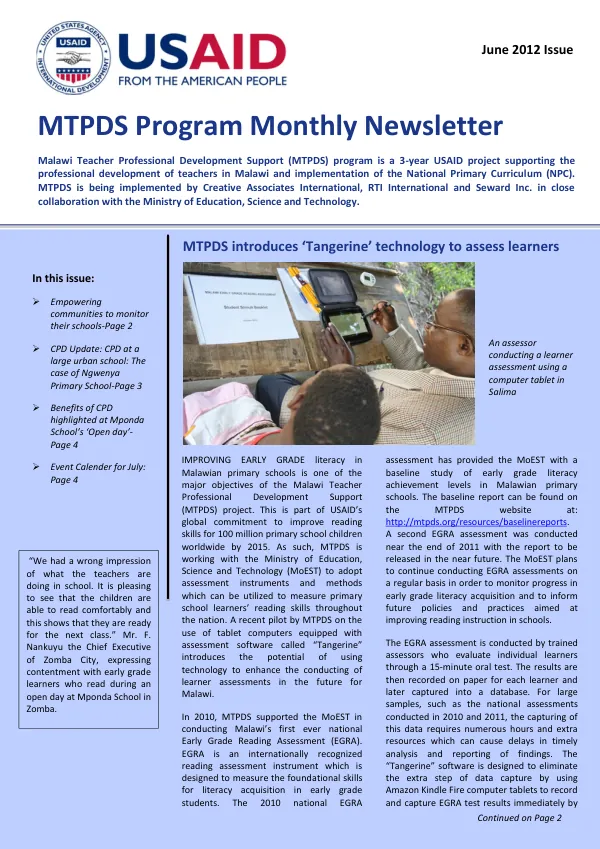
The program is being implemented by Creative Associates International, RTI International, and Seward Inc. in close collaboration with the Ministry of Education, Science and Technology. The MTPDS program has been conducting Early Grade Reading Assessments (EGRA) to measure the foundational skills for literacy acquisition in early grade students. The EGRA assessment is conducted by trained assessors who evaluate individual learners through a 15-minute oral test. The results are then recorded on paper for each learner and later captured into a database. To improve the efficiency of data capture, the MTPDS program has introduced the "Tangerine" software, which uses Amazon Kindle Fire computer tablets to record and capture EGRA test results immediately. A pilot activity was conducted using the "Tangerine" software to administer EGRA assessments with 200 randomly selected Standard 1 students in two literacy intervention districts: Salima and Ntchisi. The students were sampled from five randomly selected "coached" and five randomly selected "uncoached" schools in each district. The activity aimed to pilot the "Tangerine" software and measure the impact of different levels of literacy intervention activities being conducted by MTPDS in the intervention districts. Initial responses from assessors who used the new technology have been positive, indicating that the software and computer tablets are easy to use and reduce time and effort while in the field. The MTPDS program is also working to empower communities to monitor their schools by redefining the roles of School Management Committees (SMCs). SMCs were established to ensure a participatory and collaborative environment that encourages ownership at the school level. However, their role is often viewed as limited to mobilizing community support towards infrastructural improvement and other fundraising activities. The MTPDS program is working to transform this perception by training SMC leaders, school teachers, and Primary Education Advisors (PEAs) on the use of School Report Cards (SRCs) for monitoring teaching and learning in their schools. A one-day workshop was organized in selected education zones to train SMC leaders, school teachers, and PEAs on the use of SRCs. The training was facilitated by six MTPDS Divisional M&E Officers in their respective divisions. A total of 84 teachers and 81 SMC members were trained from seven zones, one zone from each of the MTPDS literacy intervention districts, with support from their respective PEAs. The content of the training has equipped SMCs with the tools and information necessary to make monthly visits to their schools and consolidate records, monitor teacher and learner attendance, and plan for activities that can respond to diverse and continuously changing needs of learners. The MTPDS program has also been working with Ngwenya Primary School to implement a Continuous Professional Development (CPD) program for its teachers. Despite the difficult conditions, the teachers at Ngwenya Primary displayed great resolve and dedication by moving forward with their CPD activities. The school's CPD mentor, Kenneth Sitolo, is new in the role since he took over in January 2012. To manage the MTPDS-organized CPD trainings at Ngwenya, the PEA responsible for the cluster, Bester Mphunda, splits the 102 teachers into two groups, and conducts the trainings in two separate sessions.