INTERNATIONAL FERTILIZER DEVELOPMENT CENTER
Mali L4G Monthly Report: August 2015
The Mali Livestock for Growth (L4G) program is a USAID-funded initiative aimed at improving the livestock sector in Mali.
2015 · 3 pages
Sign in to readA free account is required to download.
Abstract
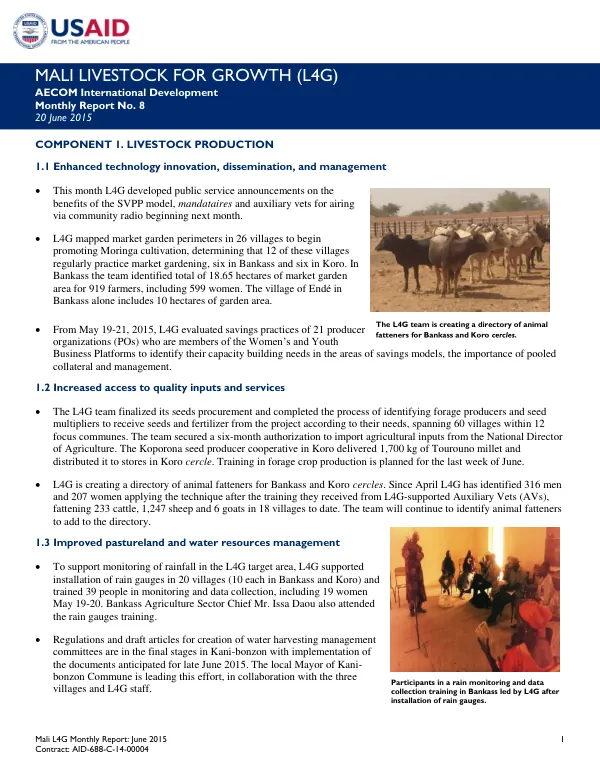
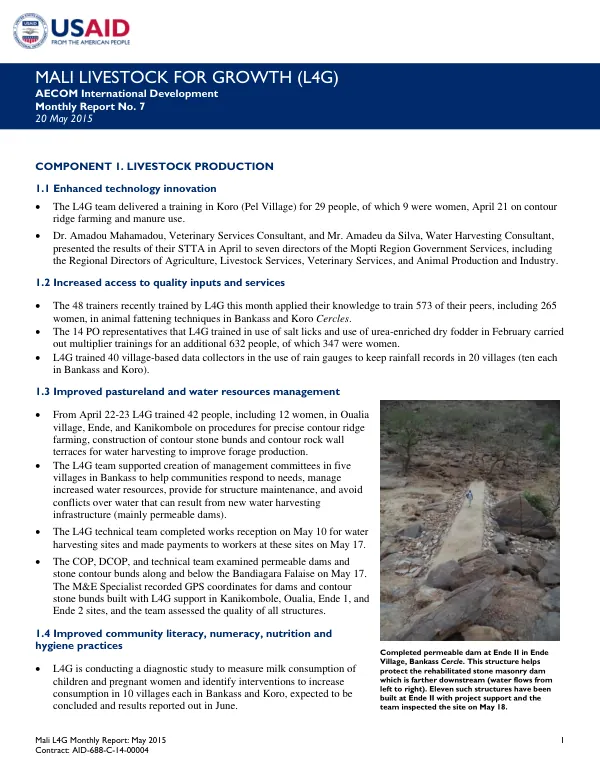
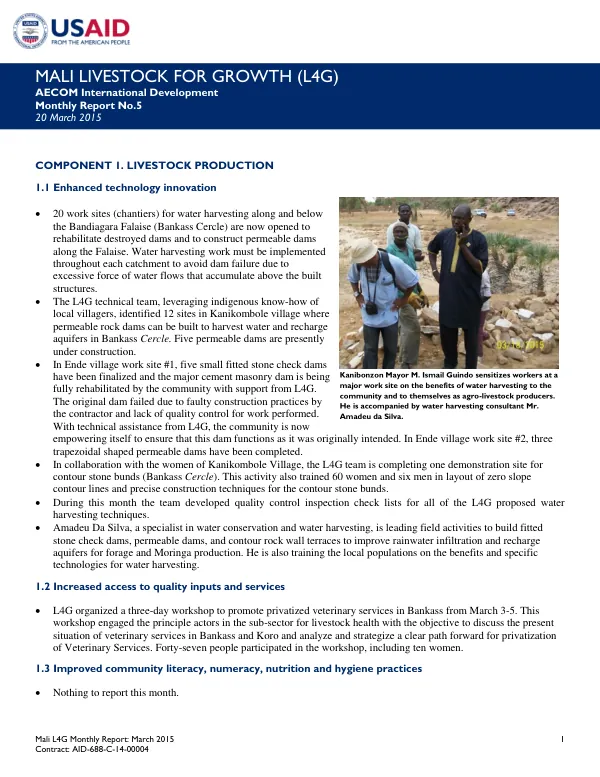
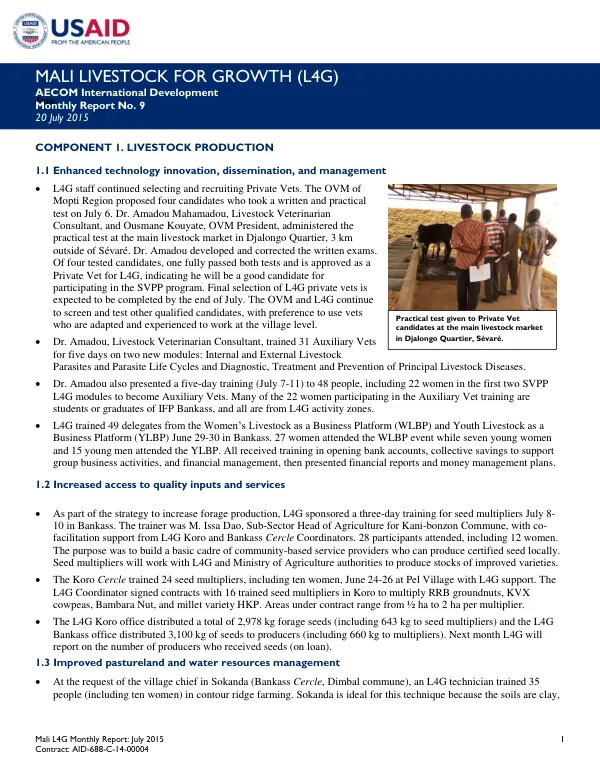
The program began in 2014 and is implemented by AECOM International Development. The program's main objective is to increase the productivity and profitability of the livestock sector, thereby improving the livelihoods of rural communities. The program is divided into five components: Livestock Production, Livestock Trade, Strengthened Local Capacities and Systems, Enabling Environment, and Operations and Human Resources. Component 1, Livestock Production, focuses on enhancing technology innovation, dissemination, and management. In August 2015, L4G-trained village animators taught contour ridge farming techniques to 20 individuals in Koro Cercle, resulting in the practice being applied to 1.75 hectares of land. Additionally, six producers were trained on contour ridge farming in Koumbogourou village, with members of the Women's Livestock as a Business Platform applying the technique to 0.5 hectares of land. Component 1 also focuses on increasing access to quality inputs and services. In August 2015, L4G distributed 4,746 kilograms of forage seeds and 9,000 kilograms of NPK fertilizer to 170 producer organization (PO) members in Koro Cercle, covering an estimated 298 hectares of land. In Bankass, 892 members of various POs received 7,422 kilograms of forage seeds and 10,050 kilograms of NPK fertilizer for an estimated 583 hectares of land. L4G also identified additional fertilizer suppliers in Koro and Bankass Cercles, as well as eight suppliers for livestock feed in Bankass. Component 2, Livestock Trade, focuses on strengthening market linkages and access. In August 2015, L4G prepared terms of reference for a study on trade and non-tariff barriers to livestock export and payment of illicit taxes. The study aims to identify procedures and regulations used in livestock export, institutions dealing with it, and difficulties faced, as well as propose actions to reduce trade barriers and time lost. L4G also developed a partnership convention with Premiere Agence de Microfinance (PAMF) to collaborate on possible support to microfinance for individuals and PO members and alternative loan mechanisms for animal fattening. Component 4, Strengthened Local Capacities and Systems, focuses on strengthening the capacity of livestock value chain actors. In August 2015, the third Livestock Value Chain Workshop took place in Bamako, with 45 participants, including six women. The workshop aimed to define the general concept of a value chain, present and share the inclusive L4G livestock value chain approach, and consider proposals and contributions from participants to finalize and validate the L4G value chain approach. L4G also identified private and public sector actors to support in Koro and Bankass, including private vets, cooperatives, exporters, input suppliers, and forage seed growers. Component 5, Enabling Environment, focuses on increasing the capacity of civil society for policy analysis and advocacy. In August 2015, the livestock value chain workshop permitted advocacy at the Bamako level for minimizing "rent seeking" at the Malian border and other checkpoints. Discussions included establishing a "green" telephone line to register complaints against being obliged to pay bribes and enforcing existing legislation banning the use of plastic bags. The program also has an Operations and Human Resources component, which focuses on strengthening the capacity of L4G staff and partners. In August 2015, L4G attended the fourth USAID partners meeting in Sévaré and traveled to Timbuktu to assess and select six Feed the Future (FTF) communes for expansion of L4G activities. The program also has a Monitoring and Evaluation component, which focuses on tracking progress and identifying areas for improvement. In August 2015, the L4G M&E Specialist identified 36 Village Animators, water harvesting crew leaders, and Auxiliary Vets, including 12 women, with a necessary level of education to be trained on data collection techniques to support data collection for L4G indicators.
Related documents