USAID
Mali L4G Monthly Report: June 2015
The Mali Livestock for Growth (L4G) program, implemented by AECOM International Development, aims to improve livestock production and trade in Mali.
2015 · 2 pages
Sign in to readA free account is required to download.
Abstract
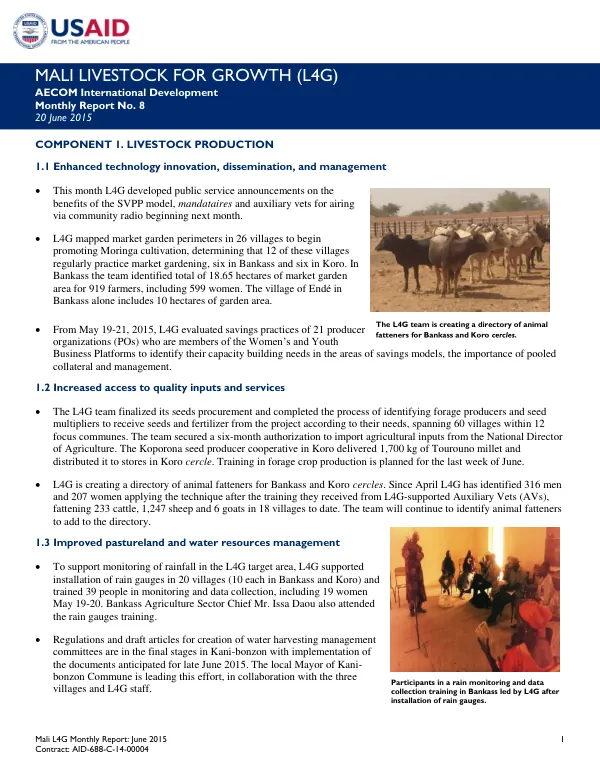
The program focuses on enhancing technology innovation, increasing access to quality inputs and services, improving pastureland and water resources management, and strengthening local capacities and systems. In June 2015, L4G developed public service announcements on the benefits of the SVPP model, mandataires, and auxiliary vets for airing via community radio. The team also mapped market garden perimeters in 26 villages to promote Moringa cultivation, identifying 12 villages that regularly practice market gardening. In Bankass, the team identified a total of 18.65 hectares of market garden area for 919 farmers, including 599 women. The village of Endé in Bankass alone includes 10 hectares of garden area. L4G evaluated savings practices of 21 producer organizations (POs) who are members of the Women's and Youth Business Platforms to identify their capacity building needs in the areas of savings models, pooled collateral, and management. The team also finalized seeds procurement and completed the process of identifying forage producers and seed multipliers to receive seeds and fertilizer from the project. The Koporona seed producer cooperative in Koro delivered 1,700 kg of Tourouno millet and distributed it to stores in Koro cercle. The L4G team is creating a directory of animal fatteners for Bankass and Koro cercles, with 316 men and 207 women identified as applying the technique after receiving training from L4G-supported Auxiliary Vets. The team also installed rain gauges in 20 villages and trained 39 people in monitoring and data collection, including 19 women. Regulations and draft articles for creation of water harvesting management committees are in the final stages in Kani-bonzon, with implementation anticipated for late June 2015. In the area of community literacy, numeracy, nutrition, and hygiene practices, L4G conducted nutrition and hygiene diagnostic studies in 26 villages, with results indicating that 548 people are categorized as having acute malnutrition in 13 villages. The team is exploring the introduction of Moringa to reduce malnutrition in existing or new gardens. L4G is also conducting hygiene surveys to collect data needed for program indicators and collaborating with other hygiene/WATSAN FTF partners. The team took an inventory of schools in 26 villages to inform planned school garden activities to introduce Moringa.
Related documents