ACADEMY FOR EDUCATIONAL DEVELOPMENT, INC. (AED)
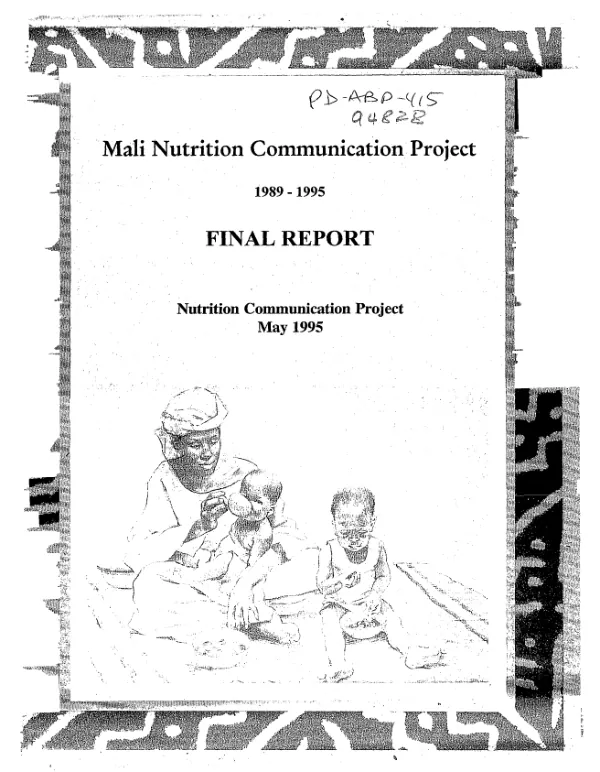
Mali : nutrition communication project, 1989-1995 : final report
Final report of the contractor, Academy for Educational Development (AED), on efforts of the Nutrition Education Project (NCP) in Mali (1989-95), to improve the nutritional status of women and young children in rural areas.
Gottert, Peter · 1995
Sign in to readA free account is required to download.
Abstract
Mali activities, which benefitted from cross-fertilization with NCP programs in Niger and Burkina Faso, took place in three phases. Under the first phase, Program Development (1989-91), major activities included audience research, a baseline survey, and strategy development together with the Ministry of Health (MOH) and three PVOs (CARE, Africare, and World Vision), which became known as the Nutrition Network. Initial emphasis was on developing a village-based counseling approach and preparing a first round of educational materials. Under the second phase, Expansion (1991-93), the project trained an expanded number of PVO Child Survival Project teams to mount nutrition communication activities. Results of the baseline knowledge, attitudes, and practices (KAP) survey led to a refining of behavioral targets and development of additional communication materials. The Nutrition Network grew to include 3 government ministries, 10 local and international PVOs, and several key donors, including UNICEF. The third phase, Consolidation (1993-95), focused on implementing the broadcast, primary school, and literacy strategies. During this period, the Nutrition Network organized regular project planning meetings, and implementation responsibility was gradually transferred to the National Center for Health Information, Education, and Communication (CNIECS). When NCP ended, UNICEF became the sole funding source of program activities, which continued under the new name, Communication Program for Family Well Being. The program eventually reached a population of about 760,000. Results of the final survey indicate that NCP improved maternal diet, child feeding behavior, and children"s growth. For example, the prevalence of malnutrition was reduced 26% in trial villages, while remaining virtually unchanged in comparison villages; and chronic malnutrition (stunting) was reduced by 33% in trial villages, while there was no significant change in comparison villages. In addition, giving children colostrum (first breastmilk) more than doubled in trial villages, compared with a 12% change in comparison villages; and the number of mothers in trial villages not giving infants water until after 4 months doubled over baseline, compared with a 6 point change in comparison villages. Also, mothers in trial villages were far more likely to introduce, and in a timely fashion, porridge, fruit, green leafy vegetables, cow"s milk, and meat or liver into a child"s diets than mothers in comparison villages. Moreover, there was a positive relationship between these improvements and the length of time a village participated in NCP improvements. Lessons learned were as follows. (1) Within rural Malian communities, improvements in nutritional status do not require increases in household income and can be obtained with low-cost communications added to child survival programs. NCP improved the chances for the 750,000 Malians participating in the community-based program, while the radio broadcasts had the potential of reaching any Bambara speaker in this country of 9 million people. The reduction in child malnutrition alone achieved through NCP activities is estimated to have prevented the deaths of approximately 850 children per year by the end of the project. (2) By linking up with ongoing programs, NCP was able to tap into existing momentum, reduce startup time, and benefit from the foundation of trust and an environment favorable to change established by locally-active PVOs. (3) A series of skills-building workshops and a wide variety of educational materials enabled and encouraged community health agents to expand the scope of their community work to include nutrition. Counseling cards which complemented the flipcharts were used without difficulty by both literate and non-literate village volunteers. Volunteers reported that using the cards increased their credibility and prestige in the village. (4) NCP"s design, in which interventions were implemented by well-established international PVOs and then expanded to the MOH and other PVOs, facilitated the progressive transfer of responsibility for activities to national team members working within CNIECS. Following 4 years of collaboration, the technical capacity and the reputation of the CNIECS grew impressively and PVO health projects have increasingly sought its assistance with materials development, radio production, and training.
Related documents
Documents in this collection
 1970
1970USAID DEC
Final report : NCP nutrition communication project -- nutrition education and social marketing field support project
Open record![Helen Keller International : nutrition-focused child survival project in Koulikoro Region, Mali (health districts of Koulikoro, Kolokani, Kati, Ouelessebougou) -- [CS-15 third] annual report, 30 September 2001-29 September 2002 : cooperative agreement no. FAO-A-00-99-0015-00 [i.e. FAO-A-00-99-00015-00]](https://covers.devme.ai/gen/57911.webp) 2002
2002USAID DEC