CHEMONICS
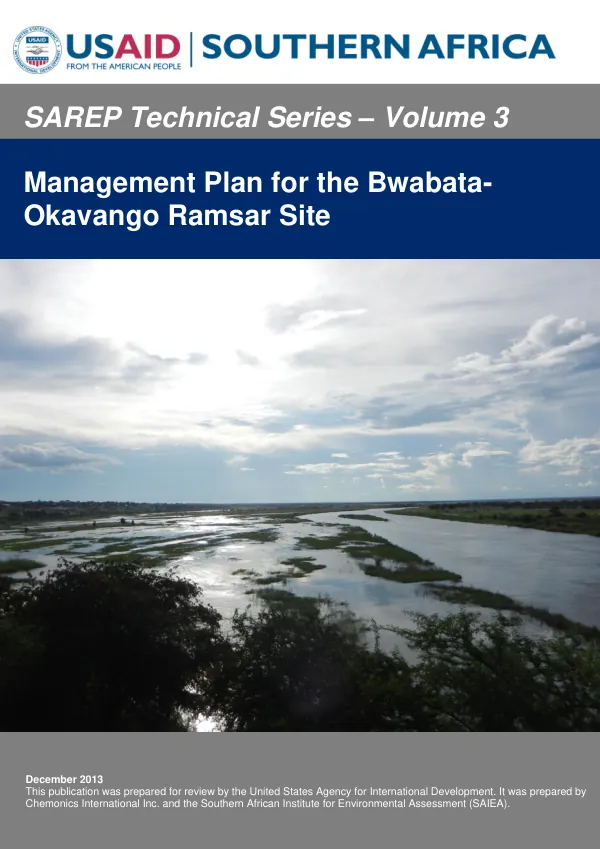
Management Plan for the Bwabata-Okavango Ramsar Site
The Bwabwata-Okavango Ramsar Site is located on the lower Okavango River in Namibia, centered on the Mahango and Buffalo core areas of Bwabwata National Park.
2013 · 75 pages
Sign in to readA free account is required to download.
Abstract
The site encompasses approximately 1,000 square kilometers of wetlands, including floodplains, riverine forests, and grasslands. The area is characterized by a diverse range of habitats, including aquatic and terrestrial ecosystems, which support a wide variety of plant and animal species. The site's geographic context is influenced by the Okavango River, which flows from Angola into Botswana and Namibia. The river's annual flood pulse creates a dynamic and diverse environment, supporting a range of aquatic and terrestrial species. The site's location within the Kavango Zambezi Transfrontier Conservation Area (KAZA) and the Okavango Delta Management Plan (ODMP) highlights its importance as a regional conservation priority. The management plan for the Bwabwata-Okavango Ramsar Site was developed by a team led by the Southern African Institute for Environmental Assessment (SAIEA) in collaboration with various stakeholders, including government agencies, local communities, and nongovernmental organizations. The plan sets out the management strategies and activities for the site, with a focus on conserving wetland habitats and their associated ecological processes and biodiversity. Effective management of the site will ensure that wetland habitats and their associated ecological processes and biodiversity are conserved, corridors for regional wildlife migration are safeguarded, economic growth provided by the Ramsar site is secured and optimized, and access to this area of the Okavango River for Namibian and international visitors is managed sustainably. The overall vision for the site is to manage the wetlands and associated ecosystems in collaborative ways while enhancing socioeconomic development, for the sustained benefit of people and the environment. Based on the existing policy and legal context for the Ramsar site, the plan presents priorities for administration, local development, and monitoring. Administration priorities include establishing a joint committee with Botswana counterparts to collaborate on management of the Ramsar site, establishing a Bwabwata West Advisory Committee as a forum for collaboration with other ministries and stakeholders, and collaborating with the Okavango River Basin Commission to play an active role basin-wide in planning and development. Local development priorities include phasing out hunting in the Mahango Core Area and moving it into the neighboring conservancy, prohibiting recreational and tourism boating on the Okavango River in the park, increasing the road network in the Mahango Core Area that is not linear to the river and accesses the inland pans, and setting a limit on the number of tourists using the Ramsar site based on limits of acceptable change. Monitoring priorities include collaboratively monitoring rainfall, river water quantity and quality, vegetation, important wildlife species, illegal activities, and fires, setting levels/limits of acceptable change and management responses, and maintaining an overview of upstream plans, proposals, policies, and potential developments that might impact the Ramsar site. Awareness raising priorities include preparing awareness materials on the value and benefits of the Ramsar site for government officials and the public alike, and holding awareness events with local communities, in line with the MET's parks and neighbors policy.