AFRICAN WILDLIFE FOUNDATION
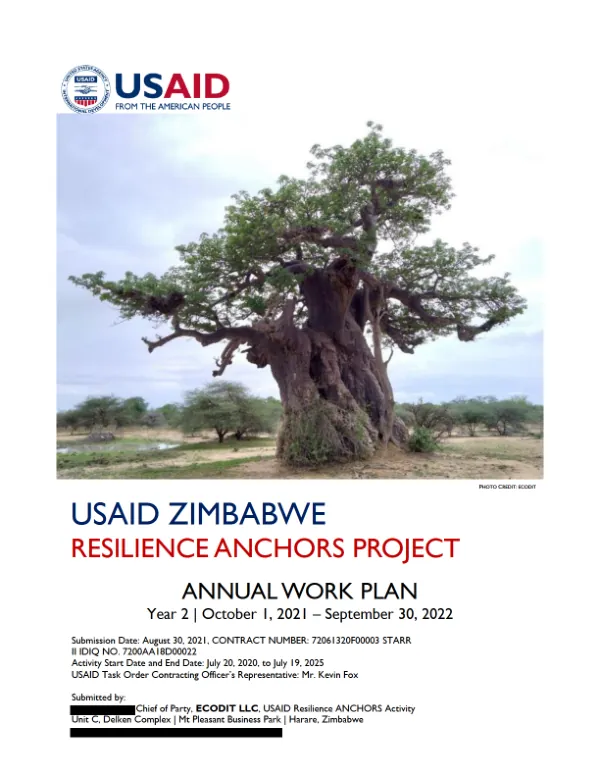
USAID Zimbabwe Resilience ANCHORS Activity | Annual Work Plan Y2 | August 2021
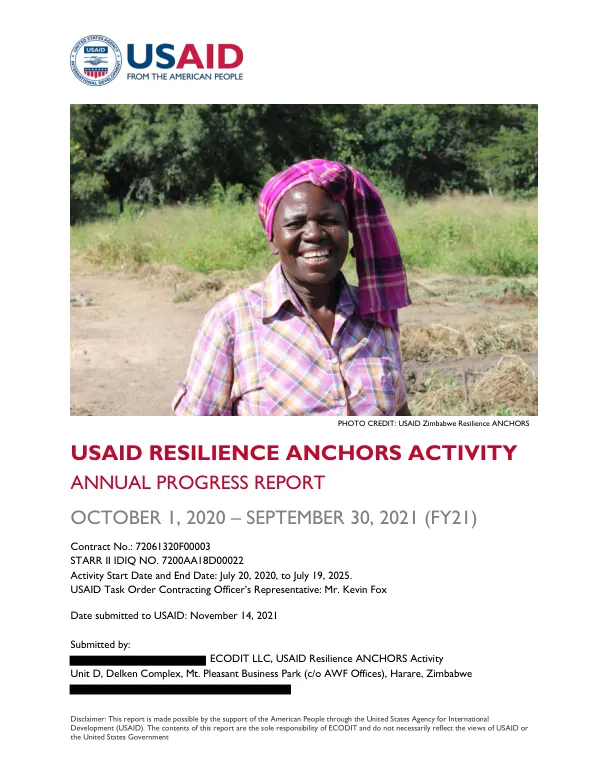
The Resilience ANCHORS Activity is a USAID-funded project aimed at supporting communities in Zimbabwe's Southeast Lowveld (SEL) to use their wildlife and natural resources in a viable basis for building long-term resilience against climate and economic shocks and stressors.
2021 · 32 pages
Sign in to readA free account is required to download.
Abstract
The project targets six wards in Bikita, Chiredzi, and Chipinge districts, with a focus on wards 1 (Gudo) and 23 (Nyangambe) in Chiredzi, wards 25 and 26 (Devure) in Bikita, and wards 29 (Maparadze) and 30 (Mahenye) in Chipinge. The project's geographic focus is on the 344,210-hectare Savé Valley Conservancy (SVC) and Gonarezhou National Park (GNP) landscapes, which form part of the Great Limpopo Trans-Frontier Conservation Area (GLTFCA). The SVC was established in 1991 and consists of 30 land titles that form 22 management properties. However, the land reform program, which started in SVC in 2000, has affected the conservancy's ability to maintain strong governance, management, and relations with communities, government, and other stakeholders. The project's purpose is to support communities around the SVC and GNP landscapes to use their wildlife and natural resources in a viable basis for building long-term resilience against climate and economic shocks and stressors. The project will focus on strengthening law enforcement, combating poaching, and supporting community conservancies in the SVC landscape. AWF's work in SVC will also support conservation in Zimbabwe since 1999, mainly in the Savé and Zambezi Valley landscapes. The project has formed a well-rounded consortium to support its activities, with the African Wildlife Foundation (AWF) as the lead subcontractor. AWF has a Memorandum of Understanding (MOU) with the Zimbabwe National Parks and Wildlife Management Authority (ZimParks), citing the SVC landscape as a priority area for its interventions. AWF's current 10-year organizational strategy builds around three interlinked goals of promoting African leaders to drive a shift in policy, planning, and finance to leverage wildlife and wildlands as essential to development; conserving, protecting, and restoring Africa's ecosystems and the services they provide; and conserving Africa's wildlife in situ and reducing poaching and trafficking as a major cause of wildlife decline. The project will also focus on strengthening environmental law, water, and natural resources governance to benefit targeted communities. ZELA and ELI will support Resilience ANCHORS through strengthening local level policy and legal frameworks related to land use and natural resource management; building the capacity of community-based resource governance institutions; and building the capacity of communities, local authorities, and other landscape stakeholders to effectively participate in policy making, to protect resource tenure rights, and to hold duty bearers accountable. The project's implementation will be based on the Activity Scope of Work (ASOW) and the Environmental Monitoring and Mitigation Plan (EMMP) for the SVC and GNP landscapes. The project will also reflect timelines for the implementation of crosscutting and coordination activities such as those falling under the Monitoring, Evaluation and Learning (MEL) Plan, the Collaborating, Learning and Adapting (CLA) Strategy, and the Communications Strategy. The project's budget for FY22 is outlined in the Budget Summary FY22, which is included in the Annexes section of the document. The project's timeline of activities for FY2 is also outlined in the Timeline of Activities in FY2, which is included in the Annexes section of the document. The project's key results matrix is outlined in Table 1, which is included in the Annexes section of the document.
Related documents