USAID. MISSION TO UGANDA
Manpower for agricultural development
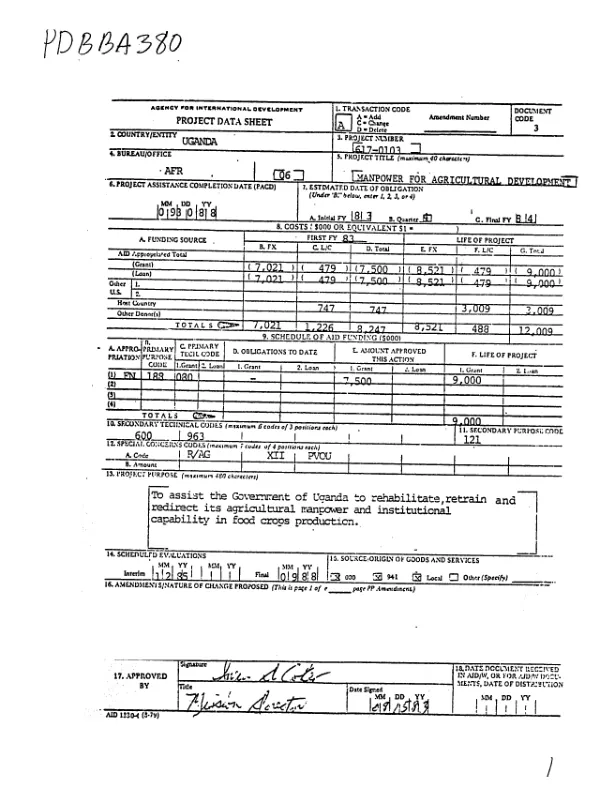
Project to help the Government of Uganda (GOU) to redirect its agricultural personnel and institutions toward improving food crop production.
1983
Sign in to readA free account is required to download.
Abstract
The Ministry of Agriculture and Forestry (MAF) and the Makerere University Faculty of Agriculture and Forestry (FAF) will implement training, research coordination, and facility upgrading activities. To create a leadership group responsible for planning and implementing the GOU"s agricultural R&D program, the project will provide 3-4 month in-service retraining for 87 senior-level professionals (42 from the FAF, 40 from the MAF, and 5 from the Ministry of Regional Cooperation) who hold Ph.D., M.Sc., or, in a few cases, B.Sc. degrees. To establish research priorities and link research with extension, six FAF members -- one each from the agricultural economics, agricultural engineering, crop science, soil science, animal science, and forestry departments -- will be selected to act as extension specialists; following U.S. training, these six will help FAF scientists to prepare publications, will conduct in-service training, and will work with FAF and MAF extension services. The project will fund up to five seminars at the FAF in which educators and scientists from U.S. universities and international research centers will participate. The project will also fund a limited number of research proposals related to food production and approved through the MAF, the Makerere research committee, and the National Research Council. The project will rehabilitate and re-equip research, teaching, and office facilities. Rehabilitation will cover: selected buildings at FAF headquarters (and its Kabanyolo Farm station) and Serere Research Station (SRS); quarters for project advisors (4 professionals, providing 13 person-years, and 4 PVO volunteers); and SRS farm facilities (a greenhouse, piggery, dairy facilities, and cattle dip tanks). Research equipment, which has suffered from limited maintenance and inadequate parts replacement during the turmoil of the past decade, will be renovated or replaced as needed. Amendment of 3/85 increases funding to cover, inter alia, the higher than expected costs of the contract with Ohio State University (OSU) to provide TA and participant training, and a 25% danger pay for OSU employees working in Uganda. (PD-ABP-202) Amendment of 7/28/86 decreases funding by $3.2 million to make funds available for Uganda"s resettlement and rehabilitation program (following the 1985/86 coup d"etat and civil war). Participant training will be reduced by about 50%, other inputs (facility upgrading, seminars, staffing, TA, commodities) less drastically. To further support Ugandan rehabilitation and because of its research importance, Kawanda Research Station, located in the war-torn Luwero Triangle, will be included in the project. (PD-BBD-487) Grant amendment of 5/10/88 authorizes Phase II (1988-93). At the University of Makerere, emphasis will be on training additional FAF faculty and on curriculum development for the Department of Agricultural Economics, the weakest FAF department. Activities will include U.S. training of 12 Ph.D."s (in agricultural engineering, agricultural economics, and soils, crop, and animal science) and U.S. or African training of 4 M.Sc."s in agricultural education/extension; all trainees will conduct their degree research in Uganda. The project will also provide up to 24 months of short-term, out of country training and will finance rehabilitation, and possibly construction, of facilities at the Makerere campus and Kabanyolo Farm. Secondly, Phase II will support adaptive, farming systems research aimed at developing and extending to farmers technology packages for food crops (maize and oilseeds, particularly sunflower and soybeans or other grain legumes). Research will be conducted under the aegis of a National Agricultural Research Organization (NARO) -- a semi-autonomous entity which is in the process of being established. Training will include Ph.D."s for 10 MAF researchers and M.Sc."s for 10 others, along with up to 40 months of short-term, out of country training. The project will also help to finance completion of facilities at Namulonge and Kawanda research stations and construction of a headquarters for NARO. Finally, OSU (using funding from non-project sources) plans additional activities to establish a long-term institutional relationship with Makerere involving training, information and faculty exchanges, and collaborative research. (PD-BBL-728)