UNIVERSITY OF PRETORIA
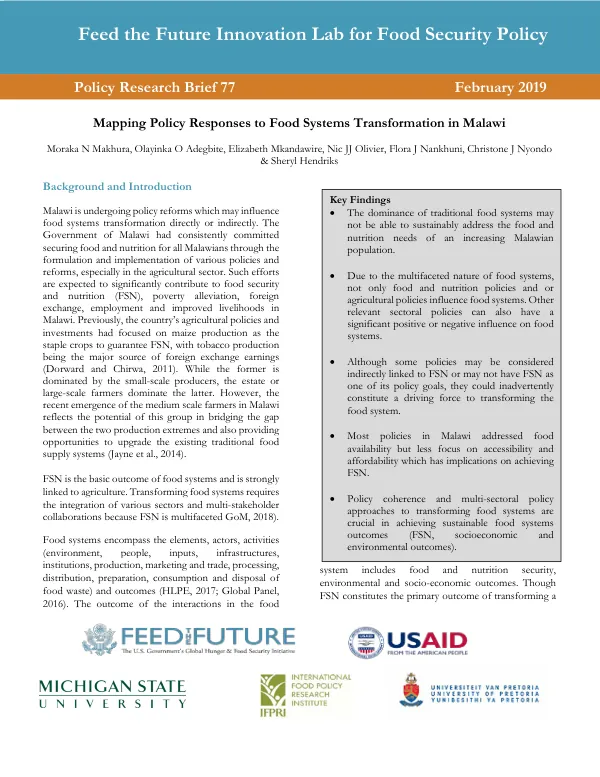
Mapping Policy Responses to Food Systems Transformation in Malawi
Malawi's agricultural policies and investments have historically focused on maize production as the staple crop to guarantee food and nutrition security (FSN).
2019 · 8 pages
Sign in to readA free account is required to download.
Abstract
However, the country's agricultural sector is dominated by small-scale producers, while large-scale farmers dominate tobacco production, which is the major source of foreign exchange earnings. The emergence of medium-scale farmers in Malawi reflects the potential of this group in bridging the gap between the two production extremes and providing opportunities to upgrade the existing traditional food supply systems. Food and nutrition security is the basic outcome of food systems and is strongly linked to agriculture. Transforming food systems requires the integration of various sectors and multi-stakeholder collaborations because FSN is multifaceted. Food systems encompass the elements, actors, activities, and outcomes that include food and nutrition security, environmental, and socio-economic outcomes. The outcome of the interactions in the food system includes food and nutrition security, environmental, and socio-economic outcomes. The dominance of traditional food systems may not be able to sustainably address the food and nutrition needs of an increasing Malawian population. Due to the multifaceted nature of food systems, not only food and nutrition policies and agricultural policies influence food systems. Other relevant sectoral policies can also have a significant positive or negative influence on food systems. Although some policies may be considered indirectly linked to FSN or may not have FSN as one of its policy goals, they could inadvertently constitute a driving force to transforming the food system. Most policies in Malawi addressed food availability but less focus on accessibility and affordability, which has implications on achieving FSN. Policy coherence and multi-sectoral policy approaches to transforming food systems are crucial in achieving sustainable food systems outcomes. The transformation of the food system in Malawi is required to sustainably address socio-economic and environmental challenges. Furthermore, the food system should advance from just providing enough food to supplying diverse nutritious and healthy diets. The study mapped policy linkages with the elements of food systems transformation in Malawi by adopting the conceptual framework for food systems. The mapping analysis revealed that 52% of the mapped policies were directly linked to FSN. All the investigated policies - whether directly or indirectly linked to FSN - addressed at least one area of food systems intervention. This confirms that FSN is a priority in Malawi's development agenda. Based on the interconnections of policies with the elements of food systems transformation, the mapping analysis revealed that the majority of the identified policies were connected with the drivers element of the food system, followed by the food supply chain, consumer behavior, and food environment. The findings suggest the need for increased sensitivity to how various policies may affect food systems transformation and the need to balance policy influence across food systems components in meeting FSN policy targets in Malawi. While previously much focus had been on policy interventions in improving the food supply chains, the results indicated that though some policies may be considered indirectly linked to FSN or may not have FSN as one of its policy goals, they could inadvertently constitute a driving force to transforming the food systems. The main drivers highlighted in various policy documents were innovation, technology, and infrastructure (59%), financial inclusion, systems development, and resource mobilization (56%), climate change, natural resource, and risk management (49%). Conversely, food prices and volatility (32%), population growth, urbanization, and migration (10%), emergency and food crises, and aids (5%) were issues of lower priority in the policies. Given the roles of financial inclusion (risk mitigation, socio-economic empowerment, and development) and its spillover effects in an economy, efforts aimed at driving food systems transformation in Malawi should consider the expansion of innovative agricultural and rural finance services and products and the development of innovative financing mechanisms for food systems transformation. The results of the mapping analysis of the food supply chain revealed that most (86%) of the policies that focused on the food supply chain in Malawi emphasized production systems, followed by processing and packaging (55%), markets (48%), input supply (45%), and storage and distribution (25%). The results imply the need for policies to address agricultural value chain development and financing of its implementation. While the development of the production system is crucial, it is not synonymous with the development of the entire food supply chain system; other elements of the food supply chain are equally important and require policy attention.
Related documents
Documents in this collection
 2018
2018USAID DEC
Feed the Future Innovation Lab for Food Security Policy Policy Research Brief 65 Analysis of the Value Chains for Root and Tuber Crops in Malawi: The Case of Cassava
Open record 2018
2018USAID DEC
![NAPAS:Malawi Annual Work Plan [FY2016]](https://covers.devme.ai/gen/145459.webp)