USAID DEC
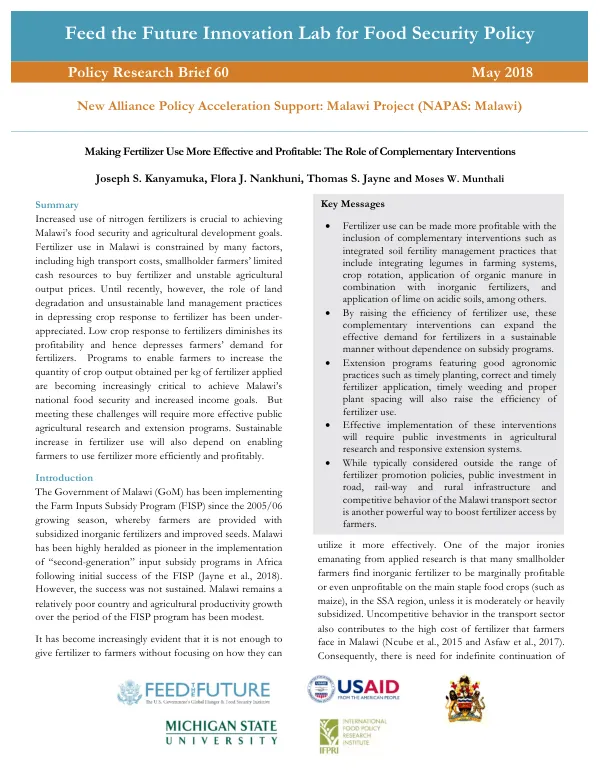
Feed the Future Innovation Lab for Food Security Policy Policy Research Brief 60 Making Fertilizer Use More Effective and Profitable: The Role of Complementary Interventions
Sign inUNIVERSITY OF ILLINOIS
Feed the Future Innovation Lab for Food Security Policy Policy Research Brief 60 Making Fertilizer Use More Effective and Profitable: The Role of Complementary Interventions
The agricultural sector in Malawi plays a crucial role in achieving the country's food security and agricultural development goals.
2018 · 5 pages
Sign in to readA free account is required to download.
Abstract
Increased use of nitrogen fertilizers is essential to achieve these objectives, but fertilizer use in Malawi is constrained by various factors, including high transport costs, limited cash resources among smallholder farmers, and unstable agricultural output prices. Until recently, the role of land degradation and unsustainable land management practices in depressing crop response to fertilizer has been underappreciated. Research has shown that low crop response to fertilizers diminishes its profitability and hence depresses farmers' demand for fertilizers. Programs to enable farmers to increase the quantity of crop output obtained per kilogram of fertilizer applied are becoming increasingly critical to achieve Malawi's national food security and increased income goals. However, meeting these challenges will require more effective public agricultural research and extension programs. Malawi's inorganic fertilizer application rate has increased from below 10 kilograms per hectare in 2005 to 55.8 kilograms per hectare in 2016, mainly due to the introduction of the Farm Inputs Subsidy Program (FISP). This rate surpasses the 2006 Abuja declaration recommendation of 50 kilograms per hectare but is still lower than application rates in developed countries. Malawi's average nutrient use efficiency (NUE) remains low at around 11.82 kilograms of maize per 1 kilogram of nitrogen applied. Researcher-managed trials in Malawi typically obtain NUE of over 20 and often over 30, clearly showing that it is possible to double or triple the contribution of fertilizer to national maize production if effective interventions are put in place to overcome the constraints that Malawian farmers face. By raising NUE, farmers will also find fertilizer use to be more profitable, thereby raising the commercial demand for chemical fertilizers. Public sector interventions to increase NUE are varied, but generally focus on farmer management practices that improve soil quality over time. Research evidence shows that NUE is often raised by increasing organic matter in the soil, reducing soil acidity, timely weeding, and timely fertilizer application, among other things. These complementary interventions are crucial for enabling profitable use of fertilizer by farmers. Integrated Soil Fertility Management (ISFM) is a sustainable intensification strategy that has shown potential to raise the efficiency of inorganic fertilizer use and improve smallholder farm productivity growth while preserving the natural resource base. ISFM includes the use of inorganic fertilizer, organic inputs, and improved germplasm, combined with knowledge on how to adapt these practices to local conditions aimed at optimizing agronomic use efficiency of the applied nutrients and improving crop productivity. Studies have shown that the efficiency of fertilizer use is greatly enhanced if it is complemented by other sustainable intensification strategies such as ISFM. For instance, integrated nutrient use from both organic and inorganic fertilizer sources results in higher maize grain yields compared to using organic and inorganic fertilizers separately. Farmers who apply ISFM practices experience greater crop response to fertilizer application than those who do not. The Ministry of Agriculture, Irrigation and Water Development has embarked on reforming the FISP to increase effectiveness of fertilizer use. Notable reforms include increasing beneficiaries' contribution to the cost of purchasing the fertilizers, increasing private sector participation in sourcing, distribution, and retailing of fertilizers, and targeting of productive poor farmers. According to the Centre for Development Management (CDM), the share of total fertilizer distributed by private sector increased from 27% in 2015/16 to almost 60% in 2016/17.
Related documents
Documents in this collection
 2018
2018USAID DEC
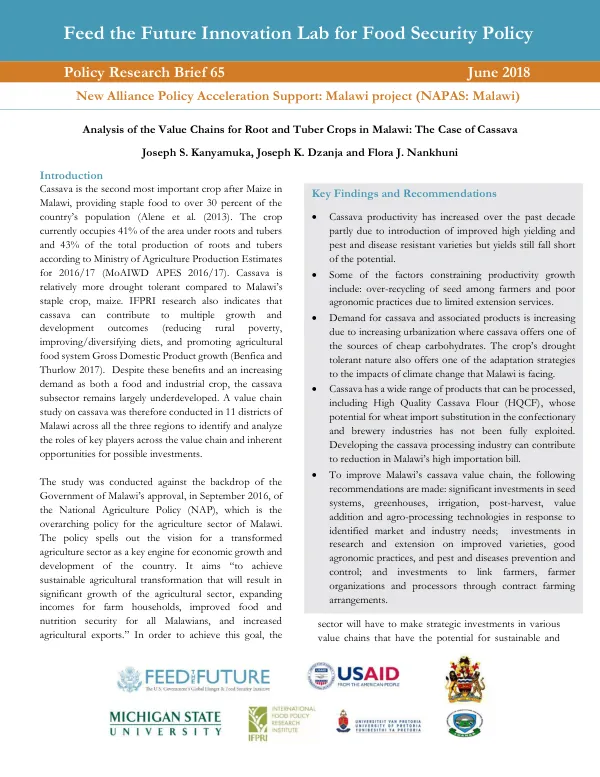
Feed the Future Innovation Lab for Food Security Policy Policy Research Brief 65 Analysis of the Value Chains for Root and Tuber Crops in Malawi: The Case of Cassava
Open record 2024
2024USAID DEC