USAID DEC
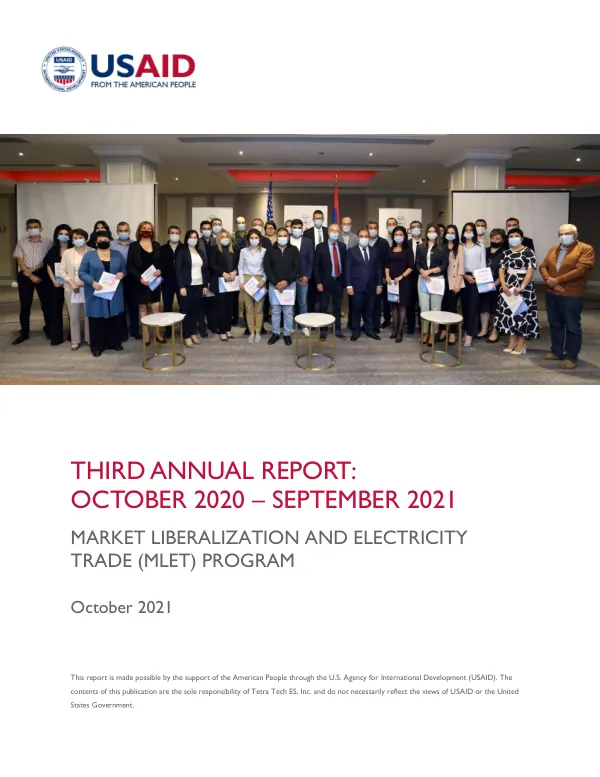
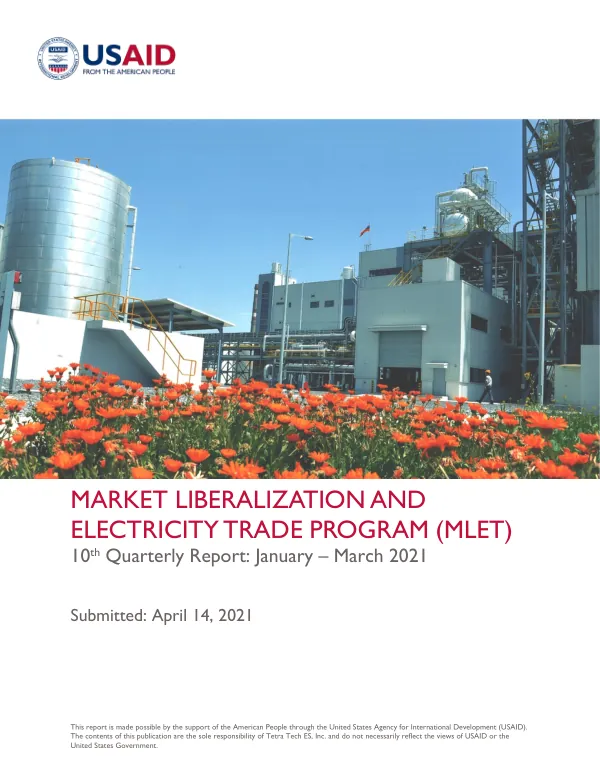
Market Liberalization and Electricity Trade Program (MLET) 11th Quarterly Report: April - June 2021
Sign inTETRA TECH ESI, INC.
Market Liberalization and Electricity Trade Program (MLET) 11th Quarterly Report: April - June 2021
The Market Liberalization and Electricity Trade Program (MLET) is a five-year initiative implemented by Tetra Tech, with funding from the United States Agency for International Development (USAID).
2021 · 39 pages
Sign in to readA free account is required to download.
Abstract
The program aims to improve the Armenian electricity market and expand electricity trade with Georgia by helping Armenian public and private energy sector institutions adopt legal and regulatory reforms, accelerate the implementation of market liberalization mechanisms, and strengthen Armenia-Georgia dialogue on cross-border electricity trade. During the third quarter of 2021, MLET continued to make progress despite the uncertain political situation in Armenia. The program completed all required program management deliverables and substantially advanced work plan tasks and technical deliverables. Key achievements include the submission and approval of the tenth Quarterly Report, the development of the Electricity Market Gap Analysis, and the revision of the Transmission Network Code. The Electricity Market Gap Analysis aims to facilitate compliance with the European Union (EU) acquis communautaire. The report reviews EU directives and regulations that apply to electricity market development, identifies potential gaps in Armenia's current framework, and outlines actions needed to meet the EU-Armenia Comprehensive and Enhanced Partnership Agreement (CEPA) requirements. An introductory presentation of the draft report is scheduled for the end of August to share with counterparts the details about the approach to the gap analysis and raise awareness of specific findings. MLET also continued revising the Transmission Network Code adopted by the Public Services Regulatory Commission (PSRC) in December 2019. The revisions include the electricity sector's reliability and security indicators and are planned throughout the entire Wholesale Electricity Market (WEM) pilot phase. The second-round review of the code continued until late April, with MLET conferring twice a week with PSRC and the Electricity System Operator (ESO). The revised document was published on e-draft for public comments and suggestions, then updated and sent to the Ministry of Justice for legal opinion in early June. In addition, MLET developed templates for operational data that market participants (MPs) need to provide to ESO and submitted the second draft in mid-June. These annual scheduling forms will support the Annual Adequacy Forecast (AAF) activity, for which the team holds weekly progress meetings with ESO. Risk Matrix for managing and monitoring the AAF development activity is developed during the reporting period. MLET also updated the risk matrix for managing and monitoring the Market Management System (MMS) software development on a monthly basis. The team met daily with the software development team and provided bi-monthly status updates to the Contracting Officer's Representative (COR) and Tetra Tech home office representatives. The MMS beta phase, which started during the previous quarter in cooperation with the Electricity Market Operator's (EMO) Market Department, was completed and accepted by MLET on May 24. The deliverables for the Pilot and Final Release phases were submitted for acceptance at the end of May. Furthermore, MLET continues developing the MMS monitoring module with the Synergy team, including discussions on how to transfer report templates to the monitoring module. In parallel, MLET and Synergy are discussing the transfer of the Market Monitoring Guidelines report templates to the MMS monitoring module and other designated modules as appropriate. Based on the Recommendations for Improvement of the Primary Legislation for Autonomous Power Production in Armenia developed earlier, MLET drafted the package of laws amending the Laws on Energy and Energy Saving and Renewable Energy that were approved by the National Assembly on June 4. MLET also provided The LCEDP update transaction advisory to the Government of Armenia (GOAM) for development of the grid-connected 200 MW Ayg-1 Solar Photovoltaic (PV) Project, with "Abu Dhabi Future Energy Company" selected as the winner of the tender.
Related documents