TETRA TECH ESI, INC.
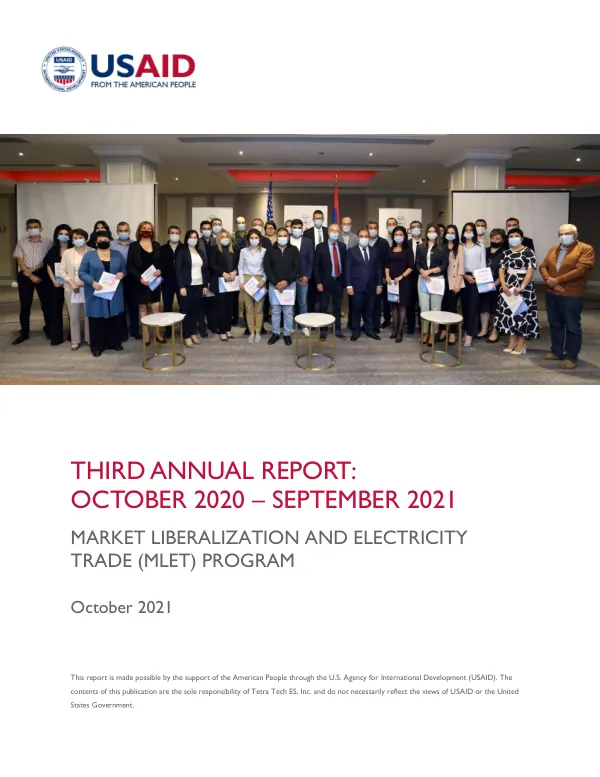
USAID MLET Third Annual Report for October 2020-September 2021
The Market Liberalization and Electricity Trade (MLET) Program, funded by the U.S.
2021 · 55 pages
Sign in to readA free account is required to download.
Abstract
Agency for International Development (USAID), aims to improve the Armenian electricity market and support expanded electricity trade with Georgia. The program's activities are designed to help key energy sector institutions adopt legal-regulatory reforms, accelerate implementation of market liberalization mechanisms, and strengthen Armenia-Georgia dialogue on cross-border electricity trade. The program's Year Three Work Plan reflected a coordinated approach developed in close collaboration with counterparts to support the Government of Armenia's (GOAM) Action Plan for Liberalization of the Republic of Armenia Energy Sector Electricity Market and Development of Cross-Border Trade. The plan included specific outputs for stakeholders to support the introduction of the Armenia Electricity Market New Model and Electricity Trade Mechanism Concept, as adopted by the Public Services Regulatory Commission (PSRC) in its Resolution No. 289 of July 18, 2018. Significant progress was made toward developing and introducing the new Wholesale Electricity Market (WEM). The second-round review process for the WEM Trading Rules and Contract, adopted in December 2019, was completed and the revised version was adopted on December 23, 2020. An Electricity Market Gap Analysis was conducted to facilitate compliance with the European Union (EU) acquis communautaire. The report reviews EU directives and regulations that apply to electricity market development, identifies potential gaps in Armenia's current framework, and lays out actions needed to meet the EU-Armenia Comprehensive and Enhanced Partnership Agreement (CEPA) requirements. Revisions to the Transmission Network Code, including for the electricity sector Reliability and Security Indicators (RSI) for the electricity sector, were planned throughout the entire Wholesale Electricity Market (WEM) pilot phase. The second-round review of the Transmission Network Code started in November and continued until late April, with MLET conferring twice a week with PSRC and the Electricity System Operator (ESO). The revised document was approved by PSRC on July 28. The Pilot development of the Annual Adequacy Forecast (AAF) started early March. MLET was discussing data collection, verification, validation, and storage weekly with the ESO as well as how to proceed with AAF development. The team also developed a Risk Matrix for managing and monitoring the AAF development activity and supported the ESO to organize a training on jROS in July and August. MLET completed the Market Management System (MMS) software development Alpha and Beta phases, then launched the Pilot for the Transition to the new WEM model in Armenia on February 1. Market participants (MPs) took part in a series of trainings and were awarded certificates of completion. Testing of all modules and elements continues based on the strict procedural chain described in the WEM Rules. Based on its earlier Recommendations for Improvement of the Primary Legislation for Autonomous Power Production in Armenia, MLET drafted a package of laws amending and supplementing the Laws on Energy and Energy Saving and Renewable Energy, which were approved by the National Assembly on June 4. Based on these amendments, MLET drafted a report on Recommendations to Improve Secondary Legislation for Renewable Energy to help PSRC bring its decisions into line with the laws' requirements. MLET provided transaction advisory to the GOAM to develop the grid-connected 200 MW Ayg-1 Solar Photovoltaic (PV) Project. The tender winner was Abu Dhabi Future Energy Company, which was awarded the contract in August 2020. The project aims to increase the share of renewable energy in the Armenian energy mix and reduce greenhouse gas emissions. The program's activities have contributed to the development of a more liberalized and competitive electricity market in Armenia, with a focus on increasing the share of renewable energy and reducing greenhouse gas emissions. The program's success has been recognized by the European Union, which has praised Armenia's efforts to liberalize its electricity market and increase the share of renewable energy.