USAID DEC
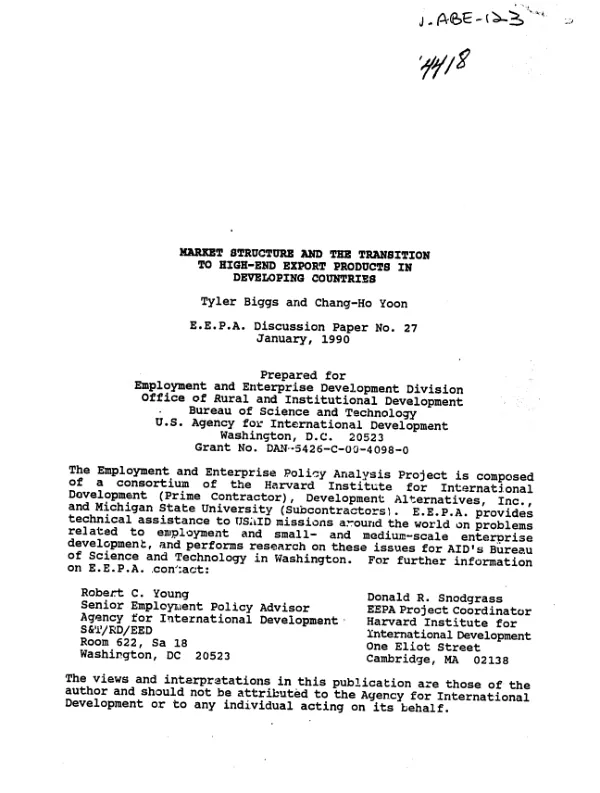
Market structure and the transition to high - end export products in developing countries
Sign inDEVELOPMENT ALTERNATIVES, INC. (DAI)
Market structure and the transition to high - end export products in developing countries
The ability of a developing country to move into high quality export markets is largely determined by its domestic market structure.
Biggs, Tyler; Yoon, Chang-Ho · 1990
Sign in to readA free account is required to download.
Abstract
To examine this hypothesis, this paper uses U.S. import data for the 1978-87 period to analyze the linkage between export performance (narrowly defined as the transition to higher-quality products) and industrial organization in Korea and Taiwan. Both countries have experienced a rapid expansion and diversification of exports since the 1960"s. Export-led growth in the two countries, however, has been accomplished with divergent domestic market structures. Large firms and conglomerates dominate the Korean export market, while small enterprises provide a majority of the output in Taiwan"s industrial sector. Over the last 20 years, Korea has moved away from its old export commodity structure at a quicker rate than has Taiwan; it has also made the transition to higher-quality exports faster, with a 100% increase during the period studied compared to Taiwan"s 60%. The paper concludes that a market structure dominated by conglomerates does have higher incentives and lower entry costs for many high-quality products and thus will make a more rapid transition in these industries. While smaller businesses may have some success in differentiating their products for niche markets or by just being quick to the market in areas with short product cycles, they generally have more trouble meeting the competition in high-quality markets.