MACRO INTERNATIONAL INC.
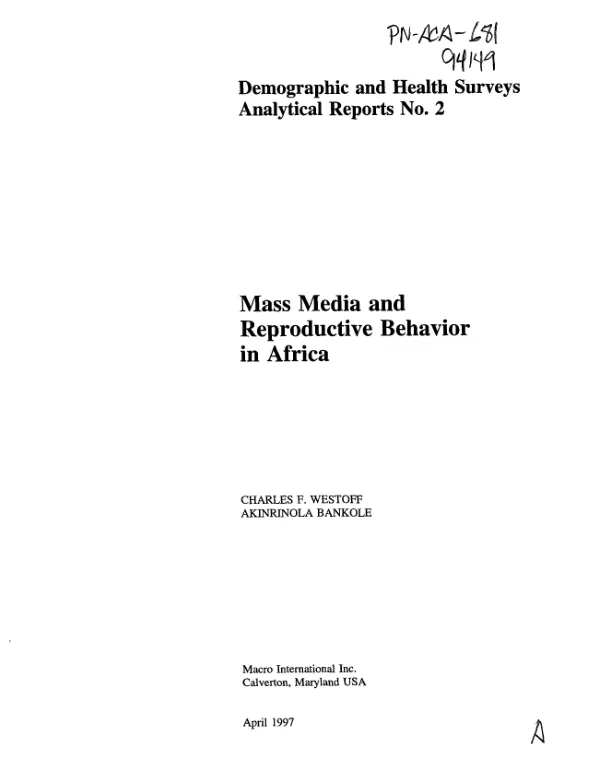
Mass media and reproductive behavior in Africa
Rapidly increasing exposure to the mass media in developing countries, e.g., through soap operas, advertising, music, and news, can have considerable effect on the transmission of modern ideas which influence reproductive behavior, even without other radical social and economic changes.
Westoff, Charles F.; Bankole, Akinrinola · 1997
Sign in to readA free account is required to download.
Abstract
This report, based on research conducted by the Demographic and Health Surveys program in the first half of the 1990s in Burkina Faso, Ghana, Kenya, Madagascar, Namibia, Zambia, and Morocco, found a persistent and frequently strong association between exposure to the mass media and reproductive behavior in Africa. Such exposure is directly related to greater knowledge and use of contraception, intention to use contraception in the future, preferences for fewer children, and intention to stop childbearing. In addition, there is evidence that media exposure is also associated with later age of marriage. These conclusions are universal for women and men, both married and single. Radio exposure in general, as well as explicit family planning messages on the radio, is most consistently related to reproductive behavior, followed by print media and television, although television is still in its infancy in many countries of this region. Media exposure is shown to have the greatest impact on the variables of marriage age and knowledge of various contraceptive measures. Includes references. (Author abstract, modified)
Connected topics