USAID DEC
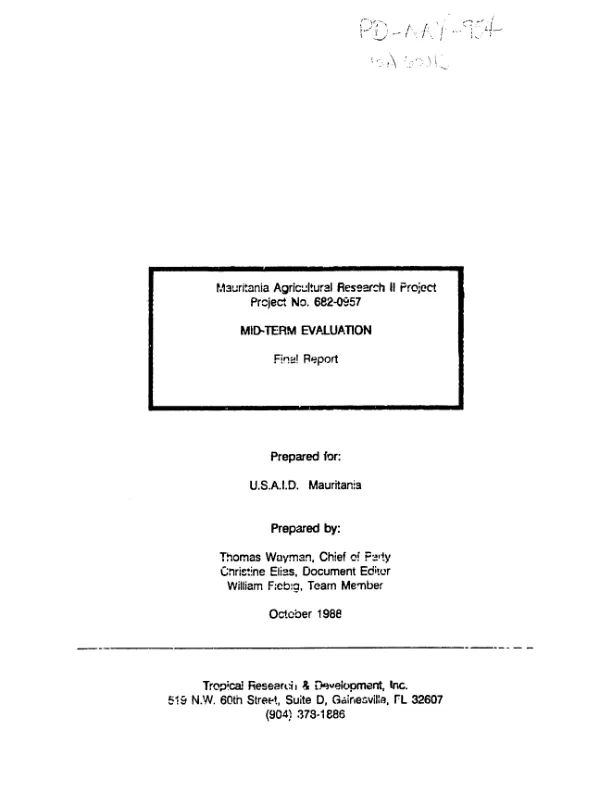
Mauritania agricultural research II project, project no. 682-0957 : mid-term evaluation -- final report
Sign inTROPICAL RESEARCH AND DEVELOPMENT, INC.
Mauritania agricultural research II project, project no. 682-0957 : mid-term evaluation -- final report
Mid-term evaluation of a project to support Mauritania's National Agricultural Research Center (CNRADA) by providing TA and researcher training.
Wayman, Thomas|Elias, Christine|Fiebig, William · 1988
Sign in to readA free account is required to download.
Abstract
External evaluation covers the period 12/85-10/88. The project has made important progress toward agricultural research institution building. Thirteen studies have been completed on farming systems, ecology, and food consumption patterns in the Senegal River Valley. Short-term, third-country training has been provided to 5 research assistants, and 7 researchers are attending U.S. universities, 5 for the B.S. degree and 2 for the M.S. Additional activities have included station and on-farm trials, collection of sorghum germplasm, and strengthening of linkages between CNRADA and other national and international research and development agencies. On the negative side, because the project was originally planned as a regional effort, the project paper contains wording which applies to Senegal and Mali only, not to Mauritania. This has caused confusion during implementation. The project paper also overestimated the availability of qualified Mauritanian researchers and the ability of CNRADA personnel to conduct/analyze agronomic trials. The 1988/89 on-farm trial program should be scaled back, taking into account CNRADA's human and material resources, while station trials need to improve data collection and interpretation. Although the project's farming systems research strategy is sound and well-adapted to Mauritanian conditions, the methodology has not always been followed. For example, in some cases farmer-managed trials were implemented when researcher management would have been more appropriate. More in-country, on-the-job training of researchers at all levels is needed. Also, the U.S. academic training should be accompanied by practical experience in agronomic trial design, implementation, and analysis. An insufficient operating budget continues to be a major problem for CNRADA, and the Government of Mauritania has stipulated that CNRADA's budget allocation will not be increased until it has further demonstrated a capacity to generate technologies acceptable to farmers. It is recommended that A.I.D. make a long-term commitment to support CNRADA in obtaining this goal. A follow-on project should also be in place to receive the participant trainees, who will not return in time to benefit from working with the advisers under this project.
Related documents
Documents in this collection
 1994
1994USAID DEC
National agricultural research project's contributions to significant advances in Egyptian agriculture : report of a 1994 USAID-sponsored mission to evaluate the national agricultural research project in Egypt
Open record 1970
1970USAID DEC
![Progress evaluation : agricultural research project phase II - supplement no. 388-0051 -- ammended [i.e. amended] version](https://covers.devme.ai/gen/14404.webp)