THE NATURE CONSERVANCY (TNC)
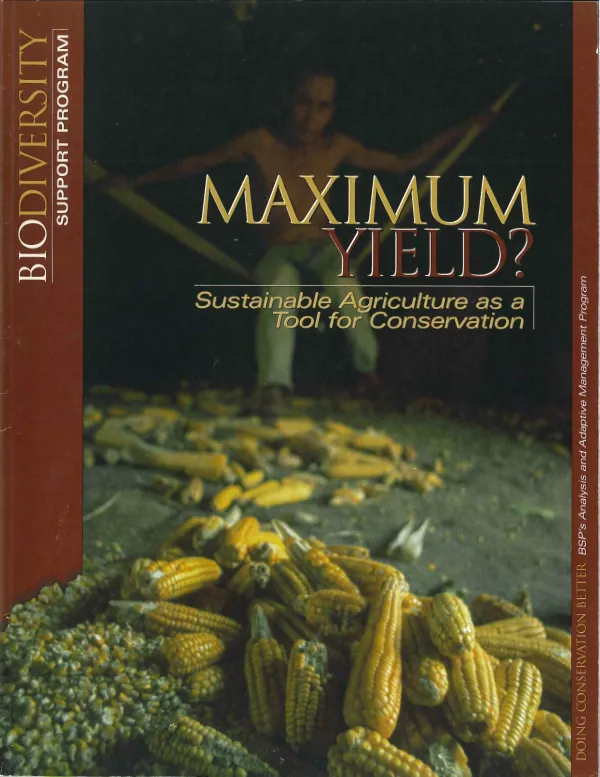
Maximum yield? : sustainable agriculture as a tool for conservation
This study examines the conditions under which sustainable agriculture (SA) techniques (e.g., cover crops, minimum tillage, contour planting, integrated pest management) effectively promote conservation.
Salafsky, Nick; Margoluis, Richard +1 more · 1970
Sign in to readA free account is required to download.
Abstract
Results, detailed below, are organized around the theme of conventional wisdom, as distilled from the literature and the perceptions of project managers in Guatemala and Mexico. Area planted to subsistence crops and deforestation. (1) SA does not necessarily lead to decreases in area planted to subsistence crops. For example, in Guatemala, farmers who used SA techniques planted more area to maize than did their non-user counterparts, whereas the opposite situation obtained in Mexico. (2) Involvement in SA programs does not necessarily result in labor input savings nor lead farmers to act in ways supportive of conservation. Thus, SA was associated with increased and decreased investments in labor per hectare in Mexico and Guatemala respectively. (3) Access to land is an important determinant of area planted and thus of deforestation. In Guatemala, where land is relatively available, farmers lacked incentives to use land efficiently and increased their maize production by increasing area planted. In Mexico, where land access is restricted, farmers were much more efficient in their use of land, and increased maize production by increasing yield. (4) Reduction in the use of fire was perhaps the greatest conservation benefit of the SA techniques used at the study sites. Fallow farming and forest recovery. In the present study, SA did not contribute to fallow amount or duration and hence had no effect in forest recovery. Chemical inputs and environmental contamination. Because study farmers used very little, if any, chemical fertilizers or pesticides, there was no evidence that SA decreased contamination from chemical inputs. However, since the use of SA decreases the use of fire to prepare fields, it can be concluded that it reduces air pollution from smoke. Attitudes about the environment. In general, farmers who used SA were more aware of the importance of biological resources and their relationship to agricultural practices. Further, SA programs proved to be crucial in building trust and confidence in the communities in which Defensores de la Naturaleza and Linea Biosfera work. Community organization as a conservation mechanism. Community organization played different roles in the SA projects at the study sites. In Guatemala, Defensores de la Naturaleza"s program encouraged farmers to participate in subsequent conservation activities. In Mexico, the highly organized nature of communities provided the foundation for the adoption and diffusion of SA throughout the project area.