GOVERNMENT OF BANGLADESH
Mayer Hashi Family Planning Project in Bangladesh (MH-II) Quarterly Report
Mayer Hashi Family Planning Project in Bangladesh (MH-II) is a follow-on project to Mayer Hashi, a four-year family planning (FP) project in Bangladesh.
2016 · 157 pages
Sign in to readA free account is required to download.
Abstract
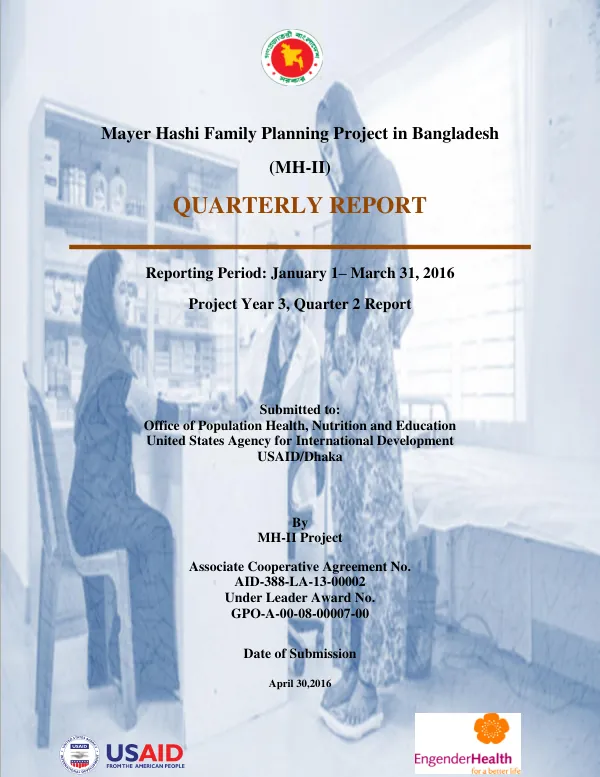
MH-II aims to advance the use of reproductive health (RH) and FP services with a focus on informed and voluntary use of long-acting reversible contraception (LARC) and permanent methods (PMs). The project provides in-country capacity development to strengthen RH service delivery by supporting Bangladesh's National FP and Maternal Health (MH) program and other FP implementing partners in the country. During the reporting period of quarter two (Q2) of project year three (PY3), January 1– March 31, 2016, MH-II continued its ongoing collaboration with the Directorate General of Family Planning (DGFP) and the Directorate General of Health Services (DGHS) of the Ministry of Health and Family Welfare (MOHFW), Government of Bangladesh (GOB). The project formed new partnerships and consolidated and strengthened existing partnerships with various non-governmental organizations (NGOs) and international, national, local, and private sector entities to provide quality FP and RH services, particularly LARC and PMs. MH-II has made progress in several areas. The project achieved 96% of the quarterly benchmark and 39% of the annual benchmark for USAID standard indicator F:3.1.7.3, which measures the percentage of USG-assisted service delivery sites. Additionally, the project achieved 93% of the target for custom indicator 5, which measures the number of service providers trained. However, the project is behind target for several indicators, including custom indicator 2, which measures the percentage of mobile teams achieving the benchmark, and custom indicator 6, which measures the percentage of MH-II trained service providers who performed at the national standard. The project has also made progress in increasing service providers' awareness on providing gender-sensitive services. In Q2, 88 participants received orientation on gender issues, and the result from the post-test showed that 93% of the participants understood gender concepts achieving a score of more than 80%. The project has also developed and distributed communication materials, with 73% and 20% of the target achieved for indicators 11a and 11b, respectively. Overall, the project is ahead of target for three indicators, on target for one, and behind target for six performance benchmarks. The MH-II Performance Tracking Table (Appendix 2) and summary of district coverage with key interventions and its follow-up (Appendix 4) provide information on 14 indicators, including two USAID standard indicators and 12 project-required indicators or custom indicators, and overall coverage of districts. MH-II has formed partnerships with various stakeholders to provide quality FP and RH services, particularly LARC and PMs. The project has collaborated with the DGFP, DGHS, and NGOs to strengthen RH service delivery and increase access to FP services. The project has also established regional training centers to provide training to service providers. The project has made significant progress in increasing access to FP services, particularly LARC and PMs. The project has achieved 81% of the quarterly benchmark and 39% of the annual benchmark for USAID standard indicator F:3.1.7.1, which measures the couple-years of protection (CYP). The project has also achieved 96% of the quarterly benchmark for USAID standard indicator F:3.1.7.3, which measures the percentage of USG-assisted service delivery sites. Overall, the project has made significant progress in advancing the use of RH and FP services, particularly LARC and PMs, and increasing access to FP services in Bangladesh. The project has collaborated with various stakeholders to strengthen RH service delivery and increase access to FP services, and has made progress in increasing service providers' awareness on providing gender-sensitive services.