FAMILY PLANNING ASSOCIATION OF BANGLADESH
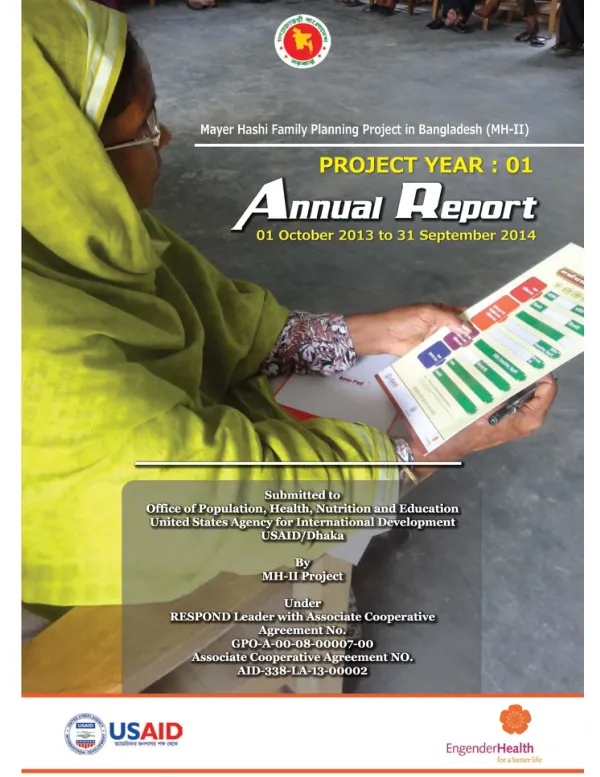
Mayer Hashi Family Planning Project in Bangladesh (MH-II) Annual Report PY1
The Mayer Hashi II (MH-II) Project in Bangladesh continued its collaboration with the Ministry of Health and Family Welfare (MOHFW) and strengthened its partnerships with nongovernmental organizations (NGOs) and the private sector to provide quality family planning (FP) and reproductive health (RH) services in Year 1 (01 October 2013 - 30 September 2014).
2014 · 33 pages
Sign in to readA free account is required to download.
Abstract
The core emphasis of MH-II was on informed choice and voluntary use of long-acting reversible contraception (LARC) and permanent methods (PM). MH-II provided various tools and services to monitor and increase the uptake of LARC and PM in the 20 districts and 136 Upazillas that it worked in Project Year 1 (PY1). At the request of the Directorate General of Family Planning (DGFP), MH-II also provided FP training and technical assistance in 31 additional districts and 112 Upazillas, which includes SDLG project areas. Thus, in total, technical assistance was provided to a total of 51 districts and 248 Upazillas. Couples Years Protection (CYP) achieved as a result of MH-II activities was 2,632,357, which is 72% of projected CYP of the Workplan year. This has been achieved from 1,777 facilities/sites within the public, NGO, and private sectors. A total of 3,080 injectable, LARC, and PM services were provided by RTM International mobile services delivery teams as a result of their sub-award under MH-II. Overall, the total number of LARC and PM services provided by all mobile services teams supported by MH-II was 18,247. MH-II succeeded in providing postpartum FP (PPFP) within 48 hours to approximately 50% of the projected population in PY1. Further, MH-II provided on-the-job training, orientation, and/or mentoring on LARC and PM to 9,039 individuals, of which 6,820 were women (75%) and 2,219 men. Approximately 85% of the MH-II trained service providers performed at the national standard in PY1. At least one supervisory visit was undertaken by MH-II Senior Quality Assurance (QA) and FP Compliance Officers at 199 selected sites/facilities. During the PY1, MH-II's Strategic Communication Plan (SCP) was developed and approved. The project developed and updated numerous information, education, and communication (IEC) and behavior change communication (BCC) materials, including job-aids. MH-II also provided technical support to the DGFP, EdM, and UNFPA for developing various types of IEC/BCC materials. In PY1, six different types of educational materials were distributed at 633 public and private facilities. Distribution also included providing hands-on orientation to service providers on ways to effectively use IEC/BCC materials in the context of LARC and PM. MH-II expanded its activities by signing a Memorandum of Understanding (MOU) with seven private sector facilities to strengthen counselling and referral for LARC/PM and injectable services through the Reproductive Health Services Provision Officers (RHSPO), a new initiative of MH-II. MH-II was successful in addressing three policy issues related to the provision of second and subsequent doses of DMPA injectable contraceptives by Community Health Care Providers (CHCP), the provision of IUD services by female Sub-Assistant Community Medical Officers (SACMO), and the supplementation of calcium fortified with Vitamin D to DMPA injectable contraceptive users. MH-II was also successful in advocating for the revision of the guideline on the management of excessive bleeding following implant use. The project is committed to delivering quality FP services and making contributions in Bangladesh by ensuring that informed choice and voluntary decision-making in FP is at the core of all of its activities. One highlight of PY1 was MH-II's contribution to the expansion of quality FP services through the private sector, including a successful workplace service delivery and training through a partnership that MH-II formed with the Bangladesh Garment Manufacturers and Exporters Association (BGMEA).