PATH
MCSP Community Health Contributions Series: Bangladesh
The Maternal and Child Survival Program (MCSP) operated globally and within 32 countries, with the ultimate goal of preventing maternal and child deaths.
2019 · 4 pages
Sign in to readA free account is required to download.
Abstract
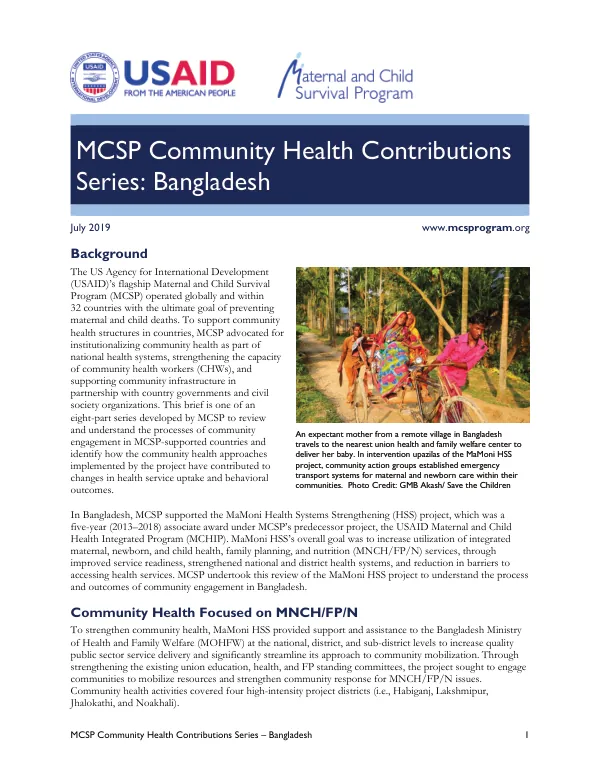
To support community health structures in countries, MCSP advocated for institutionalizing community health as part of national health systems, strengthening the capacity of community health workers (CHWs), and supporting community infrastructure in partnership with country governments and civil society organizations. In Bangladesh, MCSP supported the MaMoni Health Systems Strengthening (HSS) project, a five-year associate award under MCSP's predecessor project, the USAID Maternal and Child Health Integrated Program (MCHIP). The MaMoni HSS project aimed to increase utilization of integrated maternal, newborn, and child health, family planning, and nutrition (MNCH/FP/N) services through improved service readiness, strengthened national and district health systems, and reduction in barriers to accessing health services. To strengthen community health, MaMoni HSS provided support and assistance to the Bangladesh Ministry of Health and Family Welfare (MOHFW) at the national, district, and sub-district levels to increase quality public sector service delivery and streamline its approach to community mobilization. Community health activities covered four high-intensity project districts, including Habiganj, Lakshmipur, Jhalokathi, and Noakhali. Community action groups established emergency transport systems for maternal and newborn care within their communities. MaMoni HSS used a multi-pronged strategy to enhance community engagement around MNCH/FP, combining community service delivery with community capacity-strengthening and community social and behavior change. The project institutionalized community microplanning monthly meetings (cMPMs) and leveraged the involvement of local governments to address barriers to service utilization. The project also worked with union parishads to understand their range of responsibilities and successfully advocated for union council funds to be allocated to address local health needs. The project trained and supported community volunteers to facilitate community action groups (CAGs), promote healthy behaviors and care-seeking within their communities, and liaise with frontline MOHFW health workers. The project also provided direct project financial support for various elements of service delivery preparedness, trained and provided follow-up support to build capacity of local government institutions, and strengthened outreach workers' knowledge and skills for home visits. The community health approaches implemented by the project contributed to changes in MNCH/FP/N, showing that it is possible to mobilize local assets and increase transparency and accountability around use of local resources. Engagement of local government in health service delivery in high-intensity project districts and the activation of existing management committees was a major achievement of the project. Local government actors gained knowledge on their roles and responsibilities for service delivery and became important sources of advocacy and resources in project areas. In total, the project worked with 211 union councils to support and allocate funds for MNCH/FP/N services in the sub-districts. Union councils collectively mobilized BDT 28,547,505 (approximately USD 335,000) in funds for constructing, repairing, and maintaining facilities, purchasing emergency medicine, and providing temporary support staff. Community action groups collectively set up an emergency transport system for maternal and newborn health care within their communities and set aside approximately BDT 1 million for emergency funds to help women access care when they could not afford it. The project established community microplanning meetings (cMPMs) so that community volunteers could interface with FWAs and HAs and provide a link between CAGs and the formal health system. During these meetings, health workers and community volunteers addressed discrepancies in their counts of new eligible couples, pregnancies, births, deaths, and other vital information. The meetings also enabled participants to identify follow-up actions for the health workers and community volunteers. A total of 18,452 FWAs and HAs served as facilitators and recorders for 85% of the cMPMs in the project areas.