JHPIEGO
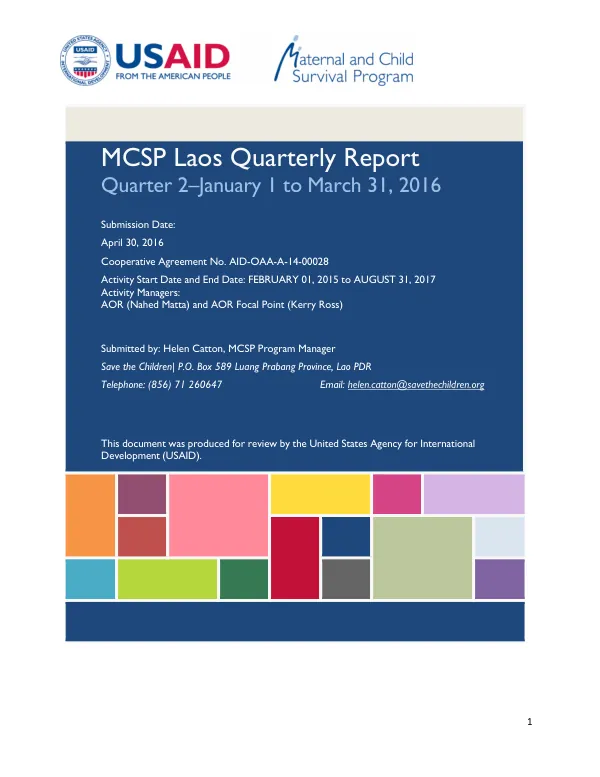
MCSP Laos Quarterly Report Quarter 2–January 1 to March 31, 2016
The Maternal and Child Survival Program (MCSP) Laos is a cooperative agreement between the United States Agency for International Development (USAID) and Save the Children, with a budget of $1,500,000 for the period of February 2015 to August 2017.
2016 · 10 pages
Sign in to readA free account is required to download.
Abstract
The program aims to improve the quality of maternal and newborn care in Luang Prabang and Sayaboury provinces by strengthening key skills for maternal and newborn care among MNH care providers, their educators, and their supervisors. The program has made significant progress in the first quarter of 2016, with two locally contracted MCSP staff commencing work in mid-January 2016. The MCSP team has worked with government and other partners to initiate the mentorship for quality of care activities for MNH service providers in select districts of Luang Prabang and Sayaboury provinces. Highlights of activities and achievements include the support of the MCSP country office team and Master Mentors to prioritize target activities and skills, the standardization and harmonization of clinical training skills of Master Mentors, and the field testing of the jointly agreed upon mentorship approach for target skills and activities. The implementation status of the program is as follows: Objective 1 aims to improve the quality of maternal and newborn care in Luang Prabang and Sayaboury provinces by strengthening key skills for maternal and newborn care among MNH care providers, their educators, and their supervisors. A provincial-led committee selected a core group of Master Mentors based on validated criteria to provide coaching, mentoring, and support to MNH service providers in the implementation area. The mentoring approach focuses on building on the mentee's existing skills, using anatomical models for guided simulations, case studies, and constructive practice, and incorporating team and peer-to-peer learning. The Master Mentors participated in an eight-day workshop from February 8-17, 2016, where they demonstrated normal delivery, including immediate essential newborn care and newborn resuscitation. The demonstrations revealed a mixed level of competencies and gaps that would require progress on during the workshop, most notably active management of the third stage of labor and newborn resuscitation. The Master Mentors also practiced the mentorship approach in depth, including mentoring skills, and determined their agreed-upon roles and responsibilities. As a next step, the Master Mentors agreed to work with their respective facility teams to highlight gaps in current practices and to identify both short and long-term solutions in a detailed implementation plan. The development of these detailed implementation plans immediately followed the completion of the workshop. The Master Mentors also agreed to emulate the skills and activities defined in the workshop to become role models and to ensure their own work sites reflected the standards of care that they had set for mentoring. Objective 2 aims to support the MoH initiative to strengthen supportive supervision of midwives with technical contributions to the national supportive supervision system and tools. During the February workshop, with support from MCSP technical advisors, the Master Mentors reviewed the global MNH standards and agreed upon a set of MNH quality of care standards for skills and activities at the time of birth. The Master Mentors also practiced the mentorship approach in depth, including mentoring skills, and determined their agreed-upon roles and responsibilities. The program has made significant progress in the first quarter of 2016, with a total estimated expenditure of $100,000 and accrued expenditures of $3,200. The work plan budget minus estimated expenditures to date is $1,264,000. The program is expected to continue making progress in the coming quarters, with a focus on improving the quality of maternal and newborn care in Luang Prabang and Sayaboury provinces.