USAID DEC
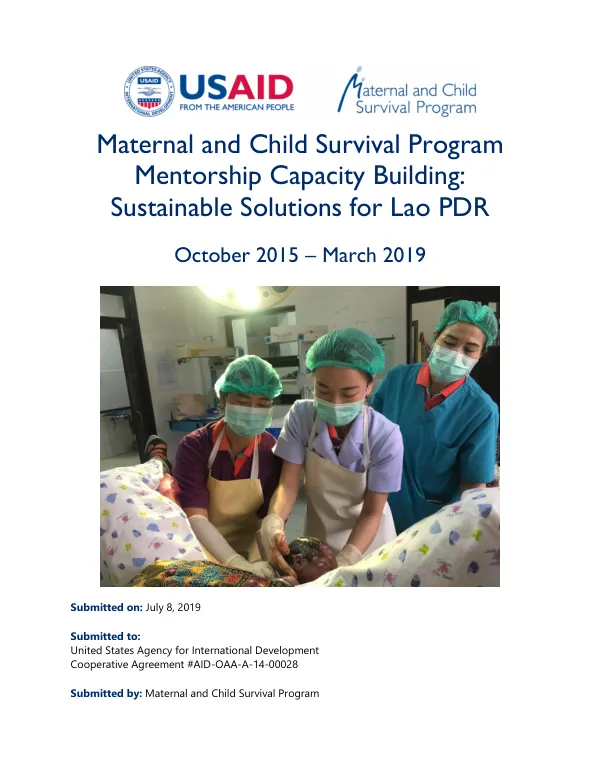
Maternal and Child Survival Program Mentorship Capacity Building: Sustainable Solutions for Lao PDR
Sign inMINISTRY OF HEALTH
Maternal and Child Survival Program Mentorship Capacity Building: Sustainable Solutions for Lao PDR
The Maternal and Child Survival Program (MCSP) is a global initiative aimed at reducing preventable maternal and child deaths.
2019 · 28 pages
Sign in to readA free account is required to download.
Abstract
The program is a United States Agency for International Development (USAID) cooperative agreement that focuses on introducing and supporting high-impact health interventions in 27 high-priority countries. MCSP engages governments, policymakers, private sector leaders, healthcare providers, civil society, faith-based organizations, and communities in adopting and accelerating proven approaches to address major causes of maternal, newborn, and child mortality. In Lao People's Democratic Republic (PDR), MCSP collaborated with the Ministry of Health (MoH) to design a mentoring approach to improve maternal and neonatal health (MNH) provider skills and supervision. The program aimed to complement the national Essential Early Newborn Care (EENC) policy, using interactive learning and coaching, and fully integrating maternal and newborn care, including Respectful Maternity Care (RMC) and Infection Control (IC). The MCSP mentoring program featured a new approach for maternal and newborn care providers to improve their skills and confidence to ensure quality care at the time of birth. The program focused on building capacity in facilities to contribute to the sustainability of knowledge, skills, and competence. To achieve this, district-level mentors were trained to mentor their peers and colleagues as part of their daily work in district facilities. The program also aimed to address the shortage of qualified midwives in Lao PDR, which had been a major constraint to health service provision. By 2015, there were only 100 midwives left in the country, and a rapid training plan was initiated to deploy 1,500 midwives by 2015. However, these midwives often lacked support or continuing professional development opportunities, which hindered their ability to provide quality care. The MCSP mentoring program addressed this issue by providing ongoing support and supervision to midwives and other healthcare providers. The program also integrated Respectful Maternity Care (RMC) and Infection Control (IC) into the training, ensuring that providers were equipped to provide high-quality care to mothers and newborns. The program's focus on building capacity in facilities and providing ongoing support to healthcare providers aimed to improve the quality of care and reduce preventable maternal and child deaths in Lao PDR. The program's results framework included several intermediate results (IRs), including IR 1: Improved community maternal and newborn health practices and care-seeking behaviors, and IR 2: Increased provision of high-impact, quality newborn care services in the community. The program also included cross-cutting and global themes, such as health systems strengthening, household and community mobilization, and gender integration. The program's recommendations and way forward emphasized the need for continued support and supervision to healthcare providers, as well as the importance of integrating Respectful Maternity Care (RMC) and Infection Control (IC) into healthcare services. The program's geographic coverage included two provinces, Luang Prabang and Sayaboury, with a total of 12 facilities participating in the program. The program's technical interventions focused on newborn health, maternal health, and health systems strengthening. The program's performance monitoring plan (PMP) was used to track progress and identify areas for improvement. The program's success story highlighted the impact of the mentoring program on improving the quality of care and reducing preventable maternal and child deaths in Lao PDR. The program's results demonstrated the effectiveness of the mentoring approach in improving the quality of care and reducing preventable maternal and child deaths in Lao PDR.