ABT ASSOCIATES, INC.
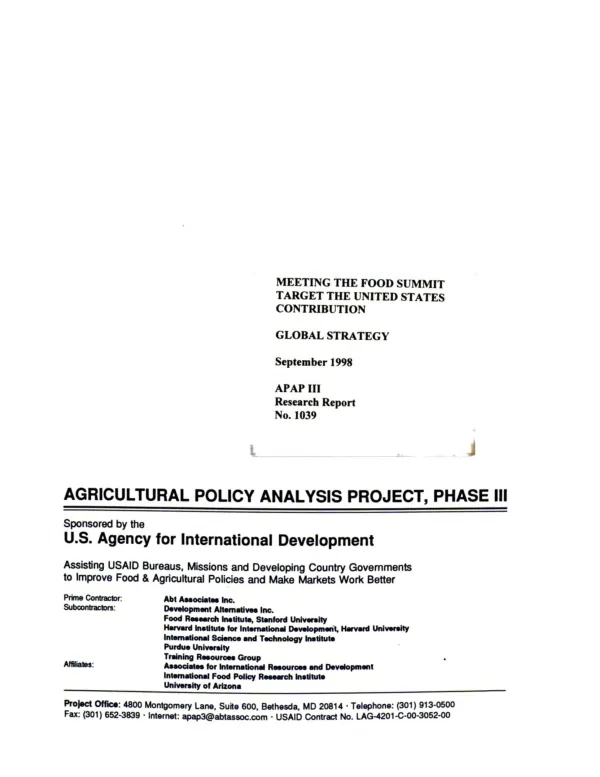
Meeting the food summit target the United States contribution : global strategy
The 1996 World Food Summit established the target of cutting in half by 2015 the number of undernourished people in the world (more than 800 million).
Stryker, J. Dirck; Metzel, Jeffrey C. · 1998
Sign in to readA free account is required to download.
Abstract
After the Summit, a U.S. Inter-Agency Working Group (IWG) was created to prepare an action plan for achieving this target both globally level and on the domestic front. Since it soon became apparent that additional budgetary resources were not going to be available, the plan was limited to describing how the United States intends to fulfill its commitments within the normal budgetary process, though leaving room for a Presidential Initiative (a proposal for which is presented in PN-ACD-350) to seek additional resources. Among the requirements for such an initiative is a U.S. strategy, presented in this report, for meeting its obligations in achieving the Food Summit target. The report assesses recent levels of undernutrition by major country and sub-region, and then projects to the year 2015 the number of undernourished in the world if no action is taken to reduce this number. These projections are based on forecasts of child malnutrition extrapolated to the entire population. The causes of undernutrition are then assessed for 14 major countries and sub-regions of the world, followed by a discussion of the consequences of world hunger for the international community, including the United States. The report examines the opportunity that currently exists for alleviating hunger and meeting the Food Summit target. Alternative interventions for achieving this goal are described and their cost-effectiveness is estimated. According to the report, the total cost of reaching the target could be less than $45 billion. Stretched out over 15 years, this amounts to no more than 5% of the current annual level of Official Development Assistance. Next, the report examines the U.S. comparative advantage in reducing world hunger. This assessment is combined with the cost-effectiveness analysis of alternative interventions to yield a U.S. strategy for meeting the Food Summit target -- a strategy in which the United States would concentrate its interventions, beyond those already being undertaken, in South Asia and sub- Saharan Africa. The report concludes with the following observations: (1) If no additional action is taken, world undernutrition is expected to increase in absolute terms by the year 2015. (2) There is a unique opportunity for U.S. global leadership in meeting the Food Summit target at the turn of the millennium. (3) A viable and affordable strategy exists for achieving this goal. This strategy draws upon the combined experience of U.S. farmers, agribusiness, NGOs, universities, foundations, and the U.S. government.
Related documents
Documents in this collection
 2000
2000USAID DEC
Food security in Ethiopia : a case study comparing the food security frameworks of the Ethiopian Government, the European Commission and the US Agency for International Development : final report
Open record 1998
1998USAID DEC