ENVIRONMENTAL INCENTIVES, LLC
Amazon Vision Summary
The Amazon Vision, developed by the United States Agency for International Development (USAID) in 2016, serves as a framework for unifying the Agency's goals across the Amazon region.
2021 · 4 pages
Sign in to readA free account is required to download.
Abstract
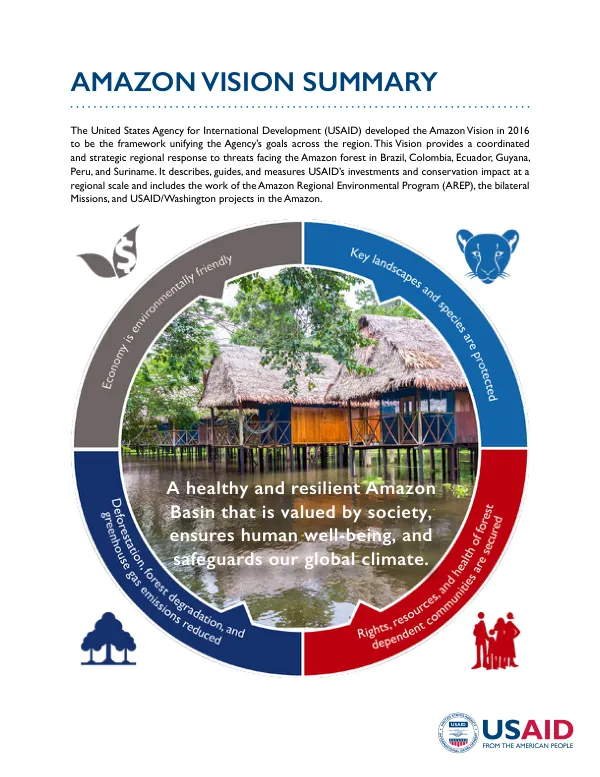
This regional response aims to address the threats facing the Amazon forest in Brazil, Colombia, Ecuador, Guyana, Peru, and Suriname. The Vision provides a coordinated and strategic approach to USAID's investments and conservation impact at a regional scale, incorporating the work of the Amazon Regional Environmental Program (AREP), bilateral Missions, and USAID/Washington projects in the Amazon. A healthy and resilient Amazon Basin is the ultimate goal, ensuring human well-being and safeguarding the global climate. USAID's Amazon Vision has four overarching goals: decrease deforestation, forest degradation, and greenhouse gas emissions; foster an environmentally friendly economy; protect key landscapes and species; and secure the rights, resources, and health of forest-dependent communities. In the Amazon basin countries, USAID is supporting projects that combat deforestation, conserve biodiversity, create environmentally-friendly economic opportunities, improve the management of important landscapes, and support Indigenous rights. Building on a long history of partnership in the region, USAID assistance is showing results for both the environment and the people who rely on it. For the period of 2015-2024, USAID has committed approximately $257 million for the implementation of activities in the region, where it has historically been one of the five largest conservation donors. The Amazon Vision has achieved significant results, including the avoidance, sequestration, or reduction of an estimated 38.5 million metric tons of CO2, equivalent to 4.4 million U.S. homes' energy use for one year. Improved economic benefits have been gained by more than 87,000 people, and land management has been improved in nearly 48 million hectares. Additionally, $21 million of private sector funding has been leveraged by USAID. One of the key success stories under the Amazon Vision is the CINCIA Innovation Lab in Peru, which works to restore lands decimated by illegal gold mining and support local communities affected by mercury poisoning. The laboratory is testing 75 native species in degraded soils collected from mining sites and researching the use of cutting-edge organic fertilizers that bring nutrients back to degraded soils and accelerate reforestation. Another notable achievement is the Partnership Platform for the Amazon (PPA) in Brazil, which has promoted an innovative development model by supporting Amazonian entrepreneurs with a vision for a sustainable local economy. A 2019 impact assessment found that the 15 accelerated businesses created 251 direct jobs, benefited 110 communities in 43 municipalities, and helped protect and restore 873,000 hectares of forest in the PPA's first year of operations. The Amazon Vision also focuses on protecting key landscapes and species, such as the Anavilhanas National Park in Brazil, where USAID's Partnership for the Conservation of Amazon Biodiversity program is finding new ways to engage local residents and tourists in the preservation of the park. The program is helping to transform the park's tourism potential through environmental education, guide training, and community and youth engagement. Finally, the Amazon Vision aims to secure the rights, resources, and health of forest-dependent communities, such as the Strengthening the Capacity of Indigenous Organizations in the Amazon (SCIOA) program, which builds capacities of communities in Brazil, Colombia, Guyana, Peru, and Suriname so they can access funding sources and advocate for Indigenous governance of the Amazon.